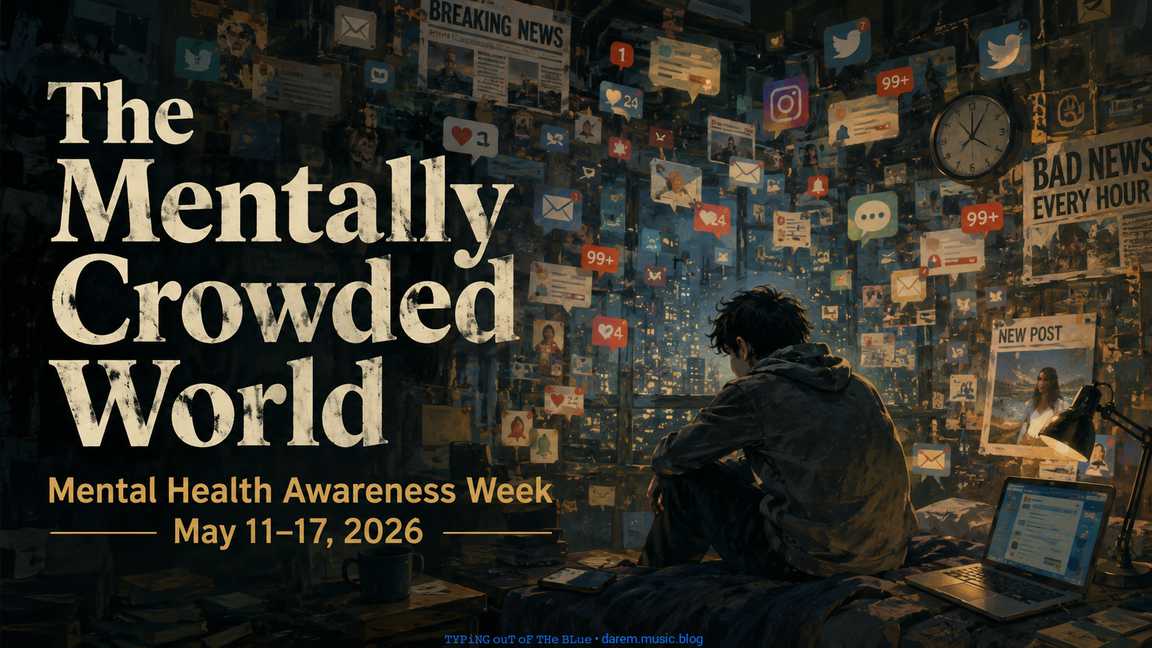
The Mentally Crowded World

Modern life feels mentally heavier than before.

Mental health is basically the state of our inner world. The way we think, handle stress, process emotions, rest, recover, and deal with life without feeling mentally crushed.

It’s not just about mental illness. A person can be mentally okay, emotionally tired, burned out, overwhelmed, or struggling with stuff like depression or anxiety disorder.

And yeah, it does feel like more people are affected today.

Partly because people talk about it more now. Before, many people just kept everything to themselves and pushed through quietly.

But life also changed.

Modern life feels mentally crowded now.

Phones buzzing all day. Endless scrolling. Pressure everywhere. Bad news every hour. People comparing their real lives to somebody else’s highlight reel. Even resting feels noisy somehow.

Sometimes we are not even tired from life itself. We’re tired from never mentally leaving the internet.

Another strange thing today is that people can be surrounded by online activity and still feel alone in real life. We can get hundreds of reactions and still have nobody to really talk to.

But not every painful emotion automatically means mental illness. Stress, grief, fear, heartbreak, confusion, exhaustion… those are still part of being human.

Sometimes the small actions help more than people expect.

Sleeping properly. 
Going outside for a bit. 
Taking a break from the noise. 
Checking on a friend. 
Being honest enough to say, “I’m not okay.”

Small things do not always solve everything. But sometimes they stop a bad day from becoming something heavier.

Funny world now. Technology keeps moving forward, but many of us feel mentally worn down trying to keep up.

⌨ ᴛʸᵖⁱⁿᵍ ᴏᵘᵗ ᵒᶠ ᵗʰᵉ ʙˡᵘᵉ ᵈᵃʳᵉᵐ ᵐᵘˢⁱᶜ ᵇˡᵒᵍ

Unbroken Pisces of a Tangled Mind • Darem Placer

The Right Way to Use POV

POV is everywhere on social media, but most posts miss the point. Here’s how to use it properly without losing meaning.

POV means point of view. Simple. It is the perspective of a person inside a moment. When you use POV, you are not just showing something. You are placing the viewer inside the scene.

That is where most posts go wrong.

Today, POV is often used as a label. People write “POV” and attach a random clip. The viewer is not part of the moment. They are just watching. If nothing changes when you remove the word “POV,” then it was never a real POV to begin with.

A real POV gives the viewer a role. They know who they are in the scene. They feel what is happening, not just see it. There is a clear angle. There is a reason for that angle.

Here is the difference.

Wrong usage:
“POV: you saw someone you like”
Then a video plays where you are just watching two people from the outside.

Right usage:
“POV: you finally see the person you have been waiting for”
Now the scene is from your eyes. The moment is yours. The feeling lands.

The strength of POV is not the word. It is the experience.

When used correctly, POV creates instant immersion. It skips long explanations. It makes the moment personal. It turns a short clip into a story.

But when used poorly, it becomes noise. It looks like content, but it does not carry anything. It feels empty because the viewer was never placed anywhere.

POV has also become a meme format, and some of these still work. But even then, the strongest ones still give a clear sense of perspective.

So before using POV, ask one question.

Does this actually give a point of view?

If the answer is no, remove it. The post will often feel stronger without it.

POV is not a trend. It is a tool. And like any tool, it only works when you know what it is for.

⌨ ᴛʸᵖⁱⁿᵍ ᴏᵘᵗ ᵒᶠ ᵗʰᵉ ʙˡᵘᵉ ᵈᵃʳᵉᵐ ᵐᵘˢⁱᶜ ᵇˡᵒᵍ