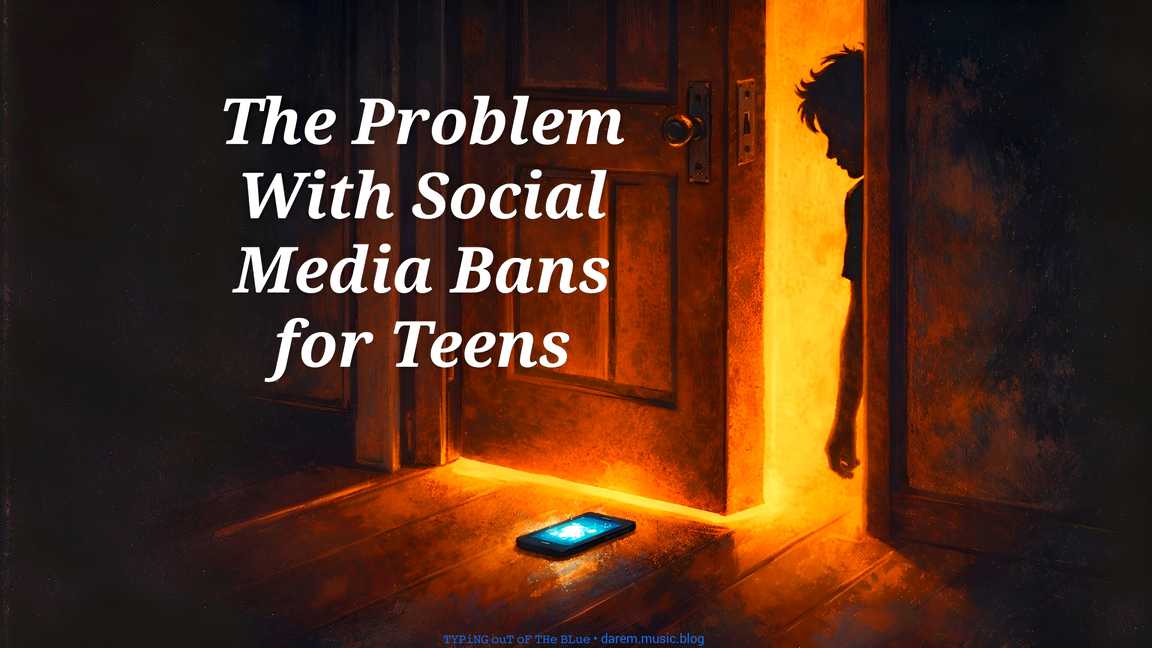
The Problem With Social Media Bans for Teens

A social media ban for teens may sound like a simple solution. But strict bans often push behavior into places adults cannot easily see.

For those who’d rather listen.

Adults have always worried about the tools young people use.

Years ago it was television. Then video games. Now the concern has shifted to social media. Many people believe the healthiest solution is simply to ban it for users under 16.

At first glance, that idea sounds reasonable.

Teenagers spend hours scrolling. Social media can create pressure, distraction, and sometimes unhealthy comparisons. It is easy to understand why many adults think the best solution is to shut the door completely.

But life with teenagers is rarely that simple.

Young people are naturally curious. They are also surprisingly creative. When something becomes forbidden, that creativity does not disappear. It simply changes direction.

Instead of stopping the behavior, strict bans often push it somewhere else.

A teenager who cannot use social media openly may start using anonymous accounts. Some move to new apps adults have never heard of. Others create private groups where conversations become harder for parents or teachers to see.

The activity does not disappear. It just becomes more hidden.

There is also another reality that many schools quietly face today.

Communication between teachers and students often happens in group chats. Announcements, reminders, and project coordination sometimes move through messaging platforms like Facebook Messenger because they are simple and everyone already has access.

Removing that channel does not automatically create a better system. Sometimes it simply removes the easiest one.

None of this means social media has no risks. It clearly does. But banning something completely does not always teach people how to handle it.

Social media is not going to disappear from the world. Eventually every teenager will encounter it.

The real challenge is not pretending it does not exist.

The real challenge is helping young people learn how to live with it wisely.

Because sometimes closing the door does not stop people from leaving.

It only teaches them how to find another exit.

Especially when the people inside are teenagers.

⌨ ᴛʸᵖⁱⁿᵍ ᴏᵘᵗ ᵒᶠ ᵗʰᵉ ʙˡᵘᵉ ᵈᵃʳᵉᵐ ᵐᵘˢⁱᶜ ᵇˡᵒᵍ

The Comment Section Trap

Comment sections often look like arguments, but many are really reactions. Understanding the trap can help us avoid the noise.

For those who’d rather listen.

Scroll through almost any political post today and you will notice a pattern. The comments quickly stop being a discussion. They turn into something else.

People repeat the same lines. Some attack the person instead of the idea. Others flood the thread with sarcasm, memes, or angry reactions.

It can feel exhausting. Sometimes even irritating.

But there is a deeper reason why this happens.

On the internet, many people are not actually trying to talk. They are trying to defend an identity. When a political figure, belief, or side becomes part of someone’s identity, criticism no longer feels like a normal disagreement. It feels like a personal attack.

So the reaction becomes emotional instead of thoughtful.

Social media also rewards this behavior. Strong reactions get attention. Angry comments get replies. Sarcastic lines get likes. The more aggressive the tone, the more visible the comment becomes.

Over time, people learn that the loudest reaction wins the most attention.

That is why comment sections often look chaotic. They are not built for careful thinking. They are built for quick reactions.

But the real question is not why this happens.

The real question is what we do when we see it.

The first option is simple: ignore it. Many people online are not looking for a conversation. They are looking for a reaction. When they get one, the cycle continues.

Another option is to pause before replying. If a comment is clearly meant to provoke anger, answering it usually gives it the attention it wanted.

Sometimes the most effective response is silence.

And when a discussion does happen, it helps to stay calm and focus on the idea rather than the person. Calm voices may not dominate the comment section, but they are the ones that keep conversations from collapsing into noise.

The internet will always have loud corners.

But we still decide whether we join the shouting or simply walk past it.

⌨ ᴛʸᵖⁱⁿᵍ ᴏᵘᵗ ᵒᶠ ᵗʰᵉ ʙˡᵘᵉ ᵈᵃʳᵉᵐ ᵐᵘˢⁱᶜ ᵇˡᵒᵍ

People•Darem Placer