
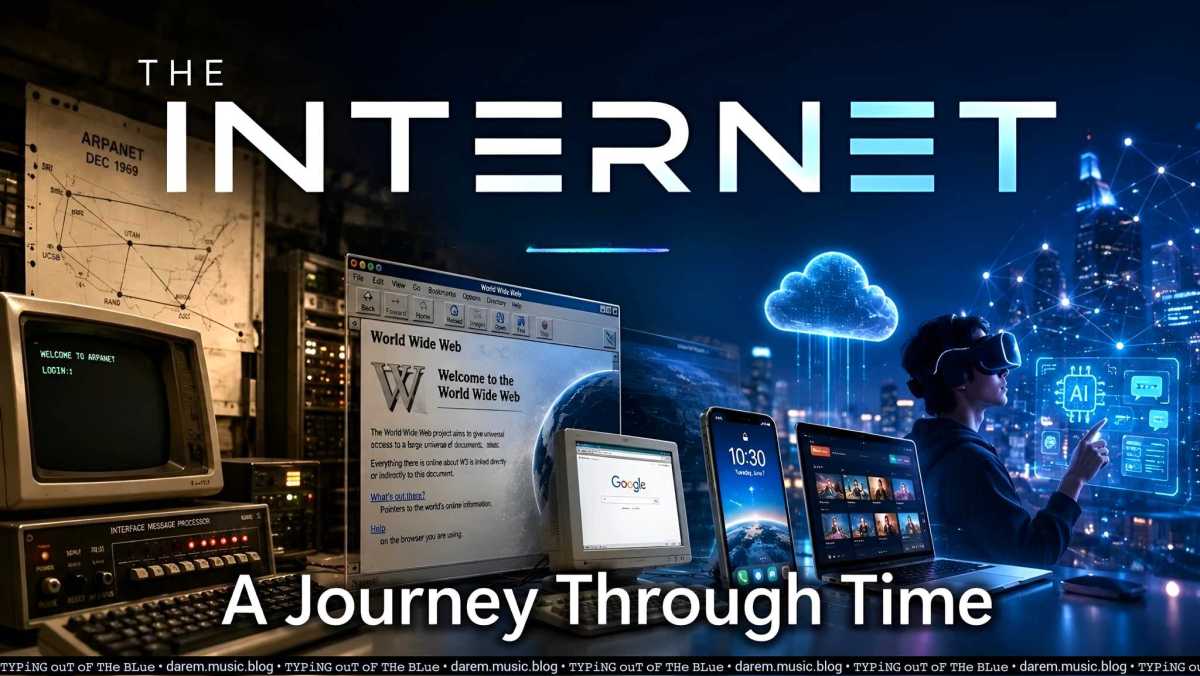
Birth of the Internet
1969: ARPANET connected its first computers in California and Utah.
This historic achievement laid the foundation for today’s Internet.
1971: The first network email was sent, introducing the @ symbol for email addresses.
Electronic messaging quickly became one of the network’s most popular uses.
1973: ARPANET established its first international connections to the United Kingdom and Norway.
The network expanded beyond the United States.
1974: The term “Internet” was introduced in a research paper.
The growing network of computers finally had a common name.
1983: TCP/IP became the standard communication protocol for connected networks.
Different networks could now communicate as one unified system.
1984: The Domain Name System (DNS) was introduced.
People could use easy-to-remember names instead of numerical addresses.
1986: More universities and research institutions joined the network.
This expansion accelerated research and collaboration while laying the groundwork for broader Internet access.
Birth of the Web
1989: Tim Berners-Lee proposed the World Wide Web.
His vision made online information easier to organize, link, and access.
1990: The first web server and the world’s first website were created.
This marked the beginning of the modern Web.
1991: The World Wide Web became available to the public.
People around the world could begin exploring the Web.
1993: The Mosaic web browser was released.
Its user-friendly design helped bring the Web into the mainstream.
Public & Commercial Internet
1995: Commercial Internet services expanded around the world.
Going online became practical for homes, schools, and businesses.
1998: Google launched its search engine.
Finding information on the Web became faster and easier.
2001: Wikipedia was launched.
Volunteers from many countries began building a free online encyclopedia together.
Social Internet
2004: Facebook was launched.
Social media transformed how people connected and shared online.
2005: YouTube was launched.
Watching, uploading, and sharing videos became part of everyday Internet life.
Mobile Internet
2007: Apple introduced the first iPhone.
The Internet became something people could carry wherever they went.
2008: Android smartphones became widely available.
Mobile Internet reached millions of new users.
Cloud Era
2010s: Cloud computing, streaming services, and mobile apps became mainstream.
People could work, learn, watch, listen, and store files online from almost anywhere.
Digital Transformation
2020: The COVID-19 pandemic greatly increased Internet use worldwide.
Remote work, online learning, video meetings, and digital services became part of everyday life.
AI Era
2022: Generative AI became widely available to the public.
People began using AI to write, create images, generate code, and boost productivity.
Today: The Internet continues to evolve with AI, faster networks, and smarter devices.
It powers communication, education, business, healthcare, entertainment, and countless everyday activities.
⌨ ᴛʸᵖⁱⁿᵍ ᴏᵘᵗ ᵒᶠ ᵗʰᵉ ʙˡᵘᵉ ᵈᵃʳᵉᵐ ᵐᵘˢⁱᶜ ᵇˡᵒᵍ