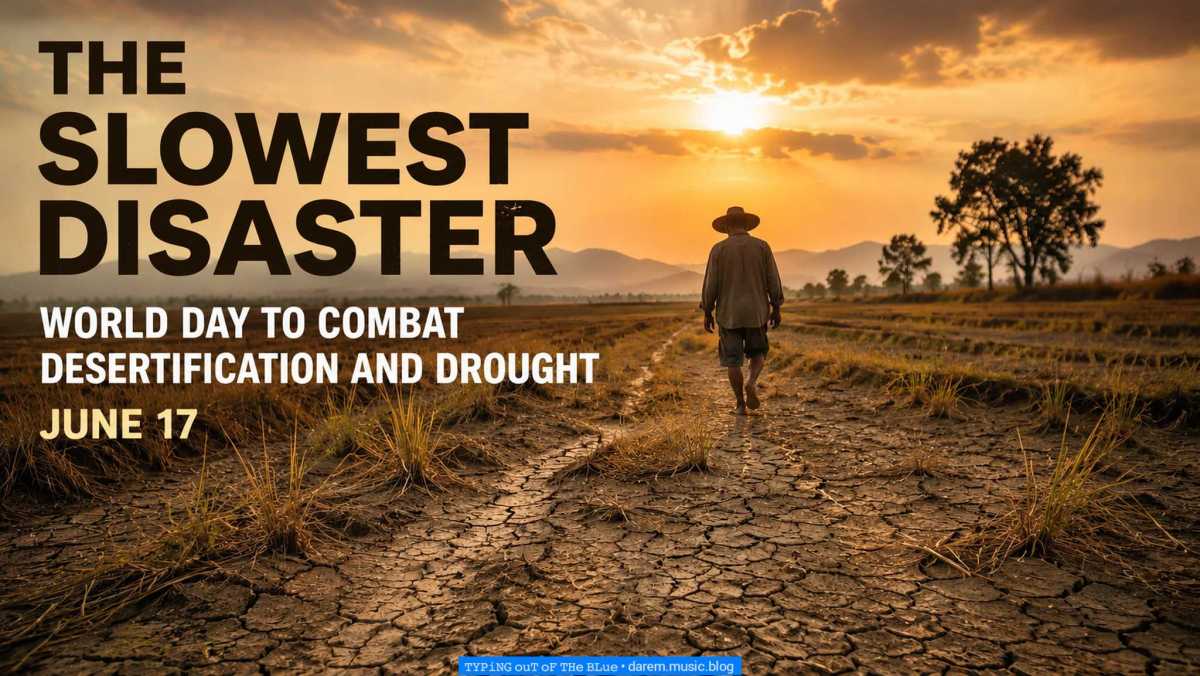
When the Rain Stops
A little preparation helps, but some problems need more than everyday solutions. It’s worth thinking ahead while we still have the chance.

A little preparation helps, but some problems need more than everyday solutions. It’s worth thinking ahead while we still have the chance.
Not every disaster arrives with a roar. Some work quietly, changing the land one season at a time.
Most environmental problems are loud.
A typhoon crashes into a coastline. A flood sweeps through a town. A wildfire turns the horizon red.
Desertification and drought are different. They don’t arrive with the same drama. They work quietly, like a guitar that slowly slips out of tune.
At first, nothing seems wrong. The song still sounds familiar. The audience keeps listening. The band keeps playing.
Then, little by little, something changes. A note doesn’t ring as clearly. A chord feels slightly off. The music is still there, but not quite the way it used to be.
That is how desertification works.
Many people think it is about deserts getting bigger. In reality, it is about land gradually losing its ability to support life. Plants struggle to grow. Water becomes harder to keep in the ground. Harvests become less reliable.
Drought makes the problem worse. Long periods without enough rain place even more stress on the land. Rivers run lower. Vegetation weakens. The ground dries out faster and takes longer to recover.
Unlike floods or earthquakes, this process can take years or even decades. By the time the effects become obvious, the damage has often been building for a long time.
In the Philippines, you will not wake up to a desert outside your window. The change is harder to notice than that. A dry season lasts a little longer. Water becomes a little harder to find. Farms produce a little less food than they used to. Small changes add up until people begin to feel them in everyday life.
The good news is that the story does not have to end there.
Protecting forests, conserving water, reducing waste, and caring for the environment can help keep the land healthy. Small actions may not seem important on their own, but together they help prevent a slow problem from becoming a permanent one.
The danger of desertification is not that it arrives suddenly.
The danger is that it can happen while the music is still playing.
⌨ ᴛʸᵖⁱⁿᵍ ᴏᵘᵗ ᵒᶠ ᵗʰᵉ ʙˡᵘᵉ ᵈᵃʳᵉᵐ ᵐᵘˢⁱᶜ ᵇˡᵒᵍ