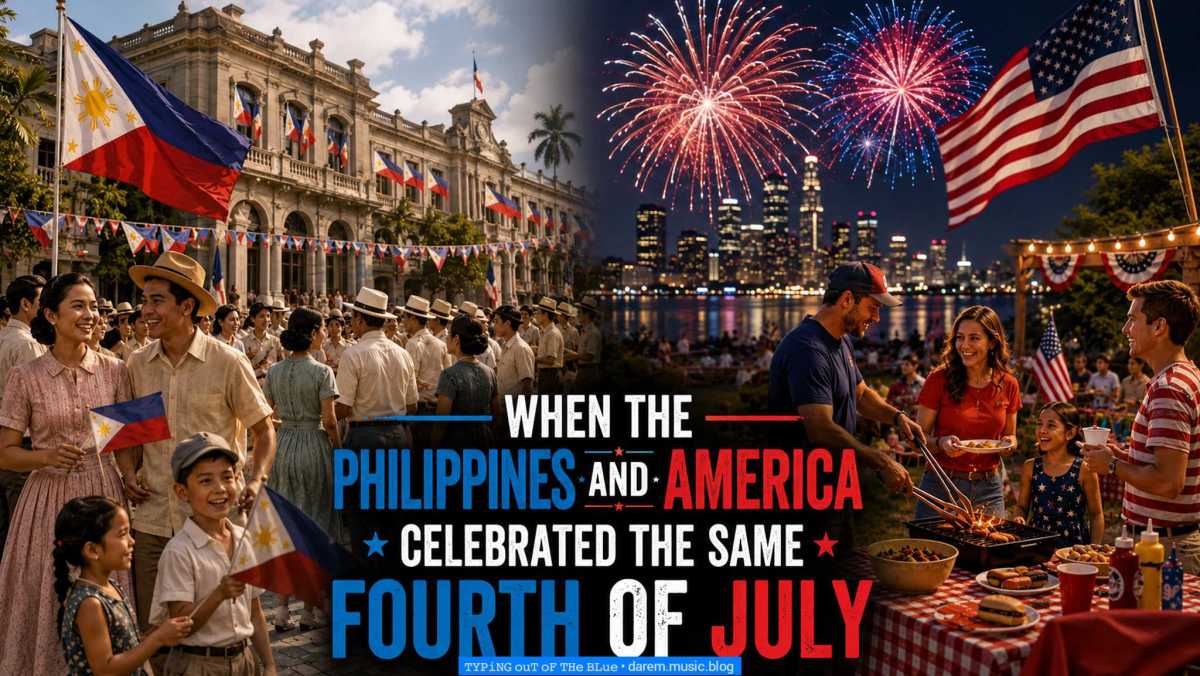
When the Philippines and America Celebrated the Same Fourth of July

Sometimes the most surprising links between nations are found on a calendar.

On every July 4, fireworks paint the skies across the United States as Americans celebrate their Independence Day. Families gather for barbecues, parades fill the streets, and the nation marks what many consider its birthday.

Few Filipinos realize that the date once held the same place in the Philippine calendar.

From 1946 to 1961, Filipinos celebrated July 4 as Independence Day, marking the birth of the independent Republic of the Philippines after American rule.

That moment came through the Treaty of Manila, signed on July 4, 1946, when the United States formally recognized the independence of the Philippines after nearly half a century of American administration.

Another page, however, was waiting to be turned.

In 1962, President Diosdado Macapagal officially moved Independence Day to June 12 to honor the declaration of independence from Spain made in 1898 under Emilio Aguinaldo. July 4 did not disappear from the story, but stepped aside to make room for an earlier chapter.

Today, while Americans celebrate with fireworks and hotdogs, July 4 quietly survives in Philippine history books as a date that once belonged to both nations. For a brief stretch of time, Filipinos and Americans greeted the same date with the same word: Independence Day.

History rarely moves in straight lines. Sometimes it rhymes, sometimes it echoes, and sometimes two nations find themselves singing different verses from the same page of a calendar.

⌨ ᴛʸᵖⁱⁿᵍ ᴏᵘᵗ ᵒᶠ ᵗʰᵉ ʙˡᵘᵉ ᵈᵃʳᵉᵐ ᵐᵘˢⁱᶜ ᵇˡᵒᵍ

Look Up in the Sky • Darem Placer • Full album. Press play.

From Foe to Friend: A Rare Chapter in History

Across oceans and centuries, a difficult past slowly became a lasting friendship.

History often remembers the battles. It remembers the flags raised and lowered, the victories celebrated, and the defeats mourned. Far less often does it remember the moment when former enemies choose to shake hands instead of clenching fists.

That is what makes Philippine-Spanish Friendship Day different.

Every June 30, the Philippines remembers not the beginning of a war, but the end of one. The date traces its roots to the Siege of Baler in 1899, when Spanish soldiers who had remained inside a church for months finally learned that the war had already ended and that Spain had transferred the Philippines to the United States under the Treaty of Paris.

What happened next was unusual for its time.

Weeks after the siege ended, President Emilio Aguinaldo issued a decree ordering that the Spanish soldiers be treated not as prisoners of war, but as friends and assisted in their return to Spain. The gesture transformed the final chapter of a conflict into the opening page of a new relationship.

More than a century later, that act of reconciliation inspired the creation of Philippine-Spanish Friendship Day through Republic Act No. 9187 in 2002.

The friendship continues today.

Spanish words still live in everyday Filipino conversations. Family names, town plazas, fiestas, churches, recipes, and traditions quietly carry pieces of a shared past. Trade, education, tourism, and cultural exchanges continue to connect both nations in the present.

None of this erases the painful parts of history. Colonial rule brought hardship alongside influence, and remembering both is part of understanding the whole story.

Philippine-Spanish Friendship Day does not ask us to forget the past. It asks something more difficult and perhaps more valuable: to remember the past honestly while choosing what kind of future to build from it.

History has many stories about how wars begin.

This is one of the rarer stories about how peace lasts.

⌨ ᴛʸᵖⁱⁿᵍ ᴏᵘᵗ ᵒᶠ ᵗʰᵉ ʙˡᵘᵉ ᵈᵃʳᵉᵐ ᵐᵘˢⁱᶜ ᵇˡᵒᵍ

Play Acoustically Amid the Noise and Haste • Darem Placer • Full album. Press play.