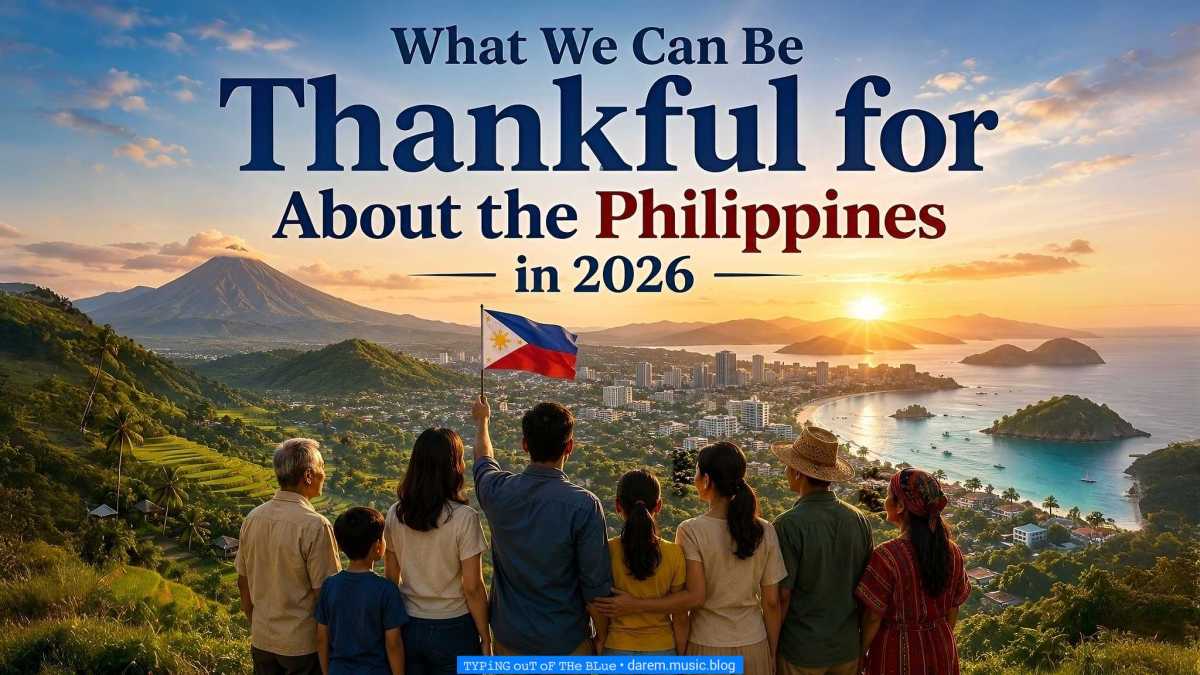
What We Can Be Thankful for About the Philippines in 2026

Looking beyond the headlines, there are still many reasons to appreciate life in the Philippines today.

It is easy to focus on problems. Every country has them. The Philippines has them too.

But there are also many things worth being thankful for.

• We live in a free country. We can speak, learn, create, vote, and practice our faith freely.

• We are surrounded by relatives, friends, and communities that support us through life’s challenges.

• When disasters happen, we often help one another by sharing food, donating supplies, volunteering, and helping neighbors rebuild.

• We have more opportunities today than ever before. Technology, education, and English have opened doors that many earlier generations never had.

• We have a rich culture. Our food, languages, stories, music, and traditions make the Philippines unique.

• We have beautiful places. Beaches, mountains, forests, rivers, and islands remind us that nature is one of our greatest treasures.

• We are creative and resourceful. We are known for music, art, storytelling, and finding ways to solve problems.

• We are growing up in a time of peace rather than war or foreign occupation.

Perhaps the greatest reason to be thankful is this:

The Philippines we know today was built by countless people who came before us. It is not perfect. It never has been. But every generation has the chance to make it a little better than they found it.

The Philippines of tomorrow will be shaped by what we do today.

Voices Across the Field • Darem Placer

⌨ ᴛʸᵖⁱⁿᵍ ᴏᵘᵗ ᵒᶠ ᵗʰᵉ ʙˡᵘᵉ ᵈᵃʳᵉᵐ ᵐᵘˢⁱᶜ ᵇˡᵒᵍ

The Philippine Flag

One date marks a victory. Another marks independence. Together, they tell the story of a nation taking shape.

Every year on May 28, the Philippines begins observing National Flag Days. It is not a random date. It marks the victory at the Battle of Alapan in 1898, where the Philippine flag was first raised after a Filipino triumph.

From that day until June 12, Independence Day, Filipinos are encouraged to display the Philippine flag. During these days, it appears across government buildings, schools, businesses, and homes throughout the country.

Many people think of June 12 as the main celebration, and it is. But the story starts earlier. Before independence was proclaimed in Kawit, Cavite, there was already a flag flying after a victory. The journey toward freedom had already begun to show itself.

There is something musical about these days. A song does not begin with its final note. It starts with the first chord, the first beat, the first moment when silence gives way to sound. In the same way, June 12 was not the first note of the story. May 28 was part of the opening melody.

When the flag is displayed during these days, it is more than decoration. It is a reminder of people who believed that the Philippines could stand on its own. Their generation carried the tune. The next generations inherited the song and continue to carry it forward.

So if you see the Philippine flag flying between May 28 and June 12, remember that it marks a journey. A victory. An independence. And a story still being sung by every Filipino today.

Full album. Press play.

⌨ ᴛʸᵖⁱⁿᵍ ᴏᵘᵗ ᵒᶠ ᵗʰᵉ ʙˡᵘᵉ ᵈᵃʳᵉᵐ ᵐᵘˢⁱᶜ ᵇˡᵒᵍ