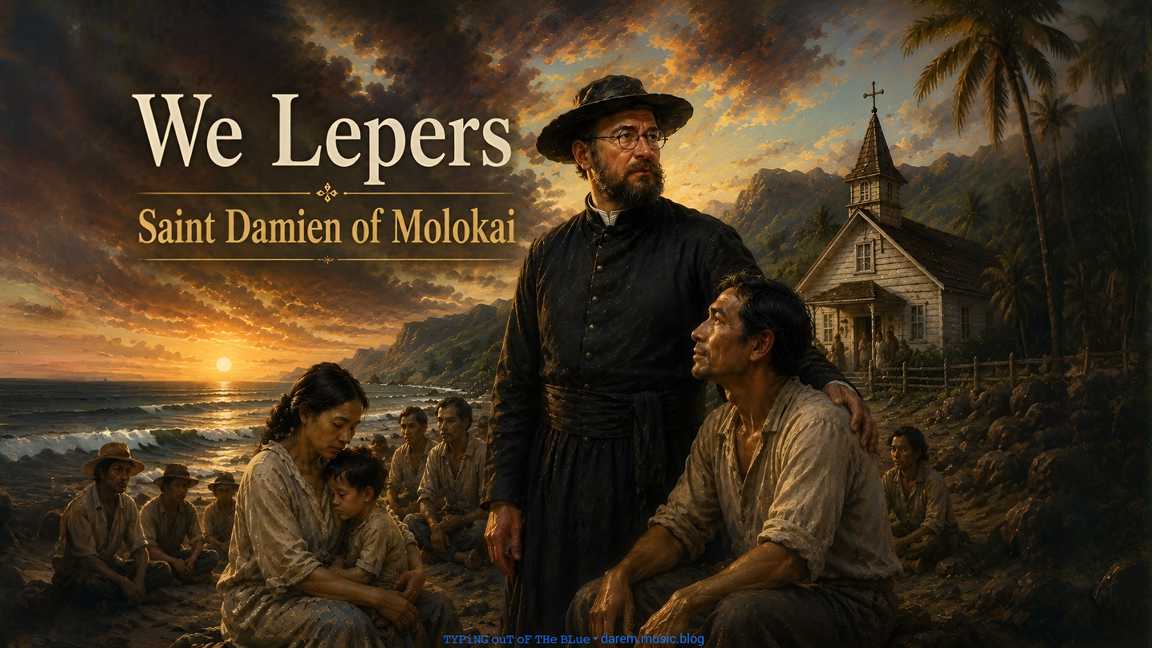
We Lepers

He lived among the rejected, cared for the forgotten, and eventually called himself one of them.

Damien of Molokai was a Belgian priest who became known for living with and caring for people with leprosy (Hansen’s disease) on the island of Molokai in Hawaii during the 1800s.

Instead of helping from a safe distance, he chose to stay with them completely. He built homes, churches, schools, roads, and even coffins. He ate with them, dressed their wounds, and treated them like human beings when the world treated them like shadows drifting outside the city walls.

Eventually, he caught the disease himself. But he kept serving until his death in 1889.

A famous moment was when he reportedly began a homily with:

“We lepers…”

That single line hit like church bells in a storm. He no longer saw himself as separate from the people he served.

He was canonized by Pope Benedict XVI in 2009 and is now considered the patron saint of people with leprosy, outcasts, and those with HIV/AIDS.

Saint Damien’s  life feels ancient and future-proof at the same time. In a world obsessed with image, distance, and convenience, he walked straight into suffering and stayed there.

Let’s keep learning the saints’ way—day by day.

⌨ ᴛʸᵖⁱⁿᵍ ᴏᵘᵗ ᵒᶠ ᵗʰᵉ ʙˡᵘᵉ ᵈᵃʳᵉᵐ ᵐᵘˢⁱᶜ ᵇˡᵒᵍ
Beyond the Clouds of Worries in the Moment • Darem Placer

Saint Marianne Cope—Music Keeps Life Normal

She introduced music as a simple way to keep daily life human and normal.

Marianne arrived in Hawaii in 1883 to serve people with Hansen’s disease, then commonly called leprosy. She was a Franciscan nun, trained as a hospital administrator, known for discipline, cleanliness, and strong systems. She eventually lived and worked in Kalaupapa, Molokai, a settlement where patients resided together for long-term care. At that time, there was no medical cure.

She understood that care involved more than treatment and routine. Daily life also needed rhythm and connection.

Alongside medical work and community order, she encouraged music as part of everyday life. She supported the formation of small choirs and bands among the patients. These were simple gatherings, not public performances. Music was for the community itself.

Her reason was plain: people forgot how to feel normal. Music reminded them they were still part of the world.

Rehearsals created regular moments to come together. Singing and playing instruments allowed people to share time and space naturally. Familiar hymns and songs connected them to faith, memory, and ordinary life.

Music also gave people roles. Someone practiced. Someone sang. Someone played. Participation mattered. It reminded everyone that they were contributors, not just recipients of care.

Sister Marianne Cope did not explain this through theory. She used music in a practical way, as part of building a stable and human community.

In Kalaupapa, music became part of daily life. It helped hold the community together.

Let’s keep learning the saints’ way—day by day.

⌨ ᴛʸᵖⁱⁿᵍ ᴏᵘᵗ ᵒᶠ ᵗʰᵉ ʙˡᵘᵉ ᵈᵃʳᵉᵐ ᵐᵘˢⁱᶜ ᵇˡᵒᵍ

Traces of courage, silence, and sacrifice—this is Saints.

Listen on Apple Music, Apple Music Classical, and YouTube Music