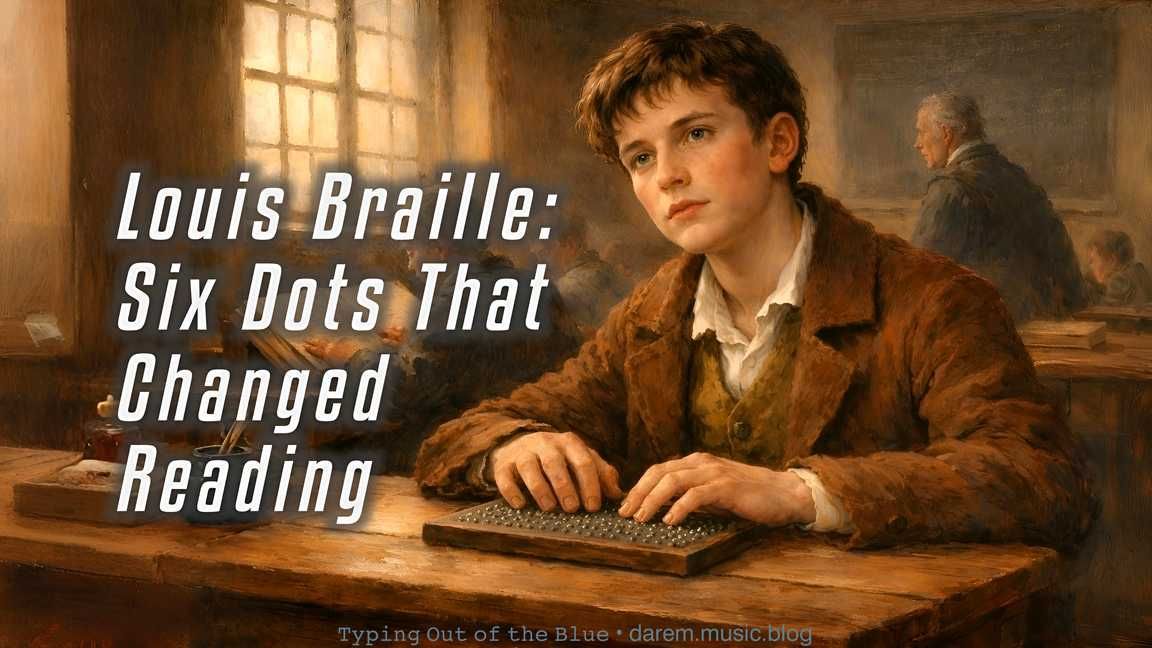
Louis Braille: Six Dots That Changed Reading

Six dots. One fingertip. How a childhood accident led him to change how the world reads.

He was three years old in Coupvray, France, when it happened. Louis Braille was inside his father’s leather workshop when an accident damaged his eye. Infection followed, and within a few years, he lost his sight completely.

In the early 1800s, blindness changed a life in very real ways. Learning depended on listening. Reading meant waiting for someone else. Books existed, but they were not designed for fingers, and writing was almost unreachable.

In 1819, Louis moved to Paris to study at the Royal Institute for Blind Youth. The school used books with raised letters shaped like ordinary print. They were heavy, slow to read, and tiring to use. Words could be felt, but reading never flowed naturally.

During his time there, Louis learned about a raised-dot system used by the French army. Soldiers read messages in the dark by touch alone. The system was complicated and impractical, but it revealed something important. Fingers understood dots better than shapes.

So he began experimenting. Patiently. Practically. Not as a grand invention, but as a response to daily difficulty. He tested combinations, removed what was unnecessary, and kept what worked. Again and again.

By focusing on a single fingertip, he reduced everything to six dots. Enough to feel at once. Enough to build letters, numbers, music, and meaning. By 1824, in Paris, the system was complete. He was fifteen years old.

Acceptance came slowly, but blind readers understood it immediately. Reading became faster. Writing became possible. Learning no longer depended on translation.

What began in a small workshop in Coupvray became a language of touch used around the world. Today, those same six dots are still read in books, schools, churches, public spaces, and digital devices. Technology has changed, but the system has not.

An accident took his sight. Experience shaped his solution. Patience turned loss into access. And for that, generations continue to read on their own terms, with gratitude.
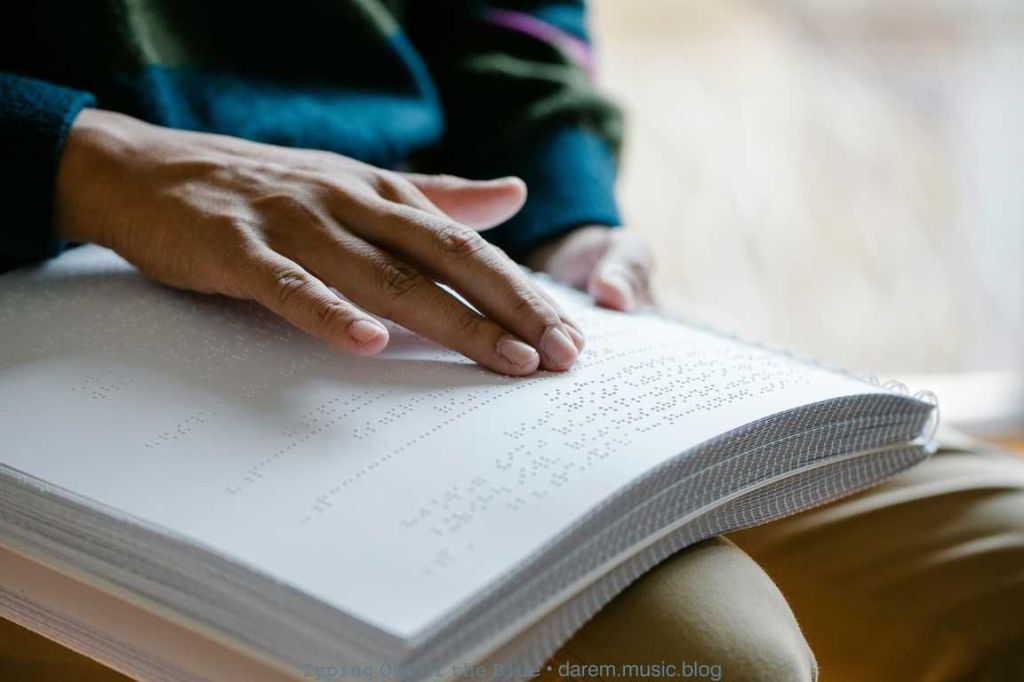
Actual embossed Braille dots used for reading by touch. Photo by Eren Li (Pexels).

⌨ ᴛʸᵖⁱⁿᵍ ᴏᵘᵗ ᵒᶠ ᵗʰᵉ ʙˡᵘᵉ ᵈᵃʳᵉᵐ ᵐᵘˢⁱᶜ ᵇˡᵒᵍ
Digital Albums by Darem Placer on Bandcamp
Listen. Buy. Download.

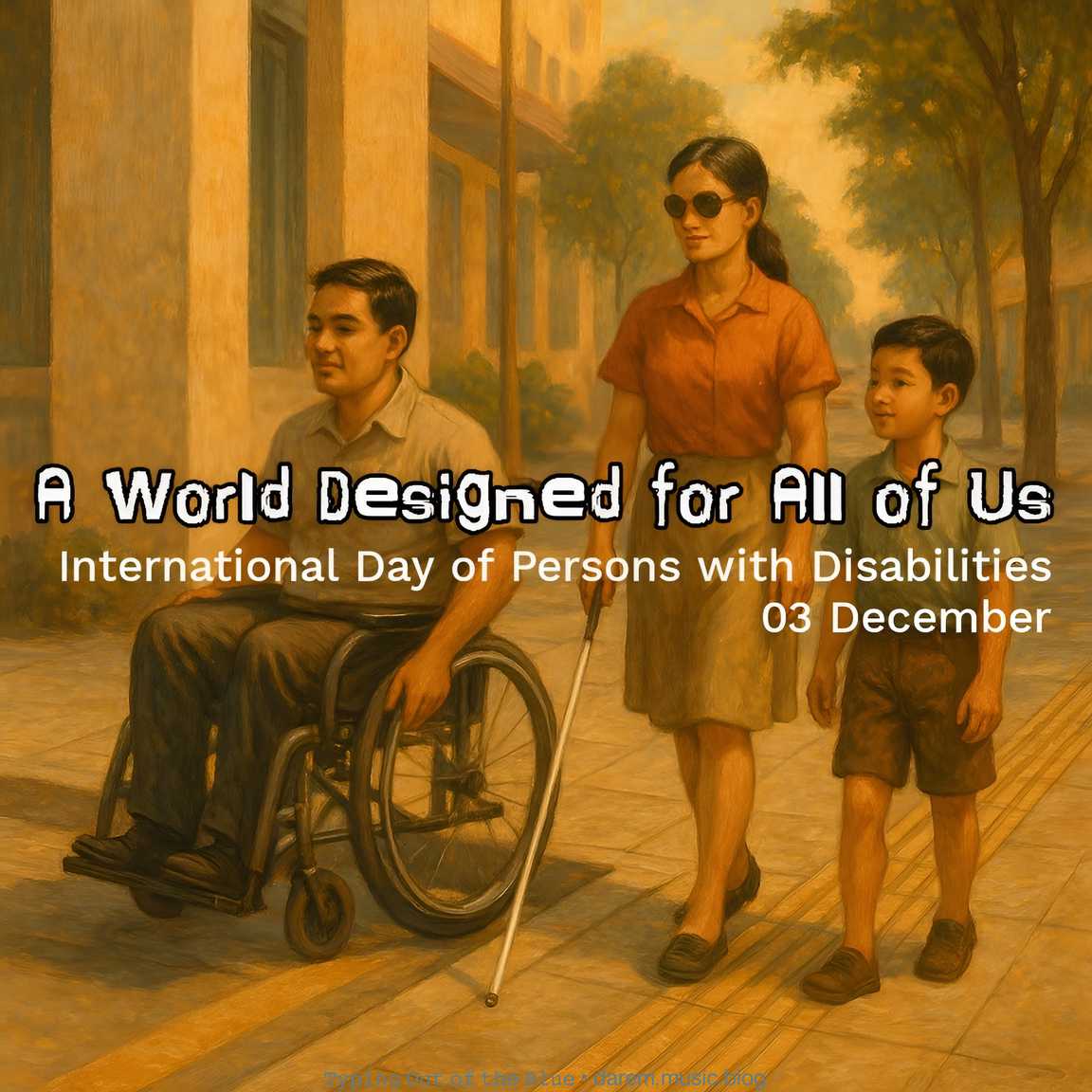
A World Designed for All of Us

A better world begins when no one is pushed aside. Remove the barriers and life becomes more human for everyone.

International Day of Persons with Disabilities • 03 December

Sometimes you notice small things that shouldn’t be difficult at all—a path that ends too soon, a doorway that feels too narrow, a setup that forgets certain people exist. And then you realize persons with disabilities deal with this every day, not once in a while.

Many of them are not asking for anything grand. They just want the world to work the same for them as it does for others—a bus they can board without trouble, a building they can enter without feeling like a problem, a routine that doesn’t turn into a battle.

What stands out is how much they still manage to do, even with all the small barriers that add up. You see someone taking their time, adjusting their path, finding a way—and you know the world could have made it easier, but didn’t.

Real progress starts in quiet places: a design that thinks ahead, a space that doesn’t force someone to struggle, a choice to include people before the inconvenience shows up.

When the world finally removes these old obstacles, life changes—not only for persons with disabilities, but for everyone. Things become smoother, calmer, more human. You start to see how much better life feels when no one is pushed to the side.

It isn’t about lifting people up. It’s about not holding them down.

A world that works for more people becomes a world that works better, period.

Maybe the real change begins when we stop expecting people to push through barriers that never needed to exist. Life doesn’t have to feel this Fragile.

Fragile • Darem Placer
Seven Shadows includes Fragile

Listen to Seven Shadows on Apple Music, Apple Music Classical, and YouTube Music

ᴛʸᵖⁱⁿᵍ ᴏᵘᵗ ᵒᶠ ᵗʰᵉ ʙˡᵘᵉ ᵈᵃʳᵉᵐ ᵐᵘˢⁱᶜ ᵇˡᵒᵍ