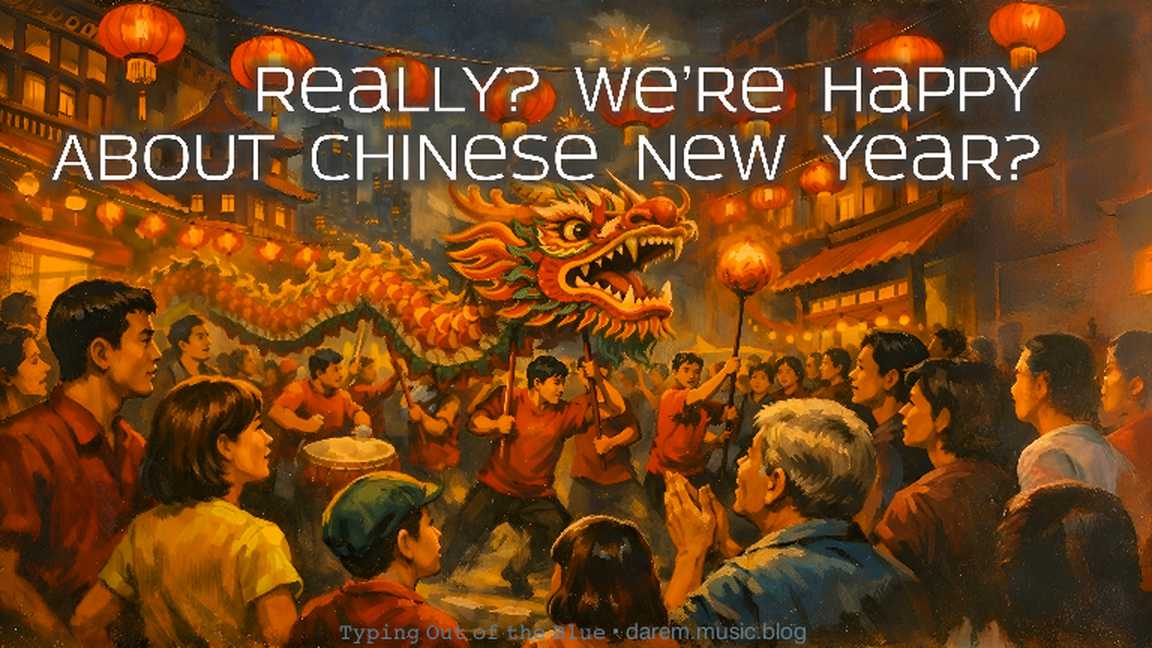
Really? We’re Happy About Chinese New Year?

Why do people still celebrate Chinese New Year despite political tensions? A look at culture beyond politics.

Every year, when Chinese New Year comes, we see red lanterns, dragon dances, fireworks, and families gathering. Malls decorate. Restaurants promote special meals. Friends greet each other with “Gong Xi Fa Cai.”

But here’s the honest question.

Some people openly criticize China’s government. There are political tensions. There are economic issues. There are disputes in the West Philippine Sea. There are strong opinions online.

So why are people still happy about Chinese New Year?

Because culture is not the same as politics.

Chinese New Year existed long before any modern government. It started as a seasonal and family celebration. It is about reunion, gratitude, fresh starts, and hope for prosperity. These are values people understand anywhere.

In the Philippines, the celebration is no longer foreign. Filipino-Chinese communities have been part of local life for centuries. They built businesses. They raised families. They became neighbors. Over time, the celebration became shared culture, not imported politics.

When people watch a dragon dance or eat tikoy, they are not taking a political side. They are continuing a tradition.

Tradition spreads through families and communities. Politics spreads through policies and leaders. They move in different ways.

Governments change. Leaders change. Policies change.

Culture remains.

We can disagree with a government and still respect its people. We can question state actions and still appreciate heritage. Those two things do not cancel each other.

Maybe it is a good sign that many people understand that difference.

Chinese New Year continues because it speaks about family, luck, and new beginnings. It does not ask anyone to choose a side. It invites people to gather and share a meal.

And as 2026 welcomes the Year of the Horse, people are not debating borders. They are thinking about moving forward, working hard, and starting again.

⌨ ᴛʸᵖⁱⁿᵍ ᴏᵘᵗ ᵒᶠ ᵗʰᵉ ʙˡᵘᵉ ᵈᵃʳᵉᵐ ᵐᵘˢⁱᶜ ᵇˡᵒᵍ

Rosette One • Darem Placer

The Sea That No One Owns

South China Sea or West Philippine Sea? History, law, and power collide—but the sea itself tells a deeper truth beyond human claims.

South China Sea or West Philippine Sea?

“The world is called Earth by man, but man does not own the world.”

We give names to everything—the mountains, the stars, the seas.

South China Sea. West Philippine Sea. Different names, different claims. But in truth, these waters don’t belong to us. They were here before we drew borders, before maps, before treaties.

The sea is a gift from God. It was never meant to be carved up like property. Nations fight over it, but the water does not fight back. It simply flows, silent and eternal.

History is older than paper, and these waters have carried fishermen and sailors for centuries. But history here is not the story of one nation alone—many peoples lived, traveled, and relied on this sea. Modern law arrived later to bring order when histories overlap. And let’s be honest—disputes sharpened when oil, gas, and rich fisheries came into focus.

The fight today is not really about names or maps. It’s about resources, power, pride. Strip that away and the sea remains what it always was: God’s sea, not man’s.

So call it what you will. Claim it, defend it, debate it. In the end, the waters don’t bend to our arguments. They remind us of one truth—what we fight to own was never ours in the first place.


Claims and Reality Check

China’s Claim Philippines’ Claim
Nine-Dash Line (1947): first published by the Republic of China after WWII, citing older Ming/Qing maps and usage to argue centuries of presence Kalayaan Island Group (1978): PD 1596 by Marcos Sr declared part of the Spratlys as Philippine territory (disputed by other states)
“Historical rights”: longstanding use should outweigh newer treaty rules UNCLOS (1982): grants coastal states a 200-nautical-mile Exclusive Economic Zone (EEZ)
Control in practice (1990s–present): since Mischief Reef (1995), artificial islands, airstrips, and bases expanded Chinese presence Arbitration (2016): UNCLOS Annex VII tribunal ruled the nine-dash line has no lawful effect against PH maritime entitlements and did not decide land sovereignty
— Geography: features like Scarborough Shoal lie far closer to Luzon than to China’s mainland
Reality Check
On paper: the Philippines is right under international law
On the ground: China acts like it’s right — coast guard ships, navy, and island bases enforce their claim
Why the clash: law vs power. The law favors the Philippines, but power favors China

𝚃𝚢𝚙𝚒𝚗𝚐 𝙾𝚞𝚝 𝚘𝚏 𝚝𝚑𝚎 𝙱𝚕𝚞𝚎 • 𝖽𝖺𝗋𝖾𝗆.𝗆𝗎𝗌𝗂𝖼.𝖻𝗅𝗈𝗀