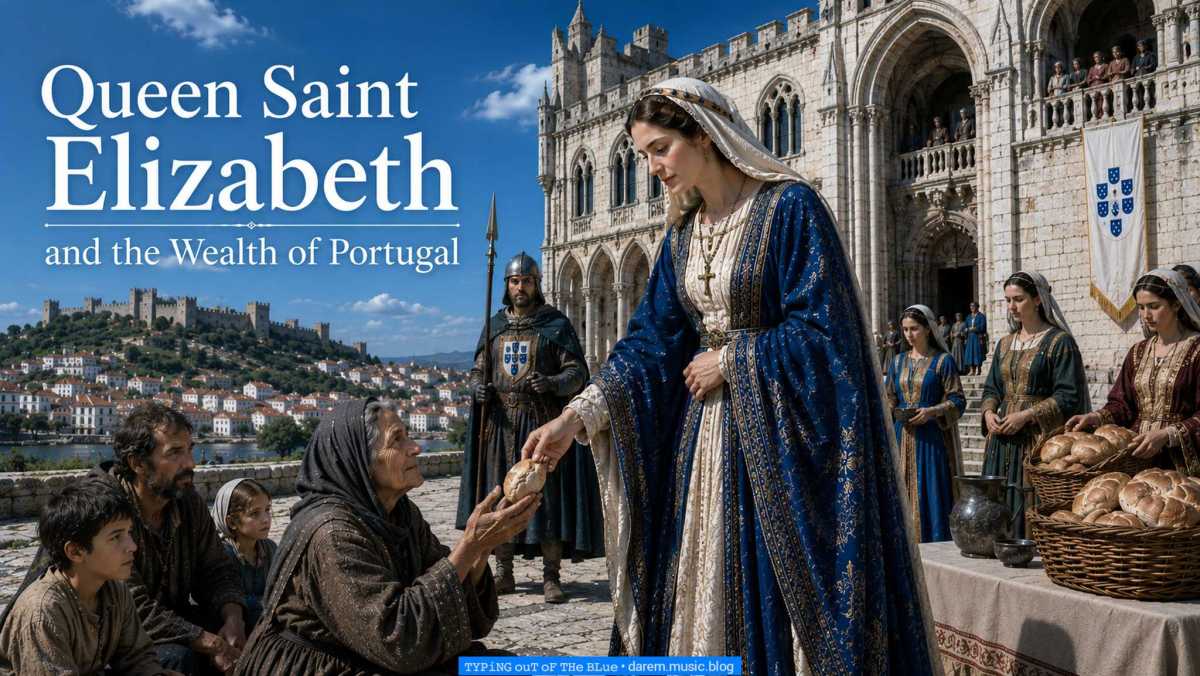
Queen Saint Elizabeth and the Wealth of Portugal

Not every treasure was meant to stay inside a royal treasury.

In 14th-century Portugal, royal wealth was often used to strengthen alliances, reward loyalty, and expand influence.

Queen Elizabeth of Portugal often spent it differently.

She supported hospitals, helped pilgrims traveling across the Iberian Peninsula, and provided financial assistance to poor young women who could not afford to marry or begin a new life. These acts were not meant to gain territory, win battles, or increase royal power.

Queen Elizabeth understood that charity follows a different kind of accounting. A coin given to someone in need does not simply disappear. It can become dignity, opportunity, and hope.

The hand that gives may become empty for a moment, but the world becomes a little less empty because of it.

More than seven centuries later, the fortunes of medieval Portugal belong to history books.

But people still remember the queen who gave.

Saint Elizabeth of Portugal understood something that still speaks to the modern world:

What seems wasted in charity is never lost.

Like a note played softly, it lingers. Sometimes it returns as an echo. Sometimes it multiplies into harmony. Sometimes it quietly becomes part of a better world—a melody no ledger will ever record.

Let’s keep learning the saints’ way—day by day.

⌨ ᴛʸᵖⁱⁿᵍ ᴏᵘᵗ ᵒᶠ ᵗʰᵉ ʙˡᵘᵉ ᵈᵃʳᵉᵐ ᵐᵘˢⁱᶜ ᵇˡᵒᵍ
Tears on an Empty Space • Darem Placer • Full album. Press play.

Saint Roque Gonzalez—A Priest Who Put People First

A priest who put people first, choosing their safety before any building or plan.

In the early 1600s, in the Rio de la Plata region of South America—today’s Paraguay, Argentina, and Brazil—Jesuit priest Roque González worked among the Guaraní people who trusted him enough to call him Pa’i Roque, their own word for priest.

Life in the missions was fragile. Raids, fires, and sudden conflict could damage a whole community overnight. In most mission settlements of that time, the usual response was clear: rebuild the chapel first. The chapel served as the center of the town, the place for prayer, teaching, meetings, and even storage. Restoring it meant restoring order.

But Roque did not start with structures.

Jesuit letters describe him as the kind of priest who checked on people before anything else—who was hurt, who had food, who had lost shelter, and which families needed immediate help. He believed a mission was not defined by buildings. It lived or died through the people who formed it.

So when trouble came, Pa’i Roque focused on stabilizing the community. He organized food, found temporary shelter, and made sure families could recover before larger rebuilding began. Only after the people were safe did he turn to the chapel or any other structure.

That is why the Guaraní trusted him. He didn’t lead from above.
He stood beside them—with their worries, their needs, and their hope.

Pa’i Roque was not just a priest in their land.

He was a priest on their side.

⌨ ᴛʸᵖⁱⁿᵍ ᴏᵘᵗ ᵒᶠ ᵗʰᵉ ʙˡᵘᵉ ᵈᵃʳᵉᵐ ᵐᵘˢⁱᶜ ᵇˡᵒᵍ

Traces of courage, silence, and sacrifice—this is Saints.

Listen on Apple Music, Apple Music Classical, and YouTube Music