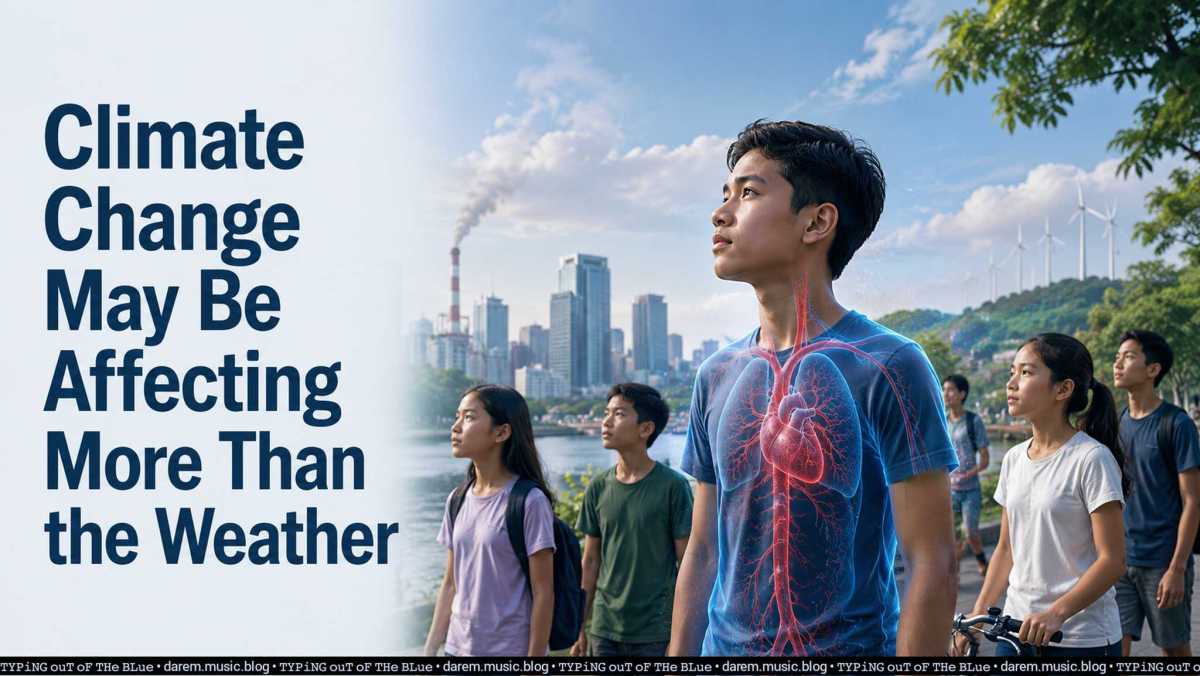
When we hear “climate change,” we usually think of hotter days, stronger heatwaves, extreme weather, floods, droughts, and rising sea levels.
But climate change may be affecting something much closer to us: our own bodies.
A 2026 study published in Air Quality, Atmosphere & Health looked at more than 20 years of U.S. health data from about 7,000 people. The researchers found that some chemicals in human blood had gradually changed over that period. Bicarbonate increased, while calcium and phosphorus decreased.
Why does that matter?
Our blood needs the right chemical balance to keep the body working properly. If that balance changes too much, it can affect important parts of the body, including the bones, muscles, nerves, and cells.
These changes happened during the same period that CO₂ levels in the atmosphere increased. CO₂ is rising mainly because we burn coal, oil, and natural gas for electricity, transportation, factories, and other everyday activities. Cutting and burning forests also adds CO₂ to the atmosphere.
But there is an important catch: the study does not prove that rising atmospheric CO₂ caused the blood changes. Other factors may also be involved, so scientists need more research.
Scientists think one reason for the bicarbonate increase may be the way our bodies respond to changes in CO₂. Our bodies may hold on to more bicarbonate to help keep the blood balanced. But scientists still need more research to know exactly what is happening.
If the current trend continues, the researchers estimate that bicarbonate levels could reach the high end of today’s healthy range within about 50 years. Calcium and phosphorus could also move closer to the low end of their healthy ranges later this century.
This does not mean people will suddenly become sick when CO₂ reaches a certain level. The researchers are looking at gradual changes across populations, not an immediate health crisis.
We already know that climate change can affect human health through heat stress, air pollution, disease, and other problems. This study raises another question: could rising CO₂ also be linked to gradual changes inside the human body?
For kids and teens today, this matters because they are growing up in a world with far more CO₂ in the atmosphere than people had decades ago.
So what can we do?
There is no need to panic. We can help reduce the amount of CO₂ we put into the atmosphere by using energy more wisely, choosing cleaner transportation when possible, protecting forests, and supporting cleaner sources of energy.
Scientists also need to keep studying the issue so we can better understand what these findings mean for human health.
Climate change is a problem we can see around us. Now we are learning that its effects may reach even closer to home.
Taking care of the planet is also part of taking care of ourselves.
⌨ ᴛʸᵖⁱⁿᵍ ᴏᵘᵗ ᵒᶠ ᵗʰᵉ ʙˡᵘᵉ ᵈᵃʳᵉᵐ ᵐᵘˢⁱᶜ ᵇˡᵒᵍ