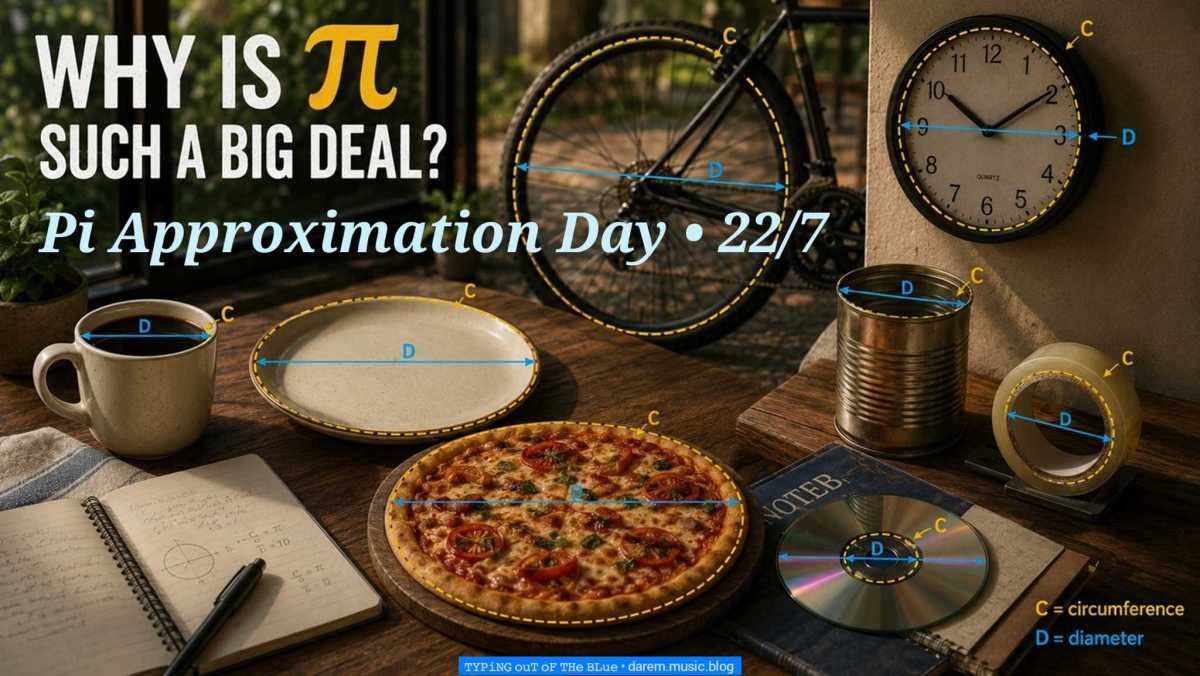
Every July 22, people celebrate Pi Approximation Day. The reason is right there in the date: 22/7. Divide 22 by 7, and you get a number pretty close to pi.
But why all the fuss about pi?
It has its own special days. People compete to memorize thousands of its digits. You see the π symbol on shirts, mugs, posters, and probably more math memes than anyone asked for.
So what makes this number so important?
Pi, written as the Greek letter π, begins with 3.14159 and keeps going forever without settling into a repeating pattern. That sounds like serious math territory, but the basic idea behind it is actually easy to understand.
Find any circle. A coin, a plate, or a bicycle wheel will do. Measure the distance around it, then divide that by the distance straight across its center.
For any perfect circle, the answer will always be pi.
The circle can be tiny or enormous. The rule stays the same.
And that simple relationship turns out to be incredibly useful.
Pi helps us calculate circular shapes, so it matters when designing wheels, gears, pipes, engines, and all kinds of machines. It also appears in science and technology when we study things that rotate or move in cycles.
It even finds its way into music and sound.
Mathematics uses pi to help describe sound waves, making it useful in understanding frequency, vibration, acoustics, and audio technology. You may never see π while listening to your favorite song, but somewhere behind the science of sound, it is part of the band.
Of course, nobody needs to memorize thousands of digits just to use pi. For many everyday calculations, 3.14 is accurate enough.
So maybe pi deserves some of the hype after all.
It begins with something as simple as measuring a circle, yet helps us understand everything from machines to sound waves.
Not bad for a number that never ends.
⌨ ᴛʸᵖⁱⁿᵍ ᴏᵘᵗ ᵒᶠ ᵗʰᵉ ʙˡᵘᵉ ᵈᵃʳᵉᵐ ᵐᵘˢⁱᶜ ᵇˡᵒᵍ