
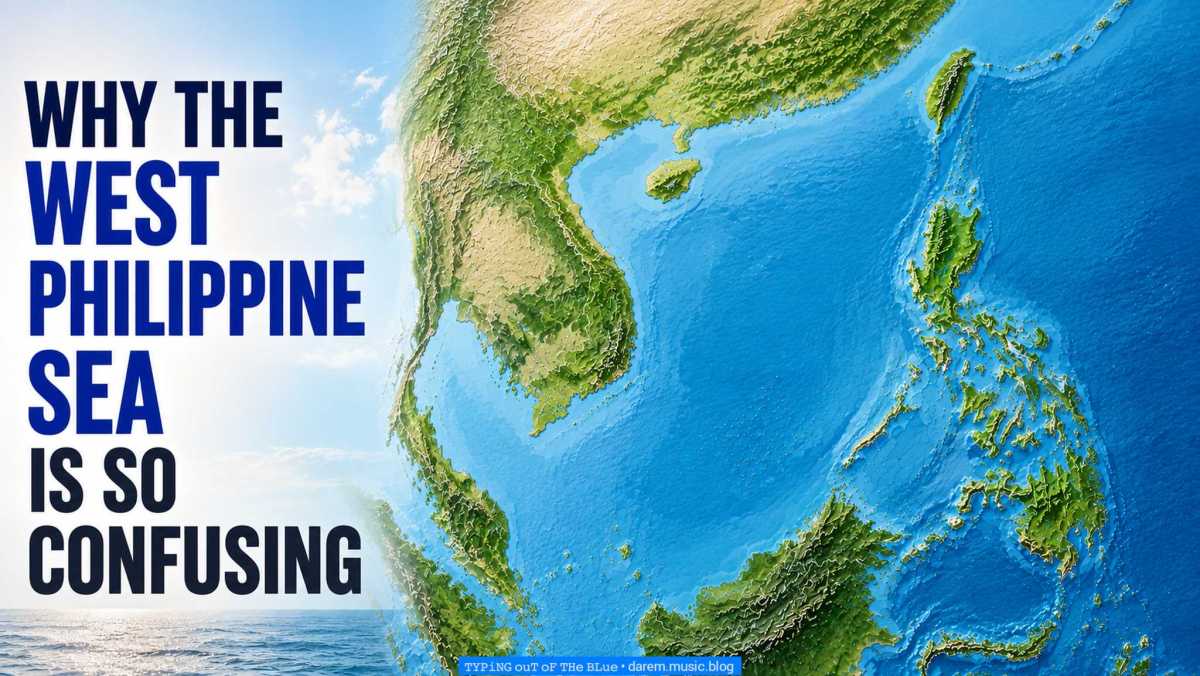
The West Philippine Sea is one of the most talked-about issues in Asia, yet it is also one of the most misunderstood. Many people hear about “China’s claim,” “Taiwan’s claim,” or the “South China Sea dispute” and assume they all mean the same thing. They do not.
The South China Sea is the large body of water shared by several countries. The West Philippine Sea is the name officially used by the Philippines for the western maritime areas of the country in the South China Sea. These include waters within the Philippines’ maritime zones as recognized under Philippine law and international law.
One important concept is the Exclusive Economic Zone (EEZ). Under the United Nations Convention on the Law of the Sea (UNCLOS), a coastal state has sovereign rights to explore, use, and manage natural resources within 200 nautical miles of its coastline. These rights apply to resources in the water, the seabed, and the subsoil, but an EEZ is not the same as territorial waters.
The confusion often begins with the number of countries involved.
There are six main claimants in the South China Sea dispute:
• Philippines 🇵🇭
• China 🇨🇳
• Taiwan 🇹🇼
• Vietnam 🇻🇳
• Malaysia 🇲🇾
• Brunei 🇧🇳
This does not mean that all six countries claim the entire West Philippine Sea. Their claims involve different islands, reefs, shoals, and maritime areas, with some overlapping one another.
Another source of confusion is the dash line.
A dash line is simply a series of broken lines drawn on a map to show the area claimed in the South China Sea. It is not an internationally recognized maritime boundary.
In 1947, the government now based in Taiwan published a map with an 11-dash line. In the early 1950s, maps published by China showed a similar claim using nine dashes instead. Although the number of dashes changed, both maps represented broad historical claims over much of the South China Sea.
Today, both China and Taiwan continue to assert broad claims in the South China Sea, although their legal and political positions are not identical. Both rejected the 2016 arbitral ruling, but for different reasons.
So what did the 2016 ruling actually decide?
Contrary to a common misconception, the arbitral tribunal did not decide which country owns the disputed islands or reefs. Questions of territorial sovereignty were outside its jurisdiction.
Instead, the tribunal ruled that China’s claim to historic rights within the 9-dash line has no legal basis under UNCLOS where it exceeds the maritime entitlements allowed by the convention. It also found that several disputed features are within the Philippines’ EEZ, where the Philippines has sovereign rights to natural resources under international law.
The dispute is not only about ownership of islands. It is also about maritime rights, fisheries, energy resources, and freedom of navigation in one of the world’s busiest sea lanes.
The issue may seem overwhelming at first, but a few key facts can make it much easier to follow.
The subject is complex, but knowing these basics helps separate facts from misconceptions.
⌨ ᴛʸᵖⁱⁿᵍ ᴏᵘᵗ ᵒᶠ ᵗʰᵉ ʙˡᵘᵉ ᵈᵃʳᵉᵐ ᵐᵘˢⁱᶜ ᵇˡᵒᵍ