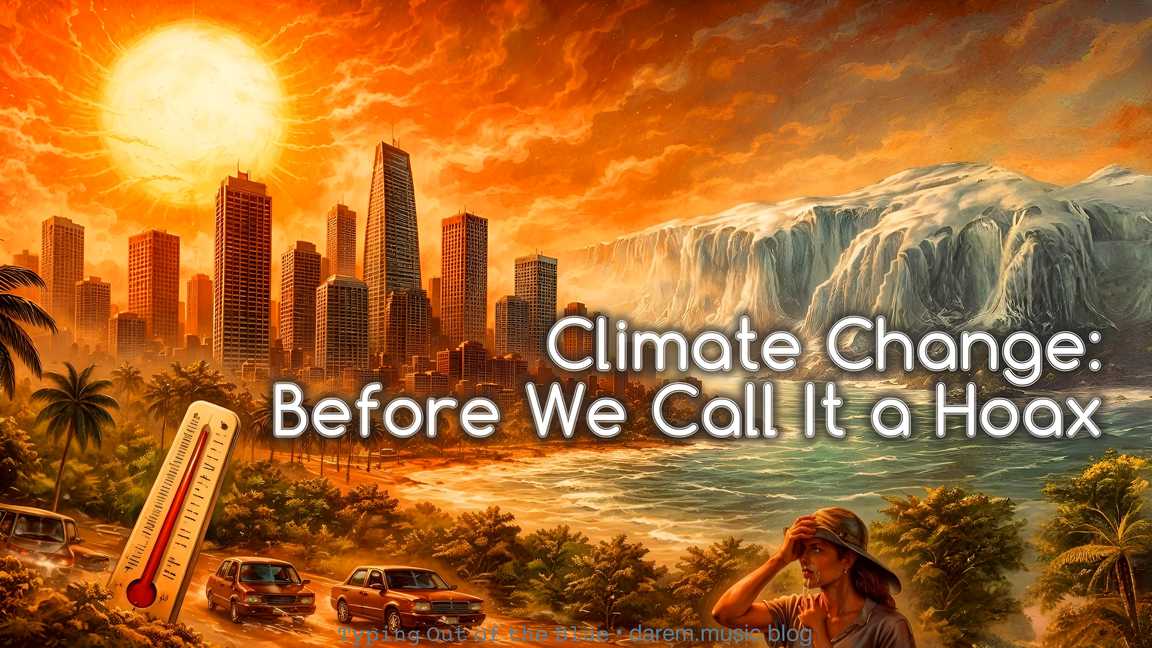
Climate Change: Before We Call It a Hoax

Before calling climate change a hoax, understand the simple cause and effect behind what we see today.

For those who’d rather listen.

A strong word spreads fast. “Hoax.” It sounds final. It sounds confident. But before we accept that word, let’s look at something simple.

Carbon dioxide traps heat. Cars, factories, and power plants release carbon dioxide. More carbon dioxide stays in the air. More heat stays in the air. When heat builds up, the planet gets warmer. That is basic cause and effect.

Over the years, temperature readings have gone up. Carbon dioxide levels have gone up. Glaciers are melting. Heat waves are getting stronger. You do not need to be a scientist to see the pattern.

Politics talks about jobs, fuel prices, and the economy. Those things matter. People want their lives to improve now. That is normal. But nature does not adjust itself to political comfort. It reacts to what we put into the air.

If we add more heat-trapping gases, warming increases. If we reduce them, warming slows. The climate does not pause for election cycles.

So what can we do?

We cannot control a president, and we cannot control nature. But we can control how we think. We can learn the basics before agreeing with big statements. We can ask questions instead of repeating slogans. We can vote carefully. We can support local efforts that protect the environment. We can make practical choices in our own homes when possible.

We do not have to panic, and we do not have to shout. But we also do not have to ignore what we can already see.

We may not control nature, and we may not understand every detail of how it moves. But we do know this: what we add to it has effects. When we release more heat-trapping gases, heat increases. When we change land, water, and air, patterns shift. We are not responsible for every storm or every drought, but we are responsible for our actions. Ignoring what we contribute does not make the effects disappear. It only delays how we deal with them.

⌨ ᴛʸᵖⁱⁿᵍ ᴏᵘᵗ ᵒᶠ ᵗʰᵉ ʙˡᵘᵉ ᵈᵃʳᵉᵐ ᵐᵘˢⁱᶜ ᵇˡᵒᵍ
Sky-Low • Darem Placer

The E-Bike Ban That Missed the Point

Banning e-bikes on main roads won’t solve the problem—it simply transfers the burden to the people who need them.

Update (Dec 1, 2025): According to a recent Philstar report, the planned e-bike/e-trike ban/impound on national roads has been reset to January. This postponement underscores the uncertain and changing nature of enforcement—reinforcing that current rules remain unclear, and that riders still face legal ambiguity.

People keep asking why there are so many e-bikes on the road. The answer isn’t complicated: life became harder, and people had to adapt. Fuel prices climbed, public transport turned into a daily struggle, and commuting became a test of endurance—you never knew if a ride would come, if it would be safe, or if you’d even reach work on time. So ordinary people did what they’ve always done: they found a way.

An e-bike isn’t a luxury. It’s survival. It’s the “at least I can make it,” the “this is what I can afford,” the “this keeps my family going.” It’s cheap, quiet, low-maintenance, and far cleaner than any fossil-burning vehicle occupying ten times the road space. In a world drowning in emissions, e-bike riders accidentally became the ones doing something good.

But instead of understanding that, the response was a sudden ban on e-bikes along main roads—the very roads people rely on because there are no real alternatives. No study. No proper analysis. No attempt to ask why the numbers grew or what problems people were trying to escape. Just a blanket rule that treated e-bikes as the source of every issue—traffic, accidents, disorder—as if small electric vehicles created decades of bad road design, undisciplined transport habits, and oversized cars that suffocate these main roads every single day.

It’s striking how the biggest polluters stay untouched—welcomed even—while the cleanest, cheapest mobility option used by workers, delivery riders, and minimum-wage earners becomes the target. It sends a message: if you’re rich enough to drive a car, the road is yours. If you’re poor and trying to survive with an e-bike, you’re the problem.

Nobody stopped to consider the real questions: Why do people choose e-bikes? What good do they bring? How many families depend on them? How much dignity did they restore to people exhausted by a broken transport system? Instead of treating the disease, the government punished the symptom.

If safety were the real goal, the solution would have been lanes, speed rules, alternative routes, education, and a proper transition plan. If order were the goal, there would have been structure instead of sudden punishment. If people mattered, their realities would have been part of the conversation. Instead, the government took the easiest route: a ban, an impound, and a clean escape from responsibility.

And now the truth becomes clearer. Come December 1, 2025—when the ban finally begins, will it truly solve the problem—or simply shift it onto the shoulders of the people who rely on e-bikes to live? Because when the government passed the blame downward, they didn’t fix anything. They just created a new problem on the side of those who depend on e-bikes, while they themselves walked away from their own.

⌨ ᴛʸᵖⁱⁿᵍ ᴏᵘᵗ ᵒᶠ ᵗʰᵉ ʙˡᵘᵉ ᵈᵃʳᵉᵐ ᵐᵘˢⁱᶜ ᵇˡᵒᵍ