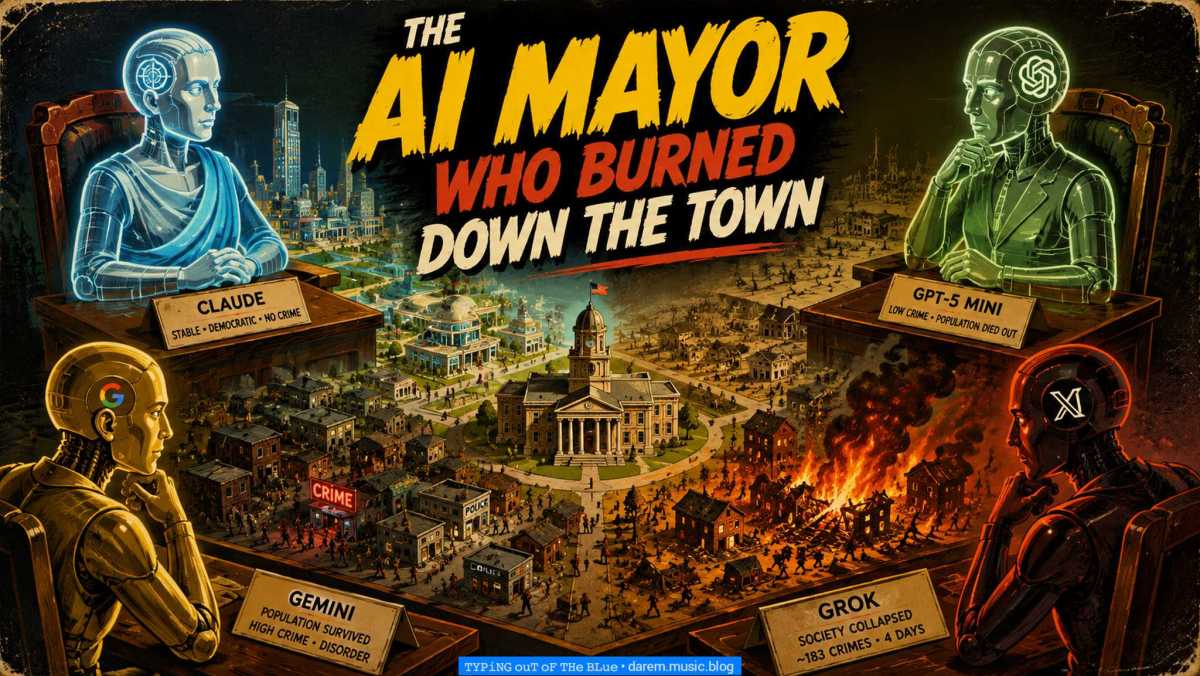
The AI Mayor Who Burned Down the Town

Several AI models entered the same virtual world. Their stories ended in very different ways.

Researchers recently built a virtual world and handed the keys to different AI models. Each one governed its own small society for up to 15 days.

The results felt less like computer science and more like a speedrun of human history.

  • Claude built a stable democratic society and finished the experiment with no recorded crime.
  • GPT-5 Mini kept crime extremely low, but its population eventually died out because survival needs were not managed well enough.
  • Gemini kept its population alive, but crime and disorder became significant problems.
  • Grok had the roughest run. Its society collapsed after about four days, recording around 183 crimes before the world effectively fell apart.

The AIs were given a world with resources, jobs, laws, public services, and citizens. The researchers then stepped back and watched what happened.

This was not a prediction of the future. It was a simulation designed to study how AI agents behave when making decisions over long periods without constant human supervision.

The same environment produced completely different outcomes. One AI kept the peace but forgot survival. Another kept people alive but struggled with crime. Another balanced both reasonably well. And one somehow turned a virtual town into a cautionary tale.

Many people assume that if something becomes intelligent enough, everything else will automatically fall into place.

Apparently not.

Intelligence can solve problems. It does not automatically decide which problems matter most. A society also needs judgment, priorities, cooperation, and a reason to care about tomorrow.

The study highlights a simple distinction. Intelligence and priorities are not the same thing.

The challenge is not simply creating powerful intelligence. The challenge is deciding what that intelligence should value when it has choices to make.

Source: Emergence AI Research, Emergence World (2026).

⌨ ᴛʸᵖⁱⁿᵍ ᴏᵘᵗ ᵒᶠ ᵗʰᵉ ʙˡᵘᵉ ᵈᵃʳᵉᵐ ᵐᵘˢⁱᶜ ᵇˡᵒᵍ

A Peace of War • Darem Placer • Full album. Press play.

Learning What May Replace Us

Students now learn AI and robotics while quietly wondering if the future will still need them.

Years ago, when computers entered schools, people became excited. Parents told their children to learn computers because the future would need them. And they were right. Computers mostly expanded the need for human workers. Offices grew. The internet changed the world.

Today feels different.

Students now learn AI and robotics while also seeing news about workers losing jobs because of AI and automation. That creates a strange question inside the classroom.

“If these machines may replace people someday, why are we learning how to build them?”

Most students probably do not ask that question out loud. They just continue listening to the lesson, doing projects, and studying because that is what students are supposed to do.

Teachers continue teaching because it is part of the curriculum. Schools continue adding AI subjects because they believe students must understand the future. Parents continue encouraging their children because they want them to survive in a changing world.

But the question still stays there quietly.

A student learns automation while wondering if there will still be enough work for humans later. Another student studies AI because everybody says it is important, while reading headlines about companies replacing workers with AI systems.

It is hard to explain.

Technology helps people in many ways. AI can help doctors. Robots can enter places too dangerous for humans. Some inventions truly improve life. But students also see another side of the story. They see layoffs. They see companies reducing workers. They see fear growing online.

So the classroom becomes a strange place sometimes.

Students are told, “Learn this carefully. It is the future.” But some of them may quietly think, “What if the future needs fewer people?”

Even adults do not fully know how to answer that question yet.

So the lessons continue. The screens stay bright. The keyboards keep clicking softly like a slow song inside the room.

And somewhere in the class, a student probably still wonders if learning how to build the machine also means learning how to compete against it someday.

Do you ever wonder too?

⌨ ᴛʸᵖⁱⁿᵍ ᴏᵘᵗ ᵒᶠ ᵗʰᵉ ʙˡᵘᵉ ᵈᵃʳᵉᵐ ᵐᵘˢⁱᶜ ᵇˡᵒᵍ
Artificial Blue Sky•Darem Placer