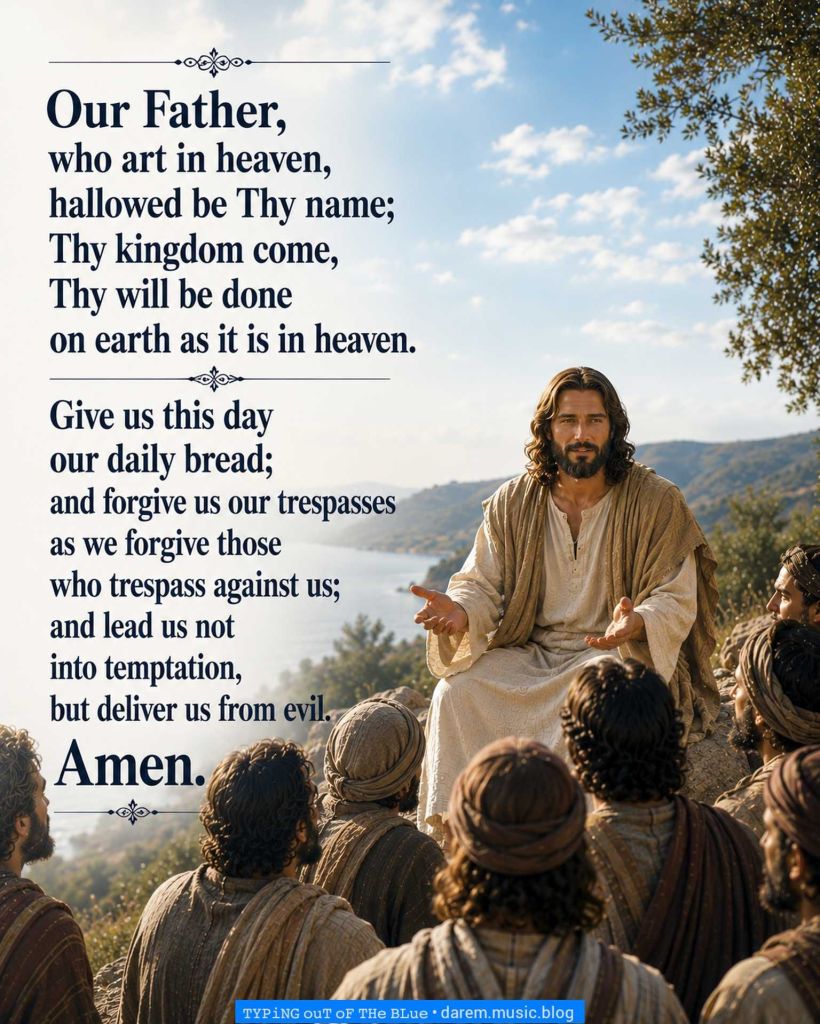
A familiar prayer reveals a rhythm woven through its words.
Most people remember the Lord’s Prayer, the prayer Jesus taught us, as a single prayer. It is easy to miss that after “Our Father” come seven distinct petitions, arranged with remarkable order.
The first three look entirely toward God:
1. Hallowed be Thy name. 2. Thy Kingdom come. 3. Thy will be done.
Only after these do the petitions turn toward us:
4. Give us this day our daily bread. 5. Forgive us our trespasses. 6. Lead us not into temptation. 7. Deliver us from evil.
The structure itself says something. Before bread comes God’s Kingdom. Before forgiveness comes God’s will. Before our worries, God’s name.
Saint Thomas Aquinas and Saint Augustine saw in the first petitions the purpose of human life itself: to glorify God and to share in His Kingdom. The remaining petitions place before God our needs for sustenance, mercy, strength, and protection from evil.
Its lasting power lies in its movement from eternity to everyday life, from heaven to the ordinary concerns of human life.
There is a rhythm to it: God first, then us. Heaven first, then earth.
Different voices, one prayer. A reflection that unites the Christian faith through the Our Father.
Our Father, who art in heaven
We call God our Father—not just mine, not just yours. We’re all connected because of Him. He is above everything, yet closer than we know. His presence reminds us that we belong to something greater than ourselves.
Hallowed be Thy name
We ask that God’s name be honored—not only by what we say, but by how we live. May our lives reflect His goodness, not just in prayer but in everyday choices.
Thy kingdom come
We long for a world shaped by love, justice, and peace. We pray that this kind of world begins here and now—through our actions, our hearts, and how we treat one another.
Thy will be done, on earth as it is in heaven
We surrender to what God knows is best. Even when it’s hard or unclear, we trust His way over our own. Just like in heaven, may His will guide everything we do.
Give us this day our daily bread
We ask for what we need today—nothing more, nothing less. Whether it’s food, strength, or peace of mind, we trust God to provide and pray that no one goes without.
And forgive us our trespasses, as we forgive those who trespass against us
We’ve all failed. We all need grace. As we ask God to forgive us, we open our hearts to forgive others too. Forgiveness sets us free—from guilt and from grudges.
And lead us not into temptation
We admit we’re not always strong. We ask God to guide us away from choices that could harm us or others. Help us walk the right path, even when the wrong one looks easier.
But deliver us from evil
Evil is real. It can be loud, quiet, or hidden. We ask God to protect us from harm—outside and inside—and to help us live in the light, not in fear.
Amen
This word seals the prayer. It means “Yes. I believe this. I trust You.” It’s not just an ending—it’s a commitment to live the words we just prayed.
This reflection offers a shared understanding of the Lord’s Prayer embraced by many Christian traditions. It brings together meanings that are commonly accepted across groups who pray the Our Father, including Catholics, Protestants, Orthodox Christians, Jehovah’s Witnesses, and Latter-Day Saints.
It is rooted in the Scriptures—Matthew 6:9–13 and Luke 11:2–4—where Jesus teaches His disciples how to pray. While different groups may emphasize certain parts differently, the core message of trust in God, surrender to His will, daily dependence, forgiveness, and the desire to overcome evil remains central to all.
Shared with respect for all Christian traditions—one prayer, one faith, one hope.