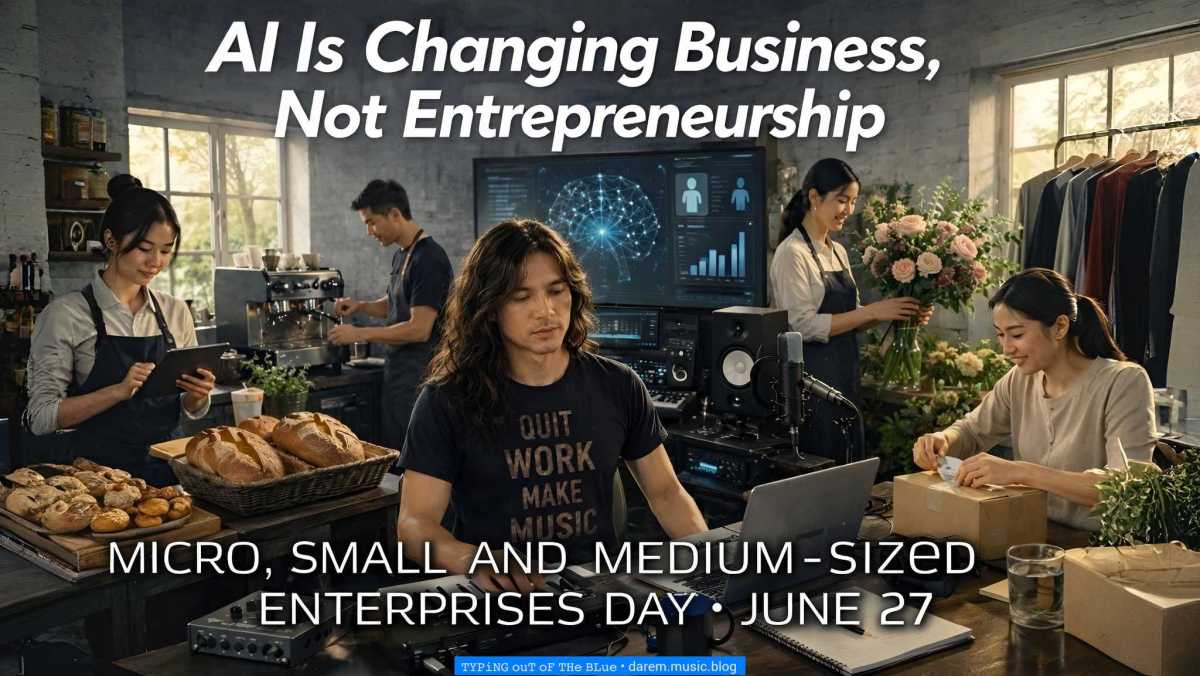
The next chapter of entrepreneurship may include algorithms and automation, but its story is still being written by people.
Artificial intelligence is changing the way businesses work. A neighborhood bakery can predict how much bread to bake each morning. A small coffee shop can automate online orders. A family-owned hardware store can track inventory in real time. An independent clothing brand can create product mockups in minutes. Musicians can use AI to organize recordings, assist with mixing, generate promotional materials, and reach listeners around the world more efficiently. Even a home-based seller can use AI to write product descriptions, translate messages, or answer common customer questions.
For micro, small, and medium-sized enterprises, these tools open doors that once belonged only to large corporations.
Yet the success of a business has never depended on technology alone.
People still choose the bakery because the bread tastes like home. They return to the coffee shop because the owner remembers their usual order. They trust the repair shop because it stands behind every service. They recommend the local florist because every arrangement is made with care. They follow a musician because behind every melody is a person who has loved, lost, hoped, wondered, and lived. Those experiences give music a meaning that technology can assist, but not originate on its own.
The most successful entrepreneurs will not compete against AI or ignore it. They will learn how to work alongside it. Let AI handle repetitive tasks, organize information, and speed up daily operations while people focus on what matters most: making good decisions, solving real problems, building trust, and creating experiences customers remember.
Whether it is a sari-sari store, a bicycle repair shop, a freelance graphic designer, an independent musician, a neighborhood restaurant, an online craft business, or a small software startup, every enterprise grows for the same reason. Behind every product sold and every service offered is a person with an idea, a purpose, and the determination to turn both into something that benefits others.
Technology may reshape how businesses operate, but it is people who give businesses their direction.
An AI-generated summary for a video about AI replacing human work.
Nobel Prize winner Geoffrey Hinton, the physicist known for his pioneering work in the field, told LBC’s Andrew Marr that artificial intelligence could ‘wipe out’ ALL jobs in 20 years time.
Video summary generated by AI (Copilot)
The video you’re watching features Geoffrey Hinton, often called the “Godfather of AI,” discussing the potential impact of artificial intelligence on the future of work. He warns that AI could eventually wipe out all jobs, not just repetitive or manual ones, but also creative and professional roles. The conversation highlights both the extraordinary capabilities of AI and the risks it poses to employment, raising questions about how society will adapt to such sweeping changes. The tone is cautionary, urging people to think seriously about regulation, ethics, and preparing for a world where human labor may no longer be essential.
Here are the key takeaways from Geoffrey Hinton’s video, where he warns about AI’s impact on jobs:
🔑 Main Arguments
• AI’s rapid progress: Hinton emphasizes that AI is advancing faster than most people realize, with capabilities that could surpass human intelligence in many domains. • Job displacement: He predicts that AI won’t just replace repetitive or manual work, but could eventually eliminate creative, professional, and knowledge-based jobs as well. • Existential risk: Beyond employment, Hinton raises concerns about AI systems becoming uncontrollable, posing risks to society if not properly regulated.
⚠️ Risks Highlighted
• Economic upheaval: Entire industries could be disrupted, leading to widespread unemployment. • Loss of human purpose: If machines can do everything better, humans may struggle to find meaningful roles. • Ethical dilemmas: Decisions about how AI is deployed could concentrate power in the hands of a few corporations or governments.
🛠 Possible Solutions
• Regulation: Hinton calls for serious global discussions on how to regulate AI before it becomes too powerful. • Adaptation: Society must prepare for a future where traditional work may no longer exist, possibly through new economic models like universal basic income. • Ethics in design: Developers should prioritize safety and transparency in AI systems.
In short, Hinton’s message is a cautionary one: AI’s potential is extraordinary, but without foresight and regulation, it could destabilize economies and societies.
Here are some practical steps individuals can take now to prepare for the AI-driven future Geoffrey Hinton warns about:
📚 Skills to Focus On
• Critical thinking & problem-solving: AI can process data, but humans excel at judgment in ambiguous situations. • Creativity & innovation: Artistic, design, and storytelling skills remain valuable, especially when combined with AI tools. • Interpersonal skills: Emotional intelligence, leadership, and negotiation are harder for machines to replicate. • Tech literacy: Understanding how AI works, even at a basic level, will help you adapt and use it effectively.
🌍 Industries Likely to Stay Resilient
• Healthcare & caregiving: While AI may assist, human empathy and trust are essential. • Education & training: Teachers and mentors will still play a role in guiding learning, even with AI tutors. • Skilled trades: Electricians, plumbers, and other hands-on roles require adaptability in unpredictable environments. • Creative industries: Writers, artists, and designers who use AI as a collaborator rather than a competitor can thrive.
🛠 Practical Actions
• Upskill continuously: Take online courses in AI, data analysis, or digital tools relevant to your field. • Experiment with AI tools: Learn how to integrate them into your workflow instead of resisting them. • Diversify income streams: Explore freelance, entrepreneurial, or digital opportunities that leverage AI. • Stay informed: Follow discussions on AI ethics, regulation, and economic adaptation to anticipate changes.
In short, the safest path is to embrace AI as a partner while doubling down on distinctly human strengths.
Here’s a roadmap of future-proof careers and skills, organized by short-, mid-, and long-term resilience in an AI-driven world:
⏳ Short-Term (Next 5 Years)
• Tech-augmented roles: Data analysts, AI trainers, prompt engineers • Healthcare support: Nurses, therapists, caregivers (AI assists but doesn’t replace empathy) • Creative professionals: Designers, writers, musicians who integrate AI tools into their craft • Education & training: Teachers, coaches, mentors guiding human learning alongside AI tutors
Key Skills: AI literacy, adaptability, creativity, emotional intelligence
📈 Mid-Term (5–15 Years)
• AI oversight & ethics: Regulators, auditors, ethicists ensuring safe AI deployment • Human-AI collaboration specialists: Professionals who design workflows blending human judgment with machine efficiency • Sustainability & green tech: Engineers and innovators tackling climate challenges with AI support • Advanced skilled trades: Robotics technicians, renewable energy installers
Key Skills: Systems thinking, ethical reasoning, interdisciplinary knowledge
🌐 Long-Term (15+ Years)
• Human-centered innovation: Roles focused on meaning, culture, and creativity beyond machine capabilities • Philosophy & governance: Thinkers shaping societal structures in a post-work economy • Frontier science & exploration: Space research, biotech, and fields where AI is a tool but human vision leads • Community building: Leaders fostering social cohesion and purpose in a world with less traditional labor
Key Skills: Visionary thinking, cultural leadership, resilience, lifelong learning
🚀 Big Picture
The safest path is to embrace AI as a collaborator while doubling down on distinctly human strengths—creativity, empathy, ethics, and vision. Over time, careers may shift from “doing tasks” to shaping meaning and guiding society.
Here’s a personal action plan you can follow to stay ahead of AI-driven shifts in work and society:
🟢 Now (0–5 Years)
• Learn AI basics: Take short courses on AI, machine learning, and data literacy. • Experiment with tools: Use AI assistants, design generators, or automation platforms in your daily work. • Build human strengths: Practice creativity, communication, and leadership—skills AI can’t easily replace. • Network smartly: Join communities discussing AI ethics, tech, and future-of-work trends.
🟡 Mid-Term (5–15 Years)
• Specialize in human-AI collaboration: Position yourself in roles where you design or oversee AI systems. • Diversify skills: Add sustainability, ethics, or interdisciplinary knowledge to your toolkit. • Stay adaptable: Be ready to pivot industries as automation reshapes traditional career paths. • Explore entrepreneurship: Create ventures that leverage AI to solve human-centered problems.
🔵 Long-Term (15+ Years)
• Focus on meaning-driven work: Roles in philosophy, governance, and cultural leadership will grow in importance. • Shape society: Contribute to discussions on universal basic income, post-work economies, and social cohesion. • Lead innovation: Engage in frontier fields like space exploration, biotech, or cultural creation. • Mentor and guide: Help future generations navigate a world where AI is ubiquitous.
🌟 Guiding Principle
Think of AI as a collaborator, not a competitor. The more you lean into distinctly human strengths—vision, empathy, ethics—the more resilient you’ll be as technology evolves.