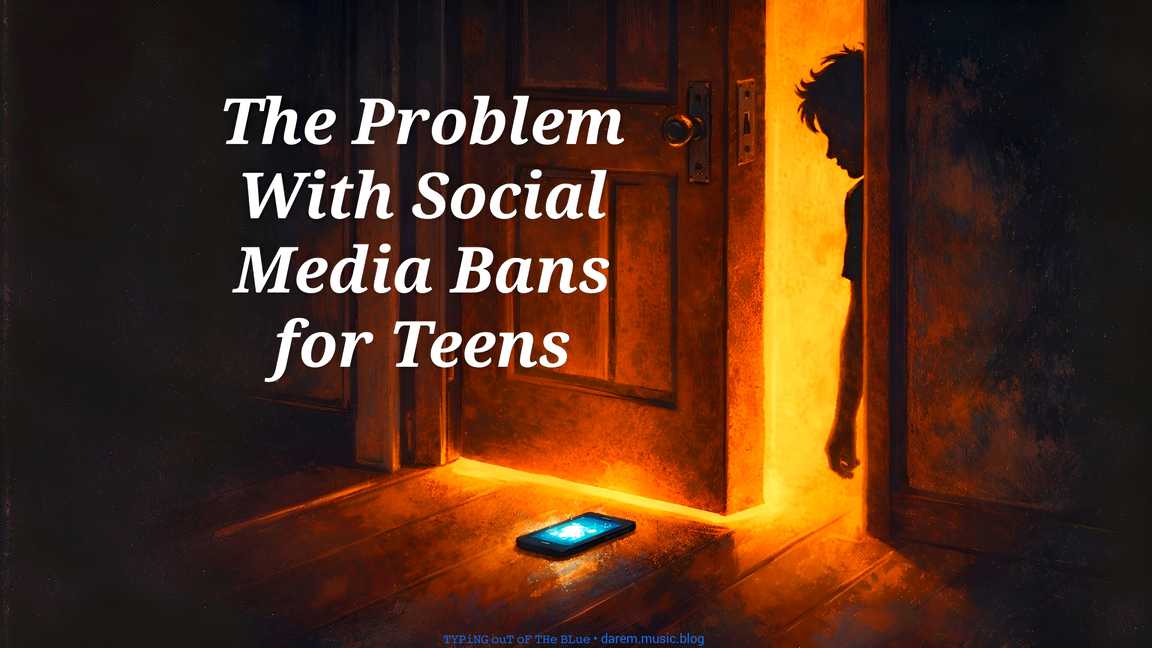
The Problem With Social Media Bans for Teens

A social media ban for teens may sound like a simple solution. But strict bans often push behavior into places adults cannot easily see.

For those who’d rather listen.

Adults have always worried about the tools young people use.

Years ago it was television. Then video games. Now the concern has shifted to social media. Many people believe the healthiest solution is simply to ban it for users under 16.

At first glance, that idea sounds reasonable.

Teenagers spend hours scrolling. Social media can create pressure, distraction, and sometimes unhealthy comparisons. It is easy to understand why many adults think the best solution is to shut the door completely.

But life with teenagers is rarely that simple.

Young people are naturally curious. They are also surprisingly creative. When something becomes forbidden, that creativity does not disappear. It simply changes direction.

Instead of stopping the behavior, strict bans often push it somewhere else.

A teenager who cannot use social media openly may start using anonymous accounts. Some move to new apps adults have never heard of. Others create private groups where conversations become harder for parents or teachers to see.

The activity does not disappear. It just becomes more hidden.

There is also another reality that many schools quietly face today.

Communication between teachers and students often happens in group chats. Announcements, reminders, and project coordination sometimes move through messaging platforms like Facebook Messenger because they are simple and everyone already has access.

Removing that channel does not automatically create a better system. Sometimes it simply removes the easiest one.

None of this means social media has no risks. It clearly does. But banning something completely does not always teach people how to handle it.

Social media is not going to disappear from the world. Eventually every teenager will encounter it.

The real challenge is not pretending it does not exist.

The real challenge is helping young people learn how to live with it wisely.

Because sometimes closing the door does not stop people from leaving.

It only teaches them how to find another exit.

Especially when the people inside are teenagers.

⌨ ᴛʸᵖⁱⁿᵍ ᴏᵘᵗ ᵒᶠ ᵗʰᵉ ʙˡᵘᵉ ᵈᵃʳᵉᵐ ᵐᵘˢⁱᶜ ᵇˡᵒᵍ

Teens and Social Media Part 2

From connection to engagement. How algorithms reshaped teen social media.

The Algorithmic Turn

For those who’d rather listen.

Early 2000s to early 2010s, teen social media use wasn’t treated as a crisis. Why?

Because social media back then was mostly chronological and simpler.

When you opened Facebook around 2008–2012, you saw posts in order. Same with early Instagram. You followed people you knew. You posted. You left.

No heavy algorithm deciding what keeps you hooked.

Then the system began to shift.

• 2012 – YouTube already had revenue sharing earlier, but influencer culture began accelerating.
• 2013–2014 – Instagram influencers started becoming commercial. Sponsored posts became common.

Monetization was becoming visible. Attention was slowly turning into income.

Around 2012–2014, platforms also began moving away from chronological feeds toward algorithm-driven systems. Engagement became the goal, not connection.

2016 was a turning point.

• Facebook fully leaned into algorithm ranking
• Instagram shifted away from chronological feeds
• Facebook expanded creator monetization tools

The focus on engagement deepened. Reach mattered. Time spent mattered.

By 2018–2019, the creator economy exploded. Platforms formalized creator funds and revenue programs.

In 2018, the Cambridge Analytica scandal became public. It exposed how social media data could be harvested and used to build psychological profiles for political targeting. That raised serious questions about privacy, manipulation, and how platforms were handling user data.

Then came short-form dopamine machines like TikTok around 2018–2020. Highly personalized systems. Endless scroll. Micro-reward loops. Fast emotional spikes.

• 2020 onward – Full creator economy era. Short-form monetization, brand deals, platform payouts.

Attention was no longer just engagement. It was income.

That’s when concerns about addiction, comparison culture, attention span, and teen mental health started getting more attention.

Teens didn’t suddenly change. The design did.

Early social media was like a digital bulletin board.

Modern social media is more like a casino floor—lights, noise, engineered engagement.

The concern did not start with teens being online. It started when social platforms shifted from connection to algorithmic control.

Teens adapted to the platforms. The platforms evolved for profit. If there is something to fix, it is not the presence of young users—but the system that shapes what they see.

⌨ ᴛʸᵖⁱⁿᵍ ᴏᵘᵗ ᵒᶠ ᵗʰᵉ ʙˡᵘᵉ ᵈᵃʳᵉᵐ ᵐᵘˢⁱᶜ ᵇˡᵒᵍ

There Was a Time • Darem Placer