Saint Anthony Mary Zaccaria: The Doctor Who Carried Two Bags

Long before his sermons reached churches, his compassion was already reaching homes and hospital beds.

Anthony Mary Zaccaria was an Italian physician and priest who lived during the early sixteenth century. Born in 1502 in Cremona, Italy, he grew up during a time of war, social upheaval, and growing calls for reform within the Church.

He studied medicine at the University of Padua, one of the leading centers of learning of his time. After completing his studies, he returned to Cremona to practice as a physician.

Doctor Anthony saw medicine not merely as a profession but as a form of service. He cared especially for the poor, treating those who could not afford medical care and giving much of his time to those most in need.

His concern extended beyond physical illness. He encouraged the sick, comforted the dying, and sought to bring peace to troubled hearts as well as healing to wounded bodies. He understood that a human life, much like music, can fall out of tune and sometimes needs a patient hand to help bring it back into harmony.

An early story from his life reflects this spirit of generosity. Meeting a poor man with almost nothing to wear, the young Anthony gave away his own expensive silk cloak because he had no money with him to offer instead.

Although he would later leave medicine to become a priest and founder of the Barnabites, he never stopped being a healer. If most physicians carried a bag for the body, Saint Anthony seemed to carry another for the soul.

Let’s keep learning the saints’ way—day by day.

⌨ ᴛʸᵖⁱⁿᵍ ᴏᵘᵗ ᵒᶠ ᵗʰᵉ ʙˡᵘᵉ ᵈᵃʳᵉᵐ ᵐᵘˢⁱᶜ ᵇˡᵒᵍ
A Glimpse of Daylight • Darem Placer • Full album. Press play.

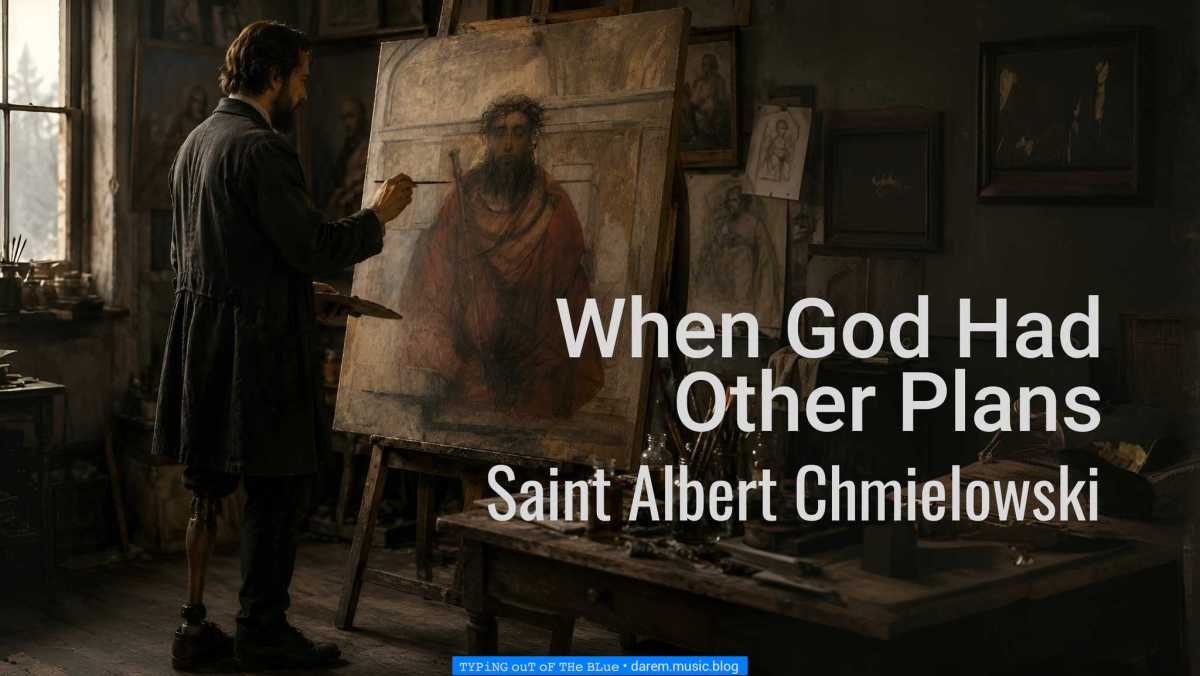
When God Had Other Plans

Life had a different destination in mind.

In 1865, after losing his leg during Poland’s uprising against Russian rule, Adam Chmielowski traveled to Ghent, Belgium, to continue his engineering studies.

While in Ghent, he discovered that he had a talent for painting. Despite the objections of his family trustees, he abandoned engineering and pursued art instead. He eventually studied at the Munich Art Academy, where he trained alongside some of Poland’s most promising young artists.

By the 1870s, Adam had become a respected painter whose works appeared in exhibitions across Poland. Yet success brought little satisfaction. He struggled with depression, and he became increasingly troubled by the poverty he witnessed in Kraków.

As he spent more time reflecting on the suffering he saw around him, religious themes began appearing more often in his work. While painting Ecce Homo, his depiction of the suffering Christ, he began to sense that God might be calling him to a different life.

Ecce Homo by Adam Chmielowski. Courtesy of Wikimedia Commons. Public Domain.

In 1880, he entered the Jesuit novitiate to discern that call. The experience, however, was marked by a severe spiritual and emotional crisis. He became ill and eventually left, realizing that the Jesuit path was not meant for him.

Not long afterward, he encountered the spirituality of Saint Francis of Assisi. Inspired by Francis’s love for the poor, Adam found the direction he had been searching for.

Instead of returning to the pursuit of artistic success, he chose to live among the homeless and poor of Kraków. He cared for those whom society ignored and gradually gave his life to serving them.

The man who once searched for his future in classrooms, battlefields, and art studios would become Saint Albert Chmielowski, remembered today for seeing the face of Christ in the poor.

Sometimes life moves in strange ways. The path we carefully plan for ourselves is not always the one we are meant to follow. What feels like a setback, a detour, or even a failure may be leading us toward something greater than we can see at the moment, drawing us ever closer to God.

Let’s keep learning the saints’ way—day by day.

⌨ ᴛʸᵖⁱⁿᵍ ᴏᵘᵗ ᵒᶠ ᵗʰᵉ ʙˡᵘᵉ ᵈᵃʳᵉᵐ ᵐᵘˢⁱᶜ ᵇˡᵒᵍ

Shaping the Ensemble • Darem Placer • Full album. Press play.