
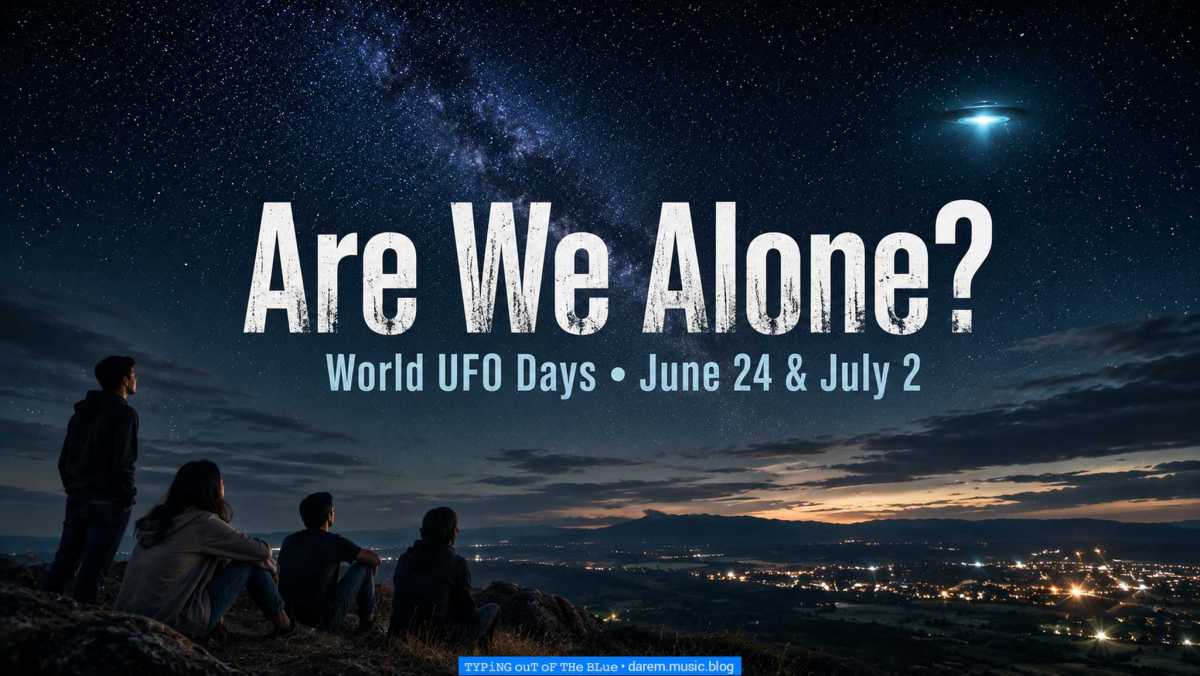
When people hear the words “UFO” or “flying saucer,” many still imagine blurry photographs, grainy videos, and stories told under a night sky. Yet in recent years, the subject has stepped out of science fiction and into government reports, congressional hearings, and public discussion. The United States government has released footage and documents involving what it now calls Unidentified Anomalous Phenomena (UAPs), objects or events observed in the sky that remain unexplained after investigation. While none of these reports have confirmed extraterrestrial visitors, they have renewed public curiosity about what may be sharing the skies with us.
The history of World UFO Day traces back to two important dates. One is June 24, 1947, when pilot Kenneth Arnold reported seeing several unusual objects flying near Mount Rainier in Washington State. His description led newspapers to popularize the term “flying saucer,” helping launch the modern UFO era. The other date is July 2, which is connected to the Roswell Incident of 1947. Reports of a mysterious crash in New Mexico became one of the most discussed UFO stories in history. Over time, July 2 became the more widely observed World UFO Day, though some enthusiasts continue to recognize June 24 as well.
For decades, UFO discussions remained on the edges of public conversation. Witness accounts, photographs, documentaries, and speculation fueled endless debates. Skeptics pointed to ordinary explanations, while believers argued that not every sighting could be explained so easily. The mystery itself became part of popular culture.
Today, the conversation is different. Governments and researchers are studying unusual sightings with greater seriousness than in the past, not necessarily because they believe in extraterrestrials, but because unexplained objects in the sky can have implications for science, aviation safety, and national security.
The UFO phenomenon has even reached the music world. Tom DeLonge of Blink-182 became one of the most recognizable figures involved in UFO research, helping bring attention to several U.S. military UAP videos.
Religious leaders have also reflected on the possibility of life beyond Earth. In 2014, Pope Francis remarked that if an expedition of Martians arrived and one of them asked to be baptized, the Church should not automatically close its doors. His point was not that aliens had been discovered, but that faith should remain open to the unexpected.
World UFO Day is not really about proving that aliens exist. It is about curiosity. Whether a person believes UFOs are visitors from another world, undiscovered natural phenomena, secret technology, or simply misunderstandings, the choice ultimately belongs to them. The sky continues to hold its secrets, inviting each generation to ask the same question: Are we alone?
⌨ ᴛʸᵖⁱⁿᵍ ᴏᵘᵗ ᵒᶠ ᵗʰᵉ ʙˡᵘᵉ ᵈᵃʳᵉᵐ ᵐᵘˢⁱᶜ ᵇˡᵒᵍ