
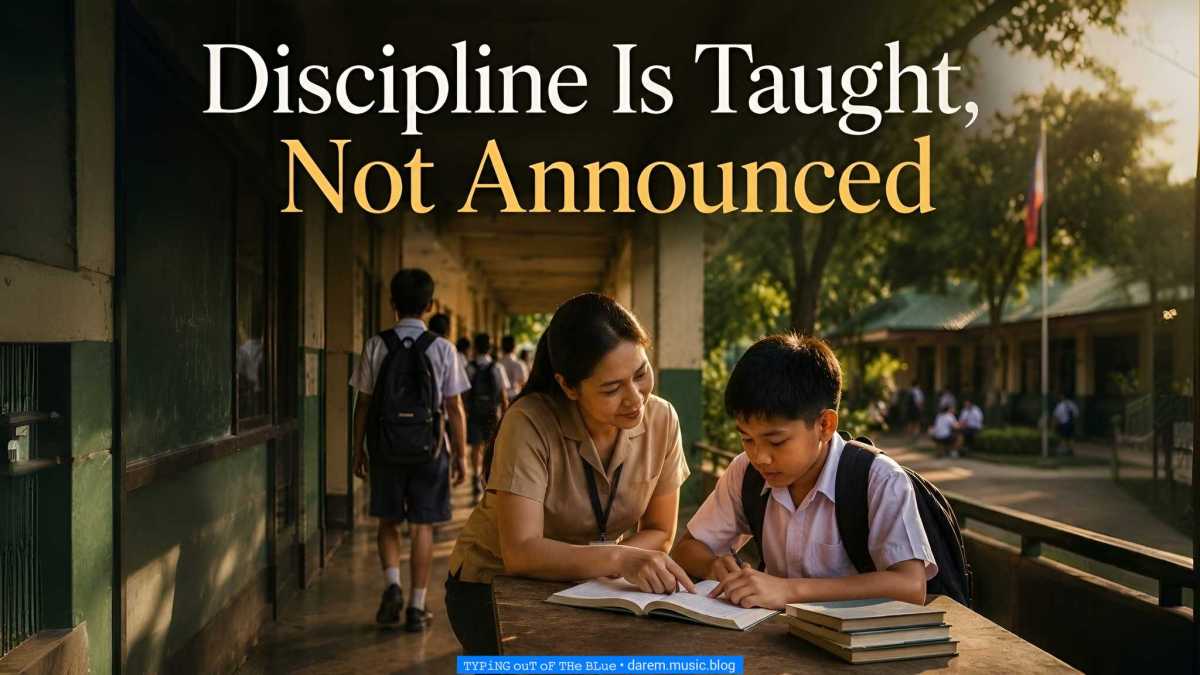
Every time a violent incident involving young people makes the news, familiar questions follow. Should penalties be stricter? Should the age of criminal liability be lowered? Should schools have tighter security?
These are important questions. But they usually come after something has already gone wrong.
Children do not develop responsibility overnight. Learning how to control anger, handle pressure, respect boundaries, and think about consequences takes time. These things are learned little by little, often long before a child faces a serious decision.
Education helps, but education alone is not enough. A student can know the rules and still struggle to follow them. A child can understand the difference between right and wrong and still make poor choices in moments of anger, frustration, or pressure.
That is why example matters.
Children pay attention to more than lessons and lectures. They watch how adults behave. Parents who keep their promises teach responsibility. Teachers who apply rules fairly teach accountability. Adults who treat others with respect quietly teach the same lesson.
Many schools spend years teaching academic subjects, yet some of life’s most important lessons are learned outside the classroom. Responsibility, self-control, conflict resolution, and respect are not learned in a single lesson. They are developed through practice, guidance, and repetition.
Recent incidents involving students have raised concerns about discipline and accountability. What makes these cases especially troubling is that they happen in a time when cameras are everywhere. Schools have CCTV. Students carry phones. Information is easy to access. Yet some still make decisions that change lives in an instant.
This suggests that the issue is not always a lack of information. Sometimes it is a lack of self-control, guidance, or a clear understanding of consequences.
That is why prevention deserves as much attention as punishment.
Schools can help shape character. Families can help build discipline. Communities can help reinforce positive values. None of these can do the job alone.
Discipline is not created by a poster on a wall or a rule written in a handbook. It grows through consistent guidance, clear expectations, and good examples.
Children need to hear what is right. More importantly, they need to see it.
When that happens often enough, responsibility stops being just another lesson and starts becoming a habit. Much like a familiar melody, it stays with them long after the lesson is over.
⌨ ᴛʸᵖⁱⁿᵍ ᴏᵘᵗ ᵒᶠ ᵗʰᵉ ʙˡᵘᵉ ᵈᵃʳᵉᵐ ᵐᵘˢⁱᶜ ᵇˡᵒᵍ