The Child Who Explained Saint Cyril of Alexandria

A child asks the questions that centuries of theology sometimes forget to ask.

In the bustling Mediterranean city of Alexandria in Egypt during the 5th century lived a bishop named Cyril, one of Christianity’s greatest theologians. The Roman Empire still stood, though cracks had already begun to appear in its walls, and Alexandria was one of the greatest cities in the world, filled with scholars, merchants, sailors, philosophers, and endless debates. And few debated more fiercely than Bishop Cyril.

Today, Saint Cyril is remembered as one of Christianity’s greatest theologians. His books and letters are filled with long arguments, difficult ideas, and enough Greek terminology to make many modern readers quietly close the book and walk away.

Yet beneath all the debates and theological language were questions simple enough for a child to ask.

Imagine if Saint Cyril were sitting on a park bench today and a child walked up to him.

“Was the baby in Bethlehem really God?” the child asks.

Cyril would probably smile.

“Yes. The tiny baby who needed to be fed, carried, and protected was God who had become one of us.”

The child pauses.

“So God was once a baby?”

“Yes.”

“Did He cry?”

“Yes.”

“Did He get hungry?”

“Yes.”

“Did He fall asleep in Mary’s arms?”

“Yes.”

The child thinks for a moment.

“Then God knows what being a child feels like.”

“Exactly,” Cyril replies.

Another question follows.

“When Jesus was sad because His friend died, was that really God being sad?”

“Yes. Jesus cried real tears.”

“When Jesus was tired from walking?”

“Yes.”

“When people were mean to Him?”

“Yes.”

“When He felt lonely?”

“Yes.”

The child grows quiet.

“Then God knows what it feels like to be me.”

Perhaps beneath all the difficult words and debates, this was one of the truths Cyril was trying to protect: God did not remain far away from human life. He entered it. He knew hunger, friendship, laughter, pain, tears, and love.

Jesus once learned to walk, asked for food and water, and fell asleep in His mother’s arms.

For Saint Cyril, this was never merely a puzzle for scholars to solve.

It was a truth too beautiful to lose.

Let’s keep learning the saints’ way—day by day.

⌨ ᴛʸᵖⁱⁿᵍ ᴏᵘᵗ ᵒᶠ ᵗʰᵉ ʙˡᵘᵉ ᵈᵃʳᵉᵐ ᵐᵘˢⁱᶜ ᵇˡᵒᵍ
Underplayground • Darem Placer • Full album. Press play.

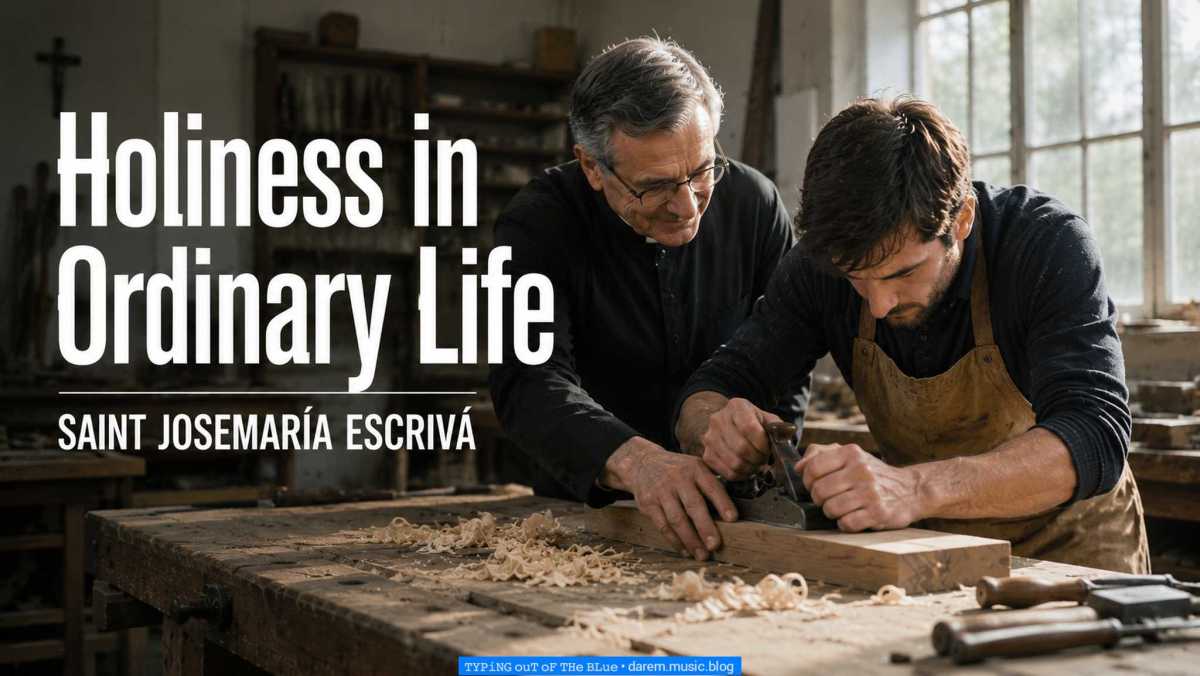
Holiness in Ordinary Life

We often separate faith from everyday life. But what if they were never meant to be apart?

Born in 1902, Josemaria Escriva was a Spanish Catholic priest who founded Opus Dei in 1928. Opus Dei, which means “Work of God,” emphasizes that every Christian is called to holiness, not only through prayer and worship, but also through ordinary life, especially our work and daily responsibilities. Father Josemaria believed that we do not need to leave the world to find God. We meet Him right where we are.

According to Father Josemaria, holiness is not reserved for priests, nuns, or people who spend hours in monasteries. It is something all of us are called to pursue.

God is already present in ordinary life. As we go about our day, we can encounter Him through the way we live, love, and serve.

Work: We do our jobs with competence, honesty, and love. A teacher teaches well. A carpenter builds carefully. A musician creates beauty without vanity. Our work becomes an offering to God.

Family responsibilities: Caring for children, honoring our parents, preparing meals, forgiving a spouse, or patiently listening to a family member are all acts of love that can become holy when done for God.

Social duties: Being truthful, paying our debts, helping our neighbors, keeping our promises, treating coworkers with respect, and serving society faithfully are also ways of living the Gospel.

Father Josemaria often summarized this spirituality in three ideas:

1. Sanctify our work. Offer it to God.

2. Grow in holiness through it. Let it shape virtues like patience, humility, diligence, and charity.

3. Lead others closer to God through it. Be a quiet witness by the way we live, not merely by what we say.

This is not about pretending every task is exciting. Washing dishes is still washing dishes. Filing paperwork is still paperwork. The difference is the intention we bring to it. When we do even the most ordinary tasks with love, excellence, and offer them to God, they can become a prayer.

This echoes Colossians 3:23:

“Whatever you do, work at it with all your heart, as working for the Lord.”

For Saint Josemaria, holiness is not mainly about where we are. It is about how we live where God has already placed us. The office, classroom, kitchen, workshop, farm, hospital, or concert hall can all become places where we encounter God.

Let’s keep learning the saints’ way—day by day.

⌨ ᴛʸᵖⁱⁿᵍ ᴏᵘᵗ ᵒᶠ ᵗʰᵉ ʙˡᵘᵉ ᵈᵃʳᵉᵐ ᵐᵘˢⁱᶜ ᵇˡᵒᵍ

Empty Piano Bar • Darem Placer • Full album. Press play.