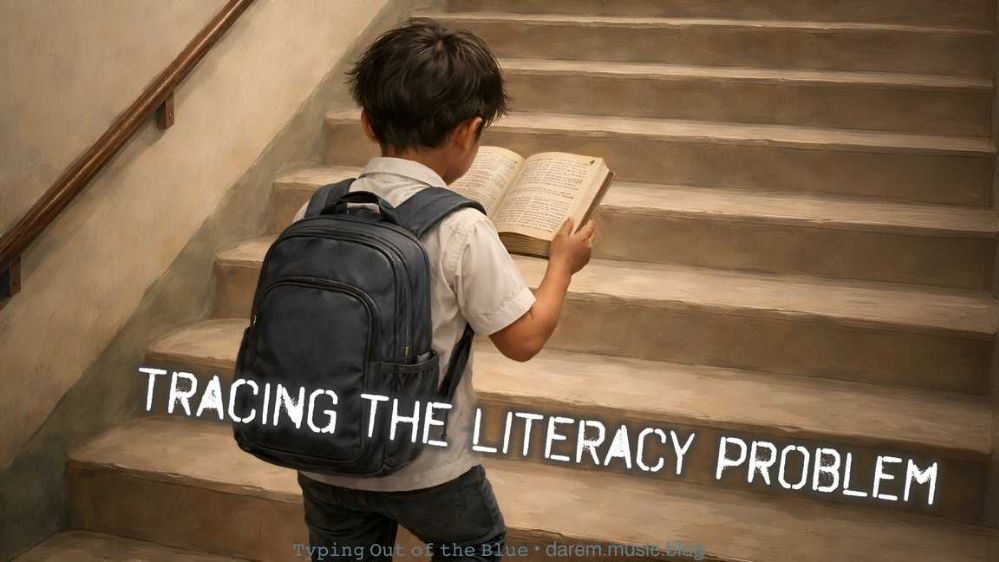
Tracing the Literacy Problem

Early reading gaps quietly grow into bigger learning problems.

EDCOM 2’s latest report, released on January 26, 2026, shows a clear pattern in Philippine education. Many students are progressing through school without strong reading and comprehension skills.

The issue begins early. In Grades 1 to 3, when reading foundations should be firmly built, many learners fall behind. These gaps often go unnoticed because students continue moving to the next grade and classes carry on as usual.

By Grade 7, the weakness becomes visible. High school assumes students can already read and understand longer texts. But many struggle. Lessons slow down. Teachers adjust. Students cope instead of learn.

By senior high, the outcome is clear. Very few students reach expected proficiency levels. This is not a sudden failure, but the result of years of unresolved learning gaps.

The data point to one conclusion: problems ignored early do not disappear. They simply resurface later, bigger and harder to fix.

⌨ ᴛʸᵖⁱⁿᵍ ᴏᵘᵗ ᵒᶠ ᵗʰᵉ ʙˡᵘᵉ ᵈᵃʳᵉᵐ ᵐᵘˢⁱᶜ ᵇˡᵒᵍ

Digital Albums by Darem Placer on Bandcamp
Listen. Support. Buy. Download.

Filipino Reading Left Behind

Math improved. Reading did not. A new study explains why many students are falling behind.

About 7 in 10 Grade 5 Students Struggle to Read

Released in December 2025, a new regional study shows that many Filipino elementary students are still struggling with basic reading.

The SEA-PLM 2024 study focused on Grade 5 students, usually 10 to 11 years old. At this level, students are expected to read and understand simple texts on their own.

The study found that about 7 in 10 Grade 5 students in the Philippines cannot do this well. What is worse is that reading scores have not improved much since 2019. The problem has stayed almost the same for five years.

Some students improved, but mostly those who were already doing well. Students who were struggling before are still struggling now. This means the learning gap is getting wider.

There is one clear contrast.

Math scores improved. More students reached the required level in mathematics in 2024. This shows that improvement is possible when there is focus and support.

So why is reading still weak?

The study points to poverty, language barriers, and lack of learning materials. Students from poor families continue to fall behind compared to those from wealthier homes. Reading needs time, practice, books, and support. Many students do not have these.

Reading is the base of learning. If a child cannot read well, other subjects also become hard.

This is not about blaming teachers or students. It is about making reading a top priority—early, consistent, and supported.

Because if students cannot read the first page, learning cannot move forward.

⌨ ᴛʸᵖⁱⁿᵍ ᴏᵘᵗ ᵒᶠ ᵗʰᵉ ʙˡᵘᵉ ᵈᵃʳᵉᵐ ᵐᵘˢⁱᶜ ᵇˡᵒᵍ

Digital Albums by Darem Placer on Bandcamp
daremplacer.bandcamp.com