
The Human Side of Saint Aloysius Gonzaga

A saint, a teenager, and a few surprisingly human stories.

Aloysius Gonzaga was a young Italian nobleman who lived in the late 1500s.

A few anecdotes, like the soft hum of a forgotten tune, make him seem less like a statue and more like a real person.

• As a child, he loved playing soldier. Since he spent time around military camps with his father, he picked up a few choice swear words from the troops. Years later, he still remembered and regretted it. Even saints, it turns out, were once ordinary children.

• His father dreamed of a powerful political future for him. Aloysius had other plans. Imagine being handed the keys to a noble estate and replying, “Thank you, but I’d rather join a religious order.”

• To become a Jesuit, he formally surrendered his inheritance to his younger brother. In today’s terms, it would be like walking away from a fortune and a guaranteed career to pursue a calling that paid nothing.

• During a plague epidemic, many people were afraid to go near the sick. Aloysius volunteered in hospitals and shelters. One tradition says he even carried an infected man on his back to receive treatment. Whether every detail is historically certain or not, his work among plague victims almost certainly led to the illness that killed him.

Like teenagers now, Saint Aloysius faced expectations from family, pressure about his future, and difficult choices about who he wanted to become. Growing up is not just about deciding what to do with our lives. It is also about deciding who we want to be.

Let’s keep learning the saints’ way—day by day.

⌨ ᴛʸᵖⁱⁿᵍ ᴏᵘᵗ ᵒᶠ ᵗʰᵉ ʙˡᵘᵉ ᵈᵃʳᵉᵐ ᵐᵘˢⁱᶜ ᵇˡᵒᵍ

Voices Across the Field • Darem Placer

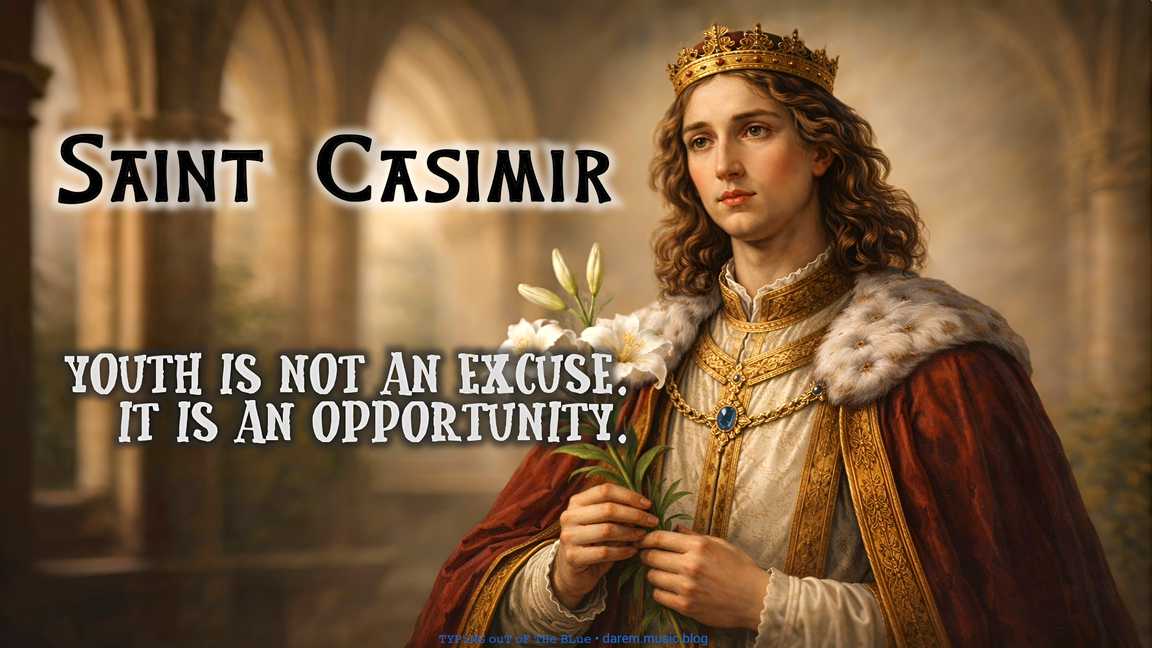
Saint Casimir

He died at twenty-five—but he did not waste his youth.

There is a quiet lesson in the life of Saint Casimir.

Casimir was born into royalty in 1458. Comfort was normal. Influence was expected. Power was within reach. He grew up in palaces, surrounded by politics and ambition.

He could have leaned into it. Many would have.

Instead, he leaned into prayer. Discipline. Charity.

He was offered the throne of Hungary while still young. The kind of opportunity people spend a lifetime chasing. But when politics turned complicated, he did not force his way forward. He stepped back rather than bend his conscience.

He chose restraint inside privilege. He chose integrity inside power.

He died at twenty-five. Which means everything he became, he became early.

There was no long retirement phase. No decades to repair mistakes. The habits he formed in youth shaped his whole life.

Many people treat youth as a waiting room. A phase to experiment without direction. A season to delay seriousness.

Casimir treated it as a foundation.

He did not wait to mature into virtue. He practiced it while young. He did not postpone discipline. He built it early. He did not assume faith was for later. He lived it now.

That is why Saint Casimir became a patron of youth. Not because he was young. But because he proved that young people are capable of depth, conviction, and self-control.

Youth is not an excuse.

It is an opportunity.

Let’s keep learning the saints’ way—day by day.

⌨ ᴛʸᵖⁱⁿᵍ ᴏᵘᵗ ᵒᶠ ᵗʰᵉ ʙˡᵘᵉ ᵈᵃʳᵉᵐ ᵐᵘˢⁱᶜ ᵇˡᵒᵍ
Saint • Darem Placer