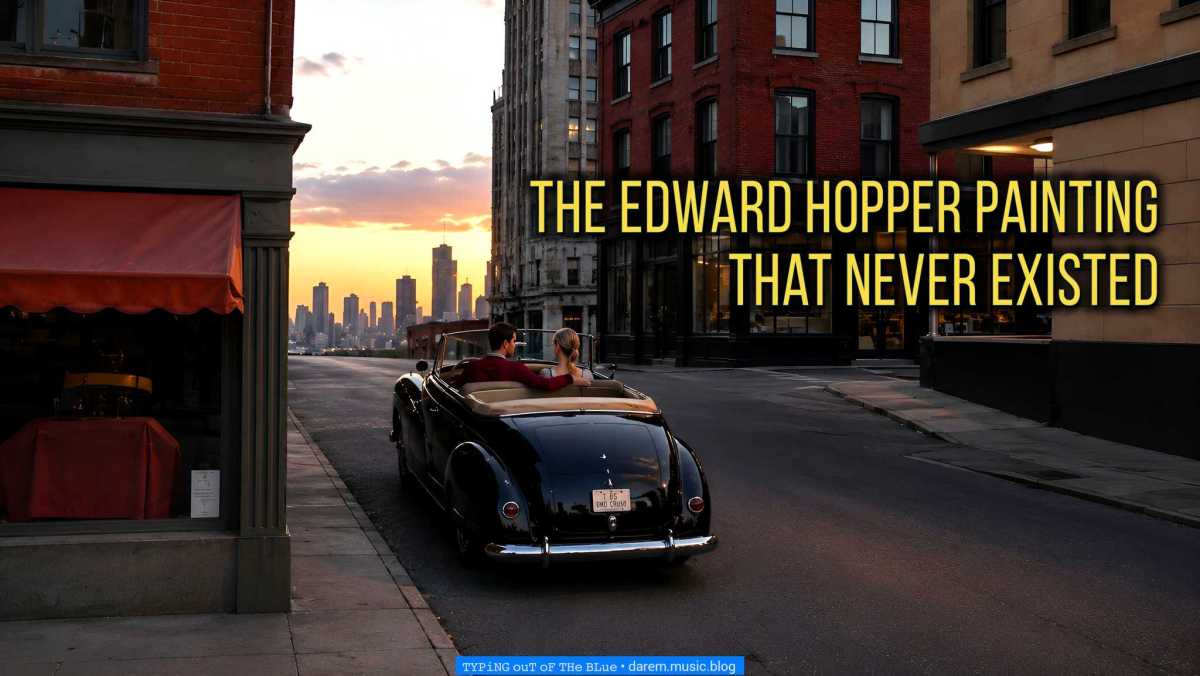
The Edward Hopper Painting That Never Existed

A look at the artwork, influences, and hidden details behind the album cover of OMD’s Crush.

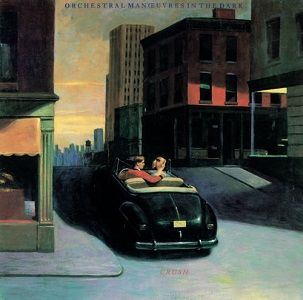
This is the cover art for Crush by the artist Orchestral Manoeuvres in the Dark. The cover art copyright is believed to belong to the label, Virgin Records, or the graphic artist(s), XL Design, painting by Paul Slater.

Some album covers look cool.

The cover of Crush by OMD feels different. It feels like a memory.

A quiet street. A fading sunset. A couple sitting in a car. Nothing dramatic is happening, yet it is impossible to look away.

The image was inspired by the paintings of Edward Hopper (1882-1967), whose work captured silence, nostalgia, and the beauty hidden in ordinary moments. His paintings often showed empty streets, quiet rooms, and people lost in thought. Decades later, they still feel timeless.

OMD originally wanted to use an actual Hopper painting, but the licensing costs were too high. Instead, artist Paul Slater was commissioned to create a new work inspired by Hopper’s style.

The result was something special: an Edward Hopper painting that never existed.

What I love most about this cover is its mood. It feels like the last minutes of summer. Like a drive home after a perfect day. Like a conversation you never wanted to end.

The city is empty, yet it never feels lonely. The couple is small against the buildings around them, but they remain the heart of the picture. Everything else quietly falls away.

There is even a hidden detail. Faces of the band members were subtly placed in some of the windows, like silent observers watching from the fading light.

Perhaps that is why the Crush cover resonates with me. Hopper’s paintings are filled with melancholy, nostalgia, and ordinary moments. Those same feelings often find their way into my music, not by intention, but by instinct. They simply appear, the way evening light settles onto an empty street.

More than an album cover, Crush feels like a scene from a film that was never made. It tells a story without saying a word.

And that’s why, after all these years, it remains one of my favorite album covers of all time.

⌨ ᴛʸᵖⁱⁿᵍ ᴏᵘᵗ ᵒᶠ ᵗʰᵉ ʙˡᵘᵉ ᵈᵃʳᵉᵐ ᵐᵘˢⁱᶜ ᵇˡᵒᵍ

Empty Piano Bar • Darem Placer • Full album. Press play.

A Life in Sadness and Sound

He never became a household name, but Adrian Borland left behind songs that still cut deep. This is about the sound he created, and the sadness he carried.

Remembering Adrian Borland

There must be a hole in my memory, because I can’t find what connects September with Adrian or The Sound. What I do find is the sadness that runs through his story, the kind that never needed a date to be remembered.

Adrian Borland was never a superstar, never the voice filling radio airwaves, never the sound blasting in stadiums. But his songs carried the kind of truth that outlives fame—urgent, aching, unforgettable.

The Sound and the silence of success

In 1985, The Sound released Heads and Hearts, the album that carried “Total Recall.” It never became a radio hit, but in the Philippines it turned into an underground anthem. In countless living room parties—with “mobile” DJs hauling speakers into cramped spaces, a lone strobe light flashing, and friends dancing… But behind that new wave of happiness was the sadness that Adrian himself could never escape. His music reached across oceans, even as he remained in the shadows.

Adrian Borland with The Sound—“Total Recall,” a haunting echo of memory and loss.


The battle inside

As the years went on, Adrian faced more than just disappointment. He struggled with depression, paranoia, and symptoms close to schizophrenia. He heard voices. He felt hunted by fears that never left him. Even when The Sound ended in 1988, he couldn’t stop making music. Solo albums followed, each one sounding more like diary pages turned into music.

Music was his medicine and his wound. It kept him alive, and at the same time, it drained him.

The last day

On April 26, 1999, Adrian was on his way to the studio to finish another solo album. But he never arrived. That morning, he stepped in front of a train in Wimbledon. He was only 41.

It was the end of a life marked by brilliance, struggle, and sadness too heavy to carry any longer.

The light that remains

Yet Adrian Borland’s story doesn’t stop on that track in Wimbledon. His voice, his words, his music—they’re still alive. Every time “Total Recall” plays, every time someone discovers one of his solo records, Adrian lives again in the sound he left behind.

The sadness may have taken his life, but the beauty he created out of it remains. And now I remember—September is Suicide Prevention Month—but there must be a hole in our memory.

𝚃𝚢𝚙𝚒𝚗𝚐 𝙾𝚞𝚝 𝚘𝚏 𝚝𝚑𝚎 𝙱𝚕𝚞𝚎 • 𝖽𝖺𝗋𝖾𝗆.𝗆𝗎𝗌𝗂𝖼.𝖻𝗅𝗈𝗀