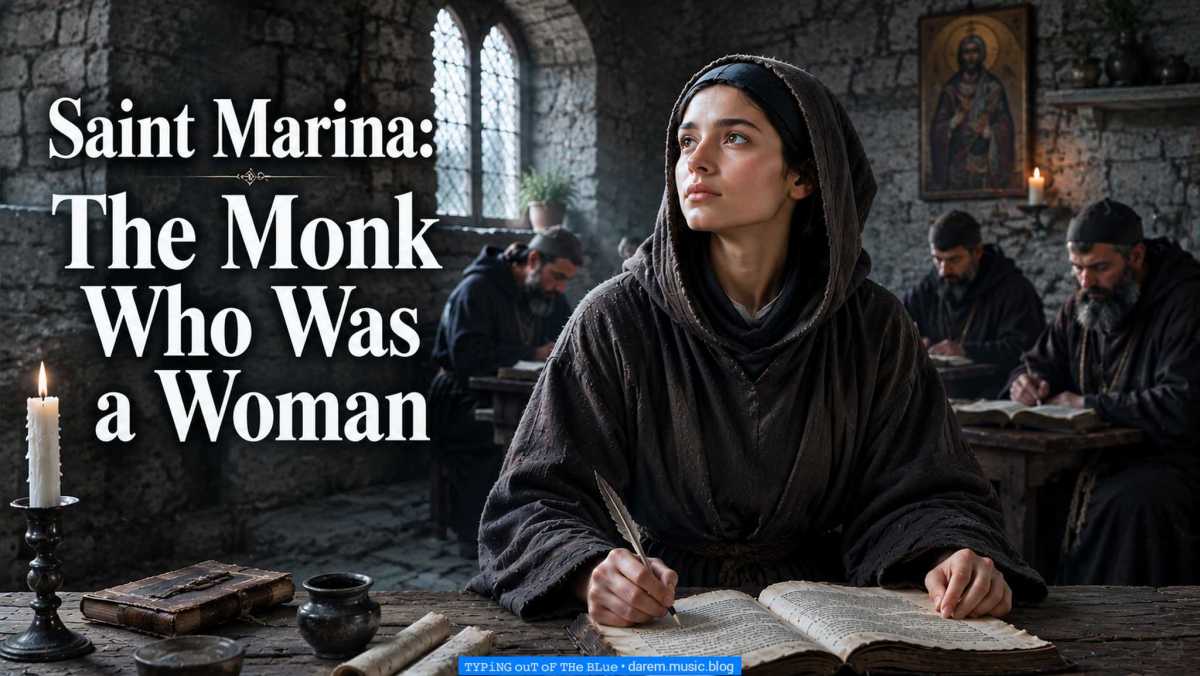
Saint Marina: The Monk Who Was a Woman

How did a woman come to be known as a monk?

According to ancient Christian tradition, Marina was believed to have lived during the early centuries of Christianity in the region of Lebanon, then part of the Eastern Roman Empire. She was the daughter of a devout Christian. After her mother’s death, her father chose to enter a monastery and dedicate his life to God. Unwilling to be separated from him, Marina disguised herself as a man and entered the monastery under the name Marinos.

For years, she lived among the monks without revealing her identity. She embraced a life of prayer, discipline, and simplicity. Those around her knew her only as a humble monk devoted to God.

The greatest trial of her life came when she was falsely accused of fathering a child. Rather than expose her secret and clear her name, Marina accepted the accusation in silence. She was expelled from the monastery and forced to live outside its walls.

Life became difficult. She endured shame, hardship, and rejection. Yet she never responded with anger or revenge. Instead, she cared for the child connected to the accusation and continued living a life of faith.

Years later, she was allowed to return to the monastery. The truth remained hidden until after her death, when the monks discovered that Marinos was a woman. Realizing her innocence and the depth of her sacrifice, they honored her memory and recognized her holiness.

Whether viewed as history, legend, or a blend of both, the story of Saint Marina has inspired Christians for centuries. It is remembered not because of power, fame, or miracles, but because of extraordinary humility.

In a world where people often rush to defend their reputation, Saint Marina’s story points to a different path. It suggests that character is not measured by what others say about us, but by how we choose to respond when life becomes unfair.

Let’s keep learning the saints’ way—day by day.

⌨ ᴛʸᵖⁱⁿᵍ ᴏᵘᵗ ᵒᶠ ᵗʰᵉ ʙˡᵘᵉ ᵈᵃʳᵉᵐ ᵐᵘˢⁱᶜ ᵇˡᵒᵍ

A Glimpse of Daylight • Darem Placer • Full album. Press play.

Saint Paul the Simple at 60

Some lives begin again later than expected. He shows how honesty, patience, and simple faith can still shape a strong life.

Paul the Simple lived in the 4th century in Egypt and became one of the early monks known today as the Desert Fathers.

According to traditional monastic stories, Paul was originally a farmer who discovered that his wife had been unfaithful. Instead of reacting with anger or revenge, he simply walked away from his former life. Already about 60 years old, he went into the desert to seek a life of prayer.

There he approached the well-known monk Anthony the Great and asked to become his disciple.

Traditional accounts say Anthony tested him first. Desert life was harsh, and many people came with enthusiasm but quickly left. Anthony reportedly tried to discourage Paul and gave him difficult tasks.

Paul remained calm and patient. He did not argue or complain. Because of that attitude, Anthony eventually accepted him.

The early monks described him as “simple,” not because he lacked intelligence, but because he had a straightforward and honest heart. He followed instructions without pride or complicated reasoning. Some of the ancient stories even say Anthony believed he had deep spiritual clarity despite having little formal learning.

Like many Desert Father accounts, these stories were preserved mainly to teach spiritual lessons.

Today, the example of Saint Paul the Simple can still be understood in a very practical way. Life becomes complicated when pride, arguments, and the need to prove ourselves take over. His story suggests another approach: stay calm, be honest, and simply do what is right. It may look ordinary, but that kind of consistent faithfulness often holds a life together.

Let’s keep learning the saints’ way—day by day.

⌨ ᴛʸᵖⁱⁿᵍ ᴏᵘᵗ ᵒᶠ ᵗʰᵉ ʙˡᵘᵉ ᵈᵃʳᵉᵐ ᵐᵘˢⁱᶜ ᵇˡᵒᵍ

Alone With a Piano • Darem Placer
When love prefers silence.