Saint Paul the Simple at 60

Some lives begin again later than expected. He shows how honesty, patience, and simple faith can still shape a strong life.

Paul the Simple lived in the 4th century in Egypt and became one of the early monks known today as the Desert Fathers.

According to traditional monastic stories, Paul was originally a farmer who discovered that his wife had been unfaithful. Instead of reacting with anger or revenge, he simply walked away from his former life. Already about 60 years old, he went into the desert to seek a life of prayer.

There he approached the well-known monk Anthony the Great and asked to become his disciple.

Traditional accounts say Anthony tested him first. Desert life was harsh, and many people came with enthusiasm but quickly left. Anthony reportedly tried to discourage Paul and gave him difficult tasks.

Paul remained calm and patient. He did not argue or complain. Because of that attitude, Anthony eventually accepted him.

The early monks described him as “simple,” not because he lacked intelligence, but because he had a straightforward and honest heart. He followed instructions without pride or complicated reasoning. Some of the ancient stories even say Anthony believed he had deep spiritual clarity despite having little formal learning.

Like many Desert Father accounts, these stories were preserved mainly to teach spiritual lessons.

Today, the example of Saint Paul the Simple can still be understood in a very practical way. Life becomes complicated when pride, arguments, and the need to prove ourselves take over. His story suggests another approach: stay calm, be honest, and simply do what is right. It may look ordinary, but that kind of consistent faithfulness often holds a life together.

Let’s keep learning the saints’ way—day by day.

⌨ ᴛʸᵖⁱⁿᵍ ᴏᵘᵗ ᵒᶠ ᵗʰᵉ ʙˡᵘᵉ ᵈᵃʳᵉᵐ ᵐᵘˢⁱᶜ ᵇˡᵒᵍ

Alone With a Piano • Darem Placer
When love prefers silence.

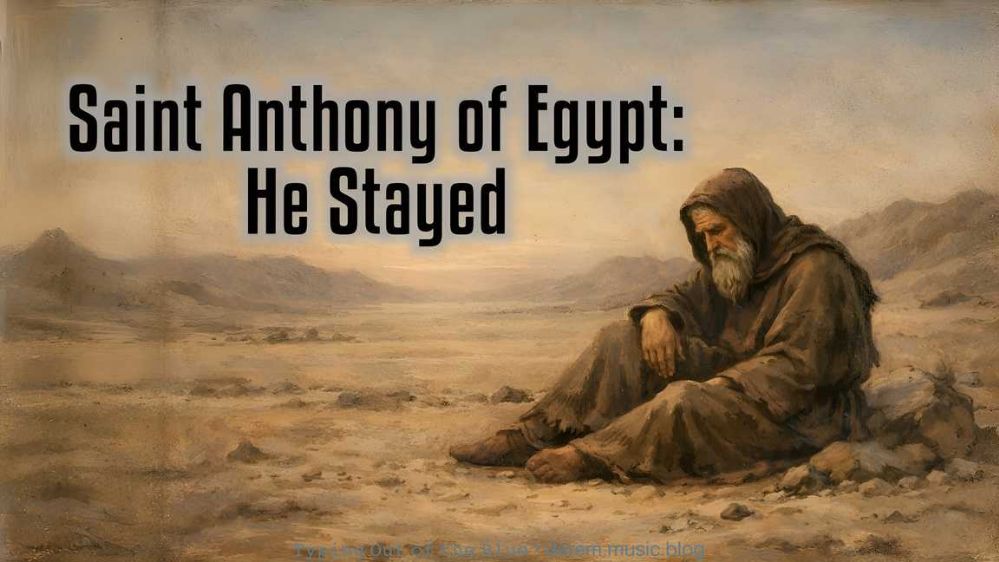
Saint Anthony of Egypt: He Stayed

Strength is not always found in rescue. Sometimes it is found in staying.

Anthony lived in Egypt as a hermit during the late 3rd and early 4th century. Born around 251, he left his wealth and chose a life in the desert, away from cities and comfort, to live in prayer and discipline. Much of what we know about his life comes from the Life of Anthony, written by Athanasius of Alexandria, which records both his way of living and the struggles he faced in solitude.

One day, after years in the desert, Anthony was badly attacked by temptations. The stories describe it as demons beating him, mocking him, trying to break him. Literal or symbolic, same point. He was left half-dead on the ground.

Later, when he recovered, he asked God something very human: “Where were You? Why didn’t You stop this?”

The answer he sensed was simple: “I was here. I was watching your struggle.”

No explanation. Just that.

The lesson isn’t “God let him suffer.” The lesson is sharper: growth wasn’t in the rescue. It was in staying.

Anthony didn’t leave the desert after that. He stayed. That was the point.

When life doesn’t interrupt the struggle, maybe it’s because the struggle itself is doing the work.

Not everything hard is a sign to quit. Some hard things are shaping us quietly, while no one’s watching.

Let’s keep learning the saints’ way—day by day.

⌨ ᴛʸᵖⁱⁿᵍ ᴏᵘᵗ ᵒᶠ ᵗʰᵉ ʙˡᵘᵉ ᵈᵃʳᵉᵐ ᵐᵘˢⁱᶜ ᵇˡᵒᵍ
Digital Albums by Darem Placer on Bandcamp
Listen. Support. Buy. Download.