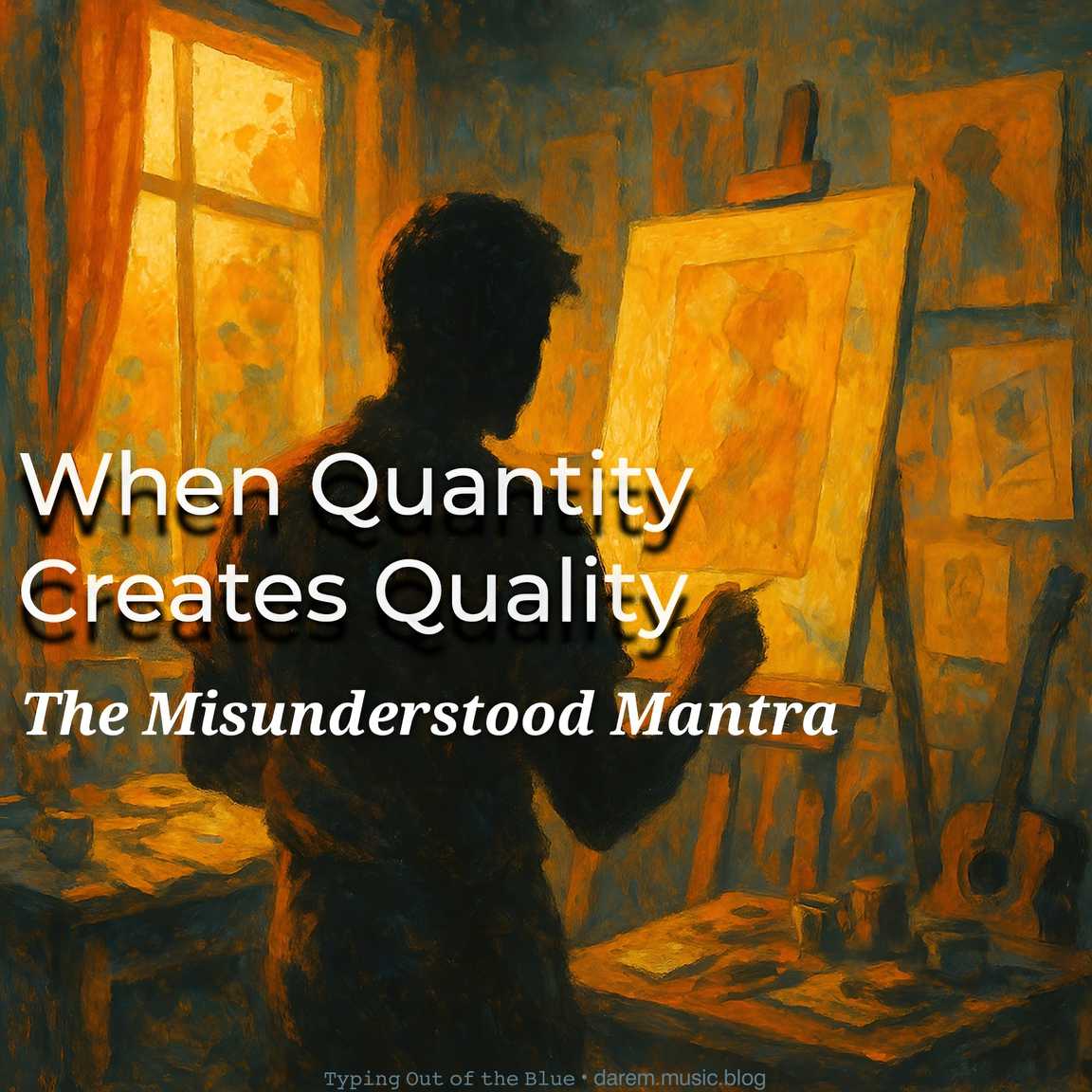
The Misunderstood Mantra
People love to say, “Quality over quantity.” It sounds wise, especially in business or offices where mistakes cost money. But in art, that saying can kill your growth.
Artists don’t find quality by waiting for inspiration—they find it by showing up, again and again. Quantity is the grind that reveals the gold. Every sketch, draft, riff, or post is part of the training. It’s not about perfection—it’s about becoming.
In factories, quantity means output. In art, it means expression. Because in art, every piece has something to do with feelings—and feelings aren’t meant to be polished. Even mistakes can become part of the beauty. There are no wrong notes when they come from truth.
Mainstream musicians, for example, write and record thousands of songs a year. But the music label decides which ones “feel commercial.” If nothing fits the market, those songs stay locked away. Some artists wait years without a release—not because they stopped creating, but because the system measures quality by sales, not soul.
That’s where independent artists stand different. They release when they’re ready, not when the boardroom approves. They create freely, without filters, without compromise.
But now, the problem isn’t just with the artists—it’s with us, the listeners, the art lovers. We stopped listening deeply. We started streaming whatever the algorithm served. The corporate world learned that, and turned art into product. The more people obey the charts, the more real art fades into silence.
Because when feelings are no longer the measure, and numbers take over, music loses its soul—and we lose a part of ours too.
So the next time someone tells you to slow down, tell them this:
“You can’t create perfection before creation itself. You can’t edit what doesn’t exist.”
In the end, artists just keep creating—because emotion has no finish line. The only limit of feeling is death. Every work, even one drawn on scratch paper, is still art. Because art isn’t about where it hangs—it’s about who felt enough to make it.
⌨ ᴛʸᵖⁱⁿᵍ ᴏᵘᵗ ᵒᶠ ᵗʰᵉ ʙˡᵘᵉ ᵈᵃʳᵉᵐ ᵐᵘˢⁱᶜ ᵇˡᵒᵍ