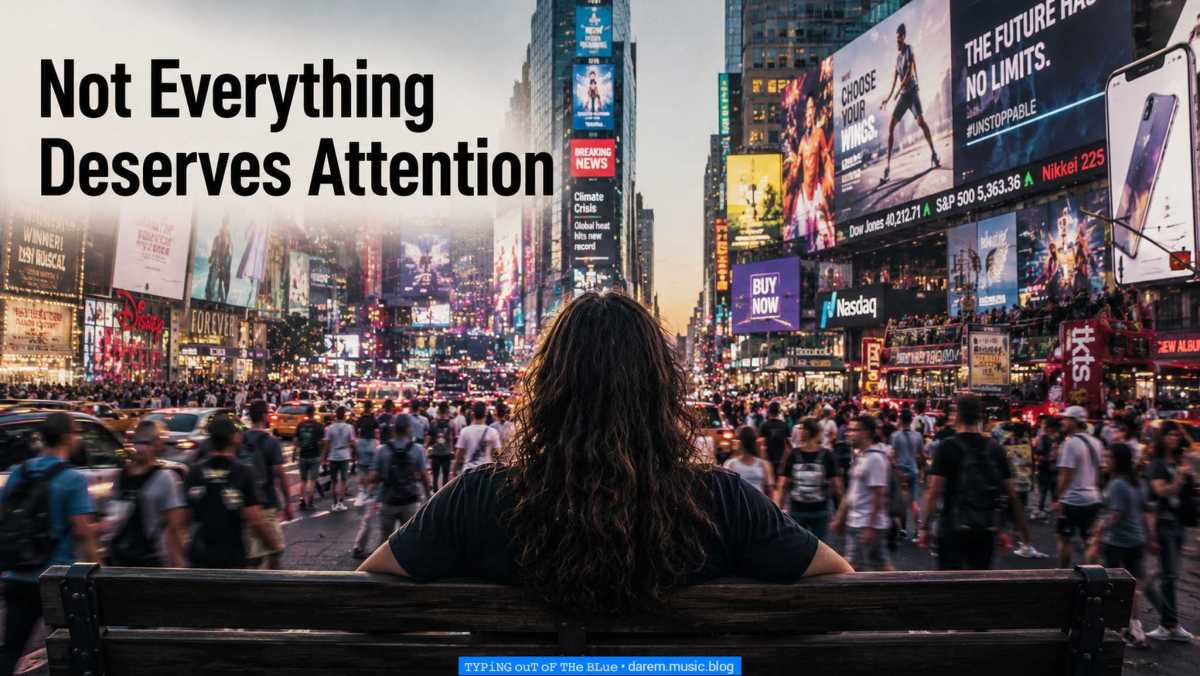
Not Everything Deserves Attention

Some things deserve our attention. Many don’t. Knowing the difference can make life a little lighter.

Many times, we give our attention to things that never earned it.

Random opinions.

Not every comment is helpful. Some are just noise.

Trends that don’t match our values.

Just because everyone is going somewhere doesn’t mean we need to follow.

The pressure to impress strangers.

Most people are too busy living their own lives to think about ours for very long.

Comparisons.

Someone else’s progress is not a fair way to measure our own.

Every thought that enters our minds.

Just because a thought shows up doesn’t mean it deserves our attention.

Petty insults.

Many insults reveal more about the speaker than the target.

The need to win every argument.

Peace is often worth more than the last word.

Doomscrolling and outrage bait.

Entire industries compete for our attention. We don’t have to give it to them.

Perfectionism.

A finished project is usually more valuable than a perfect one that never gets done.

Fear of looking foolish while learning.

Nobody starts out good at something.

Envy.

It steals enjoyment from things we already have.

Gossip.

Not every piece of information is worth carrying around.

Old mistakes that have already taught the lesson.

Learn from them. Then move on.

The expectation that everyone will understand us.

Some people won’t get our choices or our path. That’s normal.

Life is noisy enough already. The challenge is knowing which sounds belong and which ones are only noise.

⌨ ᴛʸᵖⁱⁿᵍ ᴏᵘᵗ ᵒᶠ ᵗʰᵉ ʙˡᵘᵉ ᵈᵃʳᵉᵐ ᵐᵘˢⁱᶜ ᵇˡᵒᵍ

Ego

A simple look at what ego really is, why it stays, and how it quietly affects everyday life.

For those who’d rather listen.

Ego is the voice inside a person that keeps saying, “Me first.” It is the part that wants to be right, to be seen, to be praised, to win. It is not always loud. Sometimes it hides behind good actions. Sometimes it even wears the costume of kindness. But at its core, ego is the strong attachment to self image.

In psychology, ego just means your sense of self. It is the part that knows you are you. It is not always pride. The problem starts when that sense of self becomes too big and too sensitive.

Ego is hard to remove because it protects something fragile. Deep inside, people want to feel important and safe. Ego gives that feeling. It says, “If you admit you are wrong, you lose value.” It says, “If others shine, you fade.” So people hold on to it. It becomes part of their identity. Over time, ego feels normal. It feels like survival.

The bad effects are quiet but heavy. Ego damages relationships because it refuses to listen. Ego kills conversations. While the other person is still speaking, you are already rehearsing your reply. It turns small disagreements into battles. It makes people defensive instead of honest. In work, ego blocks growth because a person will not accept correction. In families, it builds walls. In society, it creates division. Ego also steals peace. A person with a strong ego is always comparing, competing, or proving something. That is tiring.

Removing ego does not mean removing confidence. It means learning to separate worth from pride. People can start with small habits. Admit when you are wrong. Listen without planning your reply. Celebrate someone else’s success without comparing it to yours. Ask yourself, “Am I doing this to serve or to be seen?” Spend quiet time alone without showing your life online. Practice gratitude. Gratitude weakens ego because it reminds a person that not everything is earned alone.

Ego does not disappear in one day. It shrinks through awareness. Each time a person chooses humility over pride, ego loses power. Each time someone chooses understanding over winning, something inside becomes lighter.

The goal is not to become invisible. The goal is to become free.

⌨ ᴛʸᵖⁱⁿᵍ ᴏᵘᵗ ᵒᶠ ᵗʰᵉ ʙˡᵘᵉ ᵈᵃʳᵉᵐ ᵐᵘˢⁱᶜ ᵇˡᵒᵍ