The Return of Saint Apollinaris

He knew what awaited him, yet his work was far from over.

Apollinaris is remembered as the first bishop of Ravenna, in what is now northern Italy. Much of what is known about his life comes from early Christian tradition. He is said to have come from Antioch and to have been a disciple of Saint Peter, who sent him to Ravenna to preach the Gospel. He is usually placed in the first century, although the exact period of his life remains uncertain.

Being a Christian preacher in those days was not exactly a safe calling. Bishop Apollinaris gained followers in Ravenna, but his growing influence also brought trouble. He was beaten, driven out of the city, and persecuted more than once.

Still, he returned.

By then, he already knew the cost. He had experienced the violence himself, yet he continued his mission among the people he served.

Eventually, the violence caught up with him. He was severely beaten during another persecution. This time, he did not recover. He survived for several days before dying from his injuries.

It was not because they could not kill him. He returned even though he knew they could, choosing not to abandon the faith he preached and the people he had been sent to serve.

Today, we also have things we need to finish. Work we have left undone, promises we still need to keep, and people who depend on us. We may walk away when things get difficult, but if something is important enough, we can always find our way back and finish what we started.

Let’s keep learning the saints’ way—day by day.

⌨ ᴛʸᵖⁱⁿᵍ ᴏᵘᵗ ᵒᶠ ᵗʰᵉ ʙˡᵘᵉ ᵈᵃʳᵉᵐ ᵐᵘˢⁱᶜ ᵇˡᵒᵍ

Still Air•Darem Placer

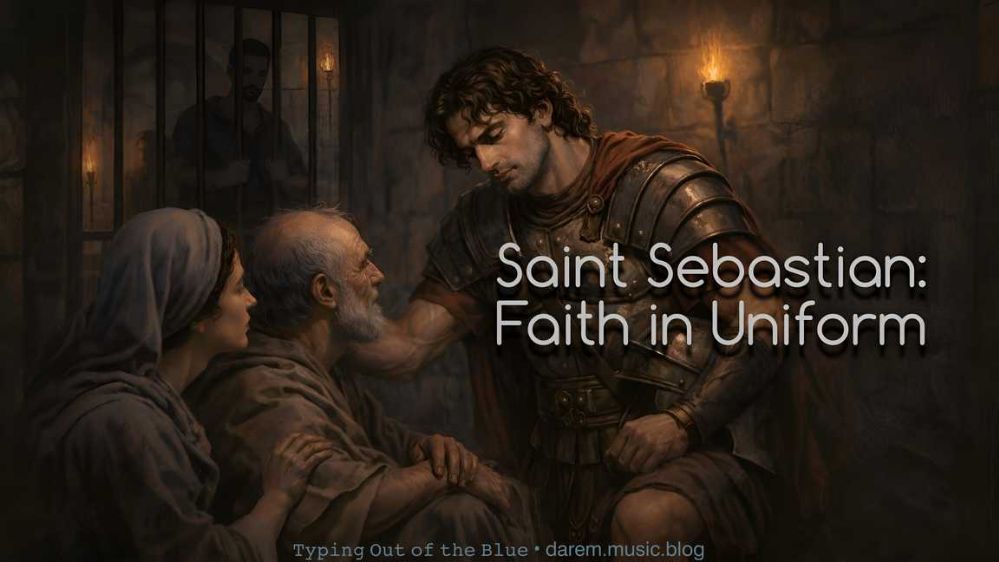
Saint Sebastian: Faith in Uniform

A Roman soldier who lived his faith quietly inside a hostile system—and stood firm when silence was no longer honest.

Sebastian lived in the late 3rd century, in Rome, during the reign of Emperor Diocletian. It was a dangerous time to be Christian. The empire demanded loyalty, and faith could mean death. Sebastian was a Roman soldier, trusted and respected. Outwardly, he served the empire. Quietly, he lived as a Christian.

While serving as a soldier, Sebastian used his position to help persecuted Christians. He visited prisoners. He encouraged them to remain faithful. He strengthened those who were afraid. He did not preach in public or challenge authority openly. He worked quietly, helping from within. To most people, he was just another officer. To suffering Christians, he was hope moving unseen.

In that sense, he was like an undercover angel. Present, helpful, unnoticed.

When his Christian identity was discovered, Diocletian ordered his execution. Sebastian was tied to a post and shot with arrows. Believed to be dead, his body was left behind.

He survived.

A woman named Irene found him, cared for his wounds, and nursed him back to health. At that point, escape would have been the reasonable choice. Silence would have meant survival.

Sebastian chose otherwise.

After recovering, he returned and confronted the emperor directly. He spoke plainly about injustice and persecution. There was no spectacle and no attempt to save himself. Only truth.

This time, he was beaten to death. No arrows. No delay. That was the end of his life.

Saint Sebastian’s courage did not begin loudly. It began in hidden faithfulness, in doing good inside a system that opposed him. When the moment came, he did not retreat. His life speaks to anyone trying to live with integrity while working within flawed systems.

He did not seek martyrdom. He simply refused to live half-true.

Let’s keep learning the saints’ way—day by day.

⌨ ᴛʸᵖⁱⁿᵍ ᴏᵘᵗ ᵒᶠ ᵗʰᵉ ʙˡᵘᵉ ᵈᵃʳᵉᵐ ᵐᵘˢⁱᶜ ᵇˡᵒᵍ
Digital Albums by Darem Placer on Bandcamp
Listen. Support. Buy. Download.