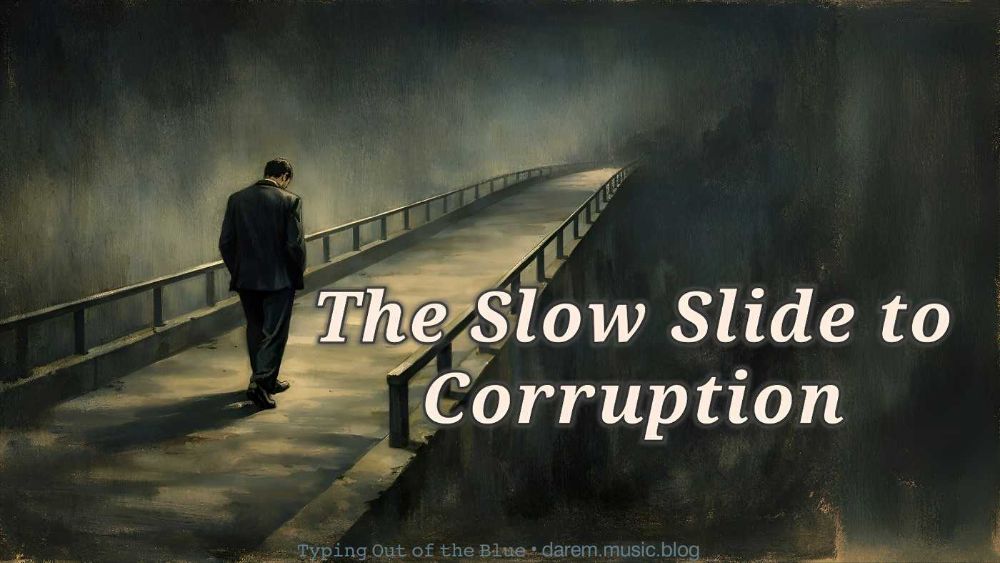
Most people who were once decent and later end up convicted of corruption did not start with “I want to steal.” It started with small changes that were barely noticeable.
First: Moral fatigue
At the beginning, principles are strong. But you are inside a broken system every day. You are constantly pulled by “this is how things work,” “you will not move forward if you do not cooperate,” “we will deal with that later.” Conscience does not break instantly. It simply gets tired of fighting.
Second: Power becoming normal
When you get used to access, favors, and shortcuts, what used to be wrong starts to feel normal. You stop asking if something is right. You start asking if it is safe. That is where the question inside the head changes.
Third: The excuse loop
This is the most dangerous part. “It is for the project.” “It will go back to the people anyway.” “Others are worse than me.” You stop calling it a wrongdoing. You start calling it a plan. When your words change, it is already over.
Fourth: Lifestyle pull
When your income rises, the fear of falling rises too. There are staff, family, image, expectations. Principles slowly become a luxury. Fear of loss becomes stronger than fear of doing wrong.
Fifth: The belief that nothing will happen
Nothing happens at first. No arrest. No case. So you think, “Maybe this is fine.” Until it reaches a point where it is too big, too visible, impossible to deny. That is when conviction finally comes. Too late.
Most corrupt people did not fall. They slid. Slowly. Comfortably. Explaining themselves the whole way down.
That is why hidden corruption is sometimes more frightening than loud evil. Nothing loud. Nothing pushed back. Just the slow change of conscience.
And when they are finally convicted, people say, “Sayang. That person used to be decent.” That is true. But what is truer is this: they did not protect being decent every day.
People do not suddenly become bad. They simply keep allowing what is wrong.
This is not only about politics. Wherever you look, the pattern is the same. In business, religion, media, schools, even in ordinary work. The accountant who said, “just this one time.” The teacher who got tired and said, “this is good enough.” The manager who signed without asking anymore. The creative who chose to sell out first, integrity later.
It does not start with being bad. It starts with exhaustion, with fear, with comfort.
⌨ ᴛʸᵖⁱⁿᵍ ᴏᵘᵗ ᵒᶠ ᵗʰᵉ ʙˡᵘᵉ ᵈᵃʳᵉᵐ ᵐᵘˢⁱᶜ ᵇˡᵒᵍ