Saint John of God—A Saint Who Begged for the Sick

A wandering soldier became a helper of the poor and sick. He begged in the streets so others could heal.

John was not originally a saintly man. His early life looked more like the story of a wanderer than a holy figure.

He was born in 1495 in Portugal. As a young man he left home and spent years traveling across Spain and North Africa. He worked as a shepherd, soldier, and laborer. His life had no clear direction.

For a long time he lived like many restless people of his time, moving from one place to another looking for work.

Everything changed in 1539 in the city of Granada, Spain.

One day he heard a powerful sermon preached by John of Ávila. The message struck him deeply. Witnesses say he began publicly crying, repenting, and asking God for mercy.

People thought he had lost his mind.

He was confined in a hospital for the mentally ill. While there, he saw how badly patients were treated. Many were neglected or abused. That experience stayed with him.

When he was released, he decided to dedicate his life to caring for the poor and the sick.

Instead of preaching, he started helping people directly.

He carried poor and sick people from the streets to safety. He went to the markets begging for food and medicine for them. Eventually, he rented a small house where the poor and sick could rest and receive care.

As more people came, the small house slowly developed into an organized place of care for the poor of Granada, one of the early models of a hospital dedicated especially to those who had no one to help them.

Little by little, others joined him.

His work eventually inspired a religious community called the Brothers Hospitallers of Saint John of God, dedicated to caring for the poor who were sick. Today the order runs hospitals and medical centers in many countries.

John died in 1550 after years of exhausting service.

A well-known story says he died after trying to rescue a drowning man from a river. Whether every detail is exact or not, the story reflects the kind of life he lived. He was always helping someone.

He was later canonized by the Church and is now remembered as the patron saint of hospitals, nurses, and the sick.

Saint John’s life carries a simple message that still speaks today.

Holiness does not always start with perfection. Sometimes it begins when a person who once wandered finally chooses to spend the rest of his life helping others heal.

Let’s keep learning the saints’ way—day by day.

⌨ ᴛʸᵖⁱⁿᵍ ᴏᵘᵗ ᵒᶠ ᵗʰᵉ ʙˡᵘᵉ ᵈᵃʳᵉᵐ ᵐᵘˢⁱᶜ ᵇˡᵒᵍ

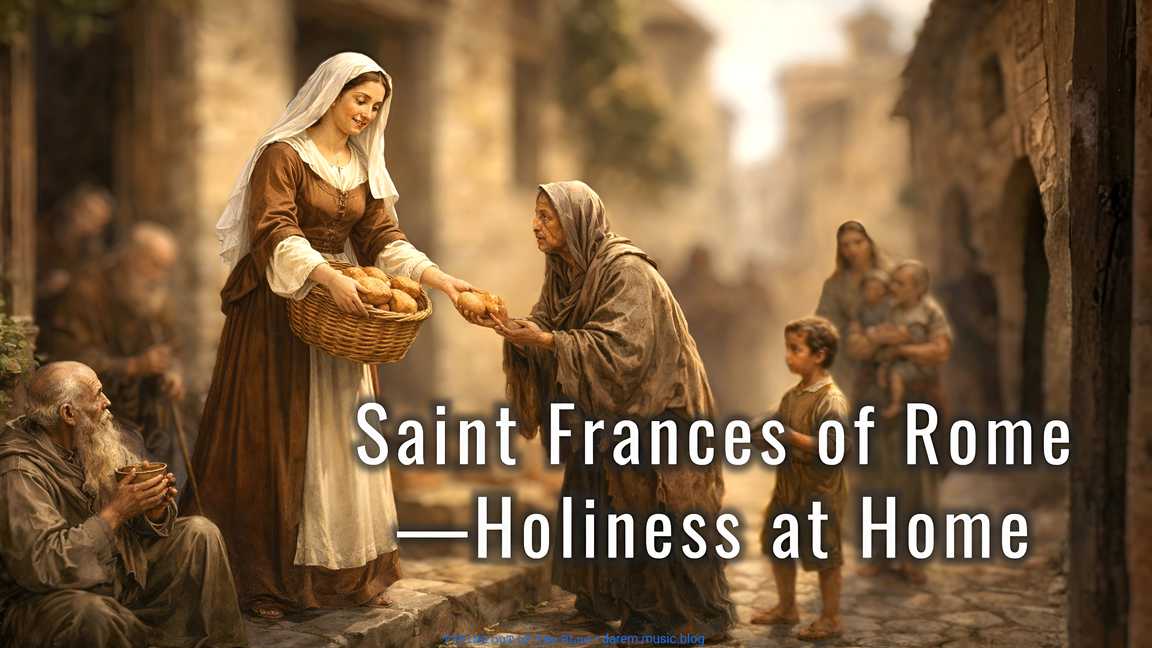
Saint Frances of Rome—Holiness at Home

She served the poor, endured hardship, and showed that holiness can grow in family life.

Frances of Rome (1384–1440) lived in a time when Rome itself was unstable. Wars, political struggles, and disease made everyday life uncertain. Yet her story is not about dramatic miracles or grand speeches. It is about faith lived in ordinary life.

Frances was born into a noble Roman family. As a young girl, she wanted to become a nun. But in those days families often arranged marriages, and at the age of thirteen she married Lorenzo Ponziani, a Roman nobleman.

Instead of rejecting that life, she slowly turned her home into a place of service.

During periods of famine and plague in Rome, Frances used the family’s wealth to feed the poor. She visited the sick, opened their house to those who had nothing, and spent long hours helping people suffering in the streets. Her charity gradually became well known in the city.

Not everyone appreciated this.

Some relatives believed she was giving away too much. At one point, when she emptied the family storehouse of grain to help the poor, her father-in-law became angry. Tradition says the grain later multiplied. Whether understood as miracle or memory, the story reflects how boldly she placed compassion above social expectations.

Her life was not easy.

Rome was shaken by wars and political conflicts during her lifetime. Her husband was wounded and later taken prisoner. Two of her children died young. Instead of withdrawing from the world, Frances continued helping others through the hardships around her.

Later in life she formed a community of women connected to the Benedictine tradition. They were not cloistered nuns. They lived in their homes but followed a shared spiritual rule of prayer and service. This community later became known as the Oblates of Saint Benedict at Tor de’ Specchi.

One detail often mentioned in her story is that she was believed to see her guardian angel guiding her during difficult moments. Whether taken literally or symbolically, the message is simple: she lived with a constant awareness of God’s presence.

After her husband died, Frances eventually joined the community she had founded and spent her remaining years in prayer and service.

She died in 1440.

Today she is remembered as Saint Frances of Rome, patron saint of widows and motorists. The motorists connection came centuries later because of the tradition that her guardian angel guided her safely on journeys.

Her story carries a simple lesson.

She did not run away from the world. She stayed inside it. Marriage, family, loss, responsibility, and city life were all part of her path.

In a world that often separates spiritual life from ordinary life, Saint Frances quietly shows that the two can exist in the same place.

Sometimes holiness looks less like escape and more like faithfulness in the middle of everyday life.

Let’s keep learning the saints’ way—day by day.

⌨ ᴛʸᵖⁱⁿᵍ ᴏᵘᵗ ᵒᶠ ᵗʰᵉ ʙˡᵘᵉ ᵈᵃʳᵉᵐ ᵐᵘˢⁱᶜ ᵇˡᵒᵍ
People•Darem Placer