
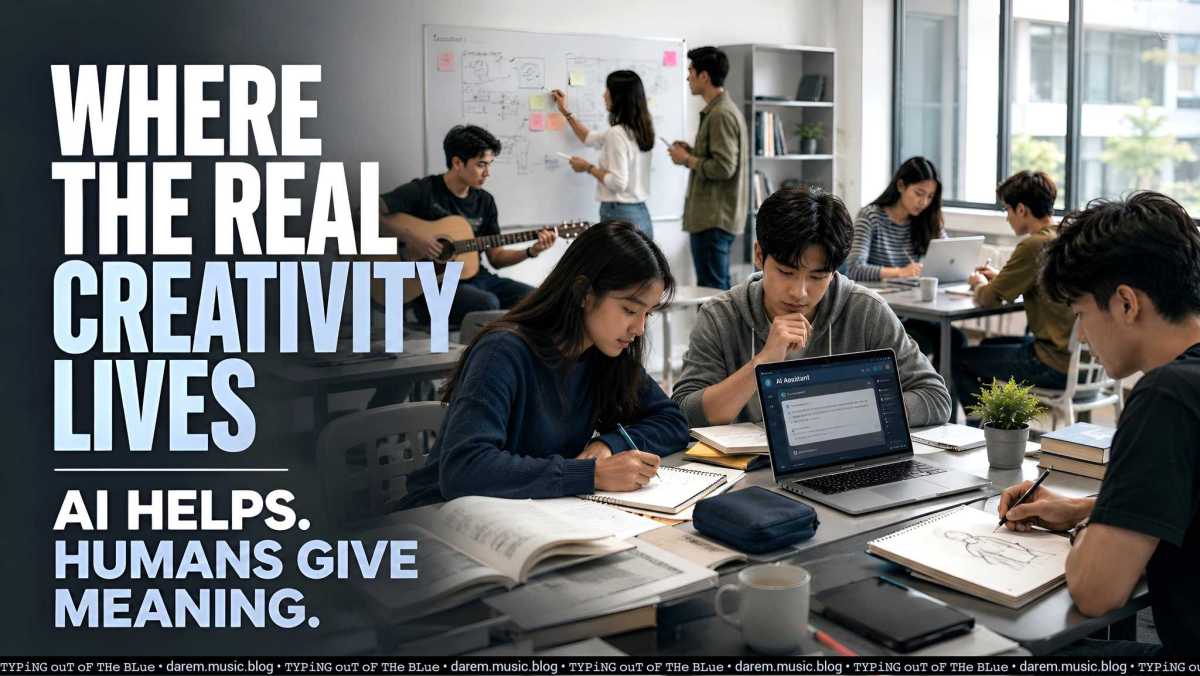
The more useful conversation is not “How do we catch people using AI?” but “What should learning look like now that AI exists?”
The irony is pretty funny: humans built AI, gave it access to an enormous amount of human knowledge, taught people how to use it, then some institutions basically said, “Now hide that you used it.” That feels less like education and more like trying to keep a horse out of a car race.
AI is very good at putting old knowledge together in new ways. It can connect things that were previously separate, suggest variations, spot patterns, improve an existing idea, and create combinations that can feel genuinely fresh.
But AI doesn’t have a personal life, physical experiences, memories of being a child, heartbreak, hunger, stage fright, or the experience of hearing a particular song at a particular moment.
That’s where human creativity gets interesting.
New ideas can come from human experience and imagination meeting what already exists. AI can help with that process, but humans still give ideas their meaning and purpose, shaped by personal experience.
For education, I’d rather see something like this:
“Use AI to explore three possible explanations. Check its claims against sources. Find something it got wrong. Add an observation or idea of your own. Explain why you agree or disagree. Then defend your conclusion.”
Now the student isn’t merely producing text. They’re thinking.
That’s what schools should actually be measuring.
A teacher could even say:
“You may use AI. But you must be able to explain every major idea in your work.”
Some AI systems can even add hidden marks to their generated text, making it possible to check whether a piece of text may have come from AI. But that is still not the same as proving who actually wrote the ideas.
If a student submits a beautiful essay generated by AI but cannot explain what it means, the problem becomes obvious without needing some secret watermark detective squad.
AI isn’t going away. Trying to make education completely AI-free is probably fighting the direction of technology itself. The better goal is not to stop students from using AI. It’s to teach them how to use it without becoming dependent on it.
AI should be the workbench, not the brain.
And there’s a nice musical parallel here.
A musician doesn’t invent every note in existence. The notes are old. The scales are old. The instruments are old. Even many chord progressions are old.
But put those old things together through a particular human mind, at a particular moment, and suddenly there’s music that didn’t exist before.
That’s where the real creativity lives.
⌨ ᴛʸᵖⁱⁿᵍ ᴏᵘᵗ ᵒᶠ ᵗʰᵉ ʙˡᵘᵉ ᵈᵃʳᵉᵐ ᵐᵘˢⁱᶜ ᵇˡᵒᵍ