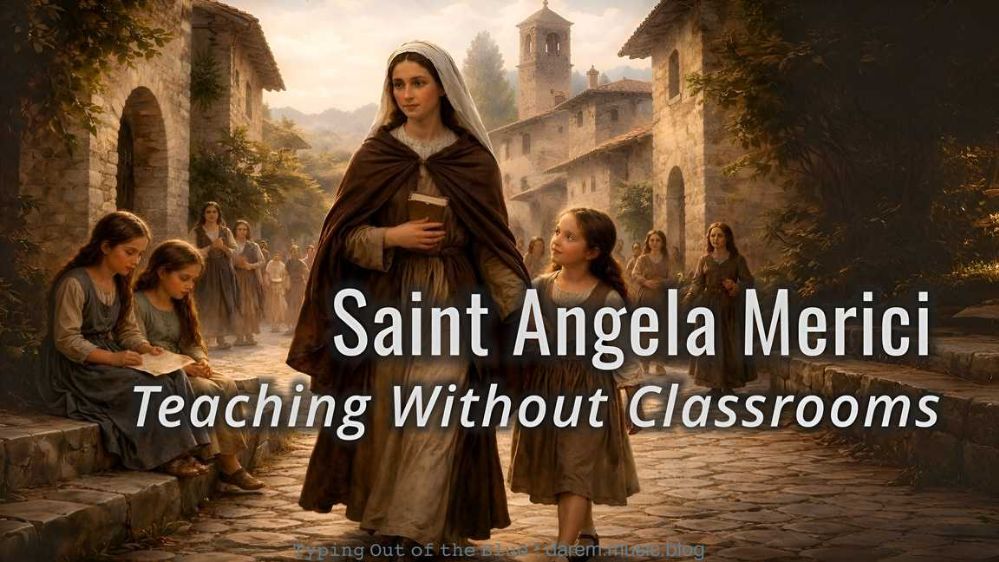
Angela Merici was a laywoman, educator, and spiritual leader who lived in northern Italy during the late fifteenth and early sixteenth centuries. She was born in 1474 in Desenzano del Garda, near Brescia, at a time when education for girls was rare and women’s roles were tightly limited.
She was orphaned young. That shaped everything. She lived with relatives and worked like ordinary women of her time. No protected life. She knew hunger, instability, and depending on others. She did not grow up comfortable. That grounded her deeply.
As a young woman, she joined the Third Order of Saint Francis. That meant choosing simplicity, prayer, and service while still living in society. She did not enter a convent. She stayed among people. She walked the streets. She watched how families lived. She learned from real life.
She walked from town to town, visiting homes. She paid special attention to families with young girls who were neglected, uneducated, or drifting. There were no formal classrooms. Teaching happened in houses, courtyards, wherever there was space. She taught basic reading, Christian life, and how to live with dignity.
She avoided titles and authority. Even when people already saw her as a leader, she insisted on being a servant. She did not command. She guided. She mentored women one by one.
She also made pilgrimages on foot, including a difficult journey to Rome. During that trip, she temporarily lost her sight. People thought she would stop. She continued anyway. When she returned home, her sight came back. She never made a story out of it. Life went on.
When she founded the Company of Saint Ursula, her instructions were concrete and unusual for the time:
• remain in your own homes
• continue your normal work
• live a disciplined prayer life
• focus on forming young girls
How she lived, simply put:
She lived ordinary days.
She walked with people.
She taught quietly.
She led without control.
She died without fame.
And yet, centuries later, schools exist because Saint Angela chose that way of living.
Nothing theatrical. Just faith practiced daily, until it changed history.
Let’s keep learning the saints’ way—day by day.
⌨ ᴛʸᵖⁱⁿᵍ ᴏᵘᵗ ᵒᶠ ᵗʰᵉ ʙˡᵘᵉ ᵈᵃʳᵉᵐ ᵐᵘˢⁱᶜ ᵇˡᵒᵍ