
Turning 80? Don’t Miss This ₱10,000 Government Cash Gift

A practical guide that could help your family avoid missing an important benefit.

Many Filipinos know about the ₱100,000 cash gift for centenarians. But here’s something many families still don’t know: you don’t have to wait until you’re 100 years old.

Under the Expanded Centenarians Act (Republic Act No. 11982), qualified Filipino senior citizens can receive government cash gifts on certain milestone birthdays.

How much is the cash gift?

Qualified Filipino citizens may receive:

  • 80 years old: ₱10,000
  • 85 years old: ₱10,000
  • 90 years old: ₱10,000
  • 95 years old: ₱10,000
  • 100 years old: ₱100,000 plus a congratulatory letter from the President.

Each milestone birthday has its own cash gift. Receiving the ₱10,000 at age 80 does not affect the cash gifts at ages 85, 90, 95, and 100.

Who qualifies?

The benefit is for qualified Filipino citizens, whether they live in the Philippines or abroad.

How to apply

No application, no cash gift. Even if you’re qualified, you still need to apply. That means preparing the required documents, submitting them, and waiting for validation. For many senior citizens, especially those who are sick or have difficulty traveling, this can be a real hassle.

With today’s digital government records, this process could be much simpler and require less paperwork. Oh, well… whatever.

Step 1: Download the application form and prepare the requirements.

Visit the NCSC’s Expanded Centenarians Act page to download the official application form and read the complete requirements, guidelines, and FAQs:

https://www.ncsc.gov.ph/expandedcentenariansact

Fill out the application form, then prepare the following:

  • One accomplished application form
  • One 2×2 ID photo
  • One full-body photo printed on A4 paper
  • PSA Birth Certificate or National ID. If these aren’t available, other accepted documents may also be used under NCSC guidelines.

Step 2: Submit the application.

Submit the completed application form and other requirements to your local Office for Senior Citizens Affairs (OSCA) or Local Social Welfare and Development Office (LSWDO).

Step 3: Wait for validation.

The National Commission of Senior Citizens (NCSC) will verify your documents and coordinate the payout schedule.

Step 4: Claim the cash gift.

Once notified, present the required ID or IDs and claim the cash gift. If the senior citizen cannot appear in person, an authorized representative may claim it by submitting the required documents.

Important reminders

  • Apply about 4 to 6 months before your milestone birthday to help avoid delays.
  • You generally have up to one year after your milestone birthday to claim the cash gift.
  • The application is free. No one should ask you to pay a processing fee or accept any deduction from the cash gift.
  • If the senior citizen passes away, the family should contact the OSCA or NCSC as soon as possible. Depending on the situation, the family may still be able to claim the cash gift.

Don’t miss it

Many families still don’t know this benefit exists until it’s too late.

If you or a loved one is about to turn 80, 85, 90, 95, or 100, contact your local OSCA or LSWDO, prepare the requirements early, and apply on time.

A little paperwork today could mean receiving ₱10,000 or even ₱100,000.

⌨ ᴛʸᵖⁱⁿᵍ ᴏᵘᵗ ᵒᶠ ᵗʰᵉ ʙˡᵘᵉ ᵈᵃʳᵉᵐ ᵐᵘˢⁱᶜ ᵇˡᵒᵍ
Alone with a Piano • Darem Placer • Full album. Press play.

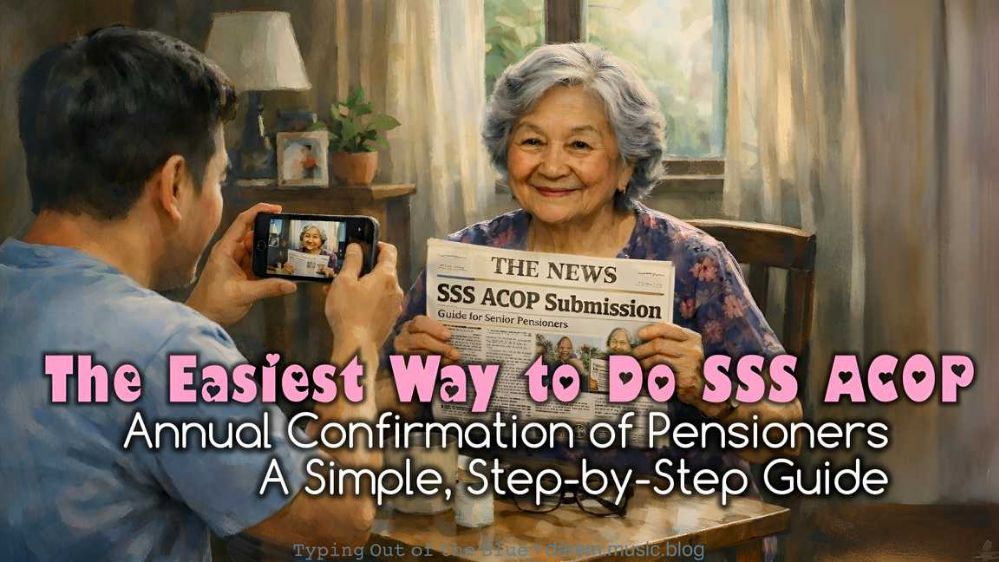
The Easiest Way to Do SSS ACOP

A simple, senior-friendly guide to submitting SSS ACOP by email, with clear steps, timing, and zero stress.

Annual Confirmation of Pensioners
A Simple, Step-by-Step Guide

Every year, senior pensioners face the same question: how do I do ACOP without stress?

In many cases, the easiest way is through email submission, when allowed by the Social Security System (SSS). This guide explains the process clearly and calmly, without unnecessary steps.

How to Do ACOP Through Email

This method is commonly accepted for senior pensioners, those with mobility issues, or those assisted by family members.

Step 1: Download the correct ACOP form

Choose the form that applies to the pensioner. You can download the official forms below.

• ACOP Form (for pensioners with living spouse or not declaring a deceased spouse)

• ACOP Form for Pensioners with Deceased Spouse (for widows or widowers)

If you are unsure which form to use, choose the one that matches the pensioner’s current marital status.

(The downloadable PDFs provided on this page are official ACOP forms from the Social Security System (SSS), uploaded here for convenience, as of February 8, 2026.)

Step 2: Prepare the required documents

• Filled-out and signed ACOP form 
• Clear photo of the pensioner’s SSS ID 
• Recent photo of the pensioner holding a newspaper, clearly showing the printed date

Step 3: Submit by email

Email Subject Line
Use a clear and simple subject line so SSS can easily identify your submission.

Recommended format:
ACOP Submission – [Pensioner’s Full Name]

If filing under a deceased spouse:
ACOP Submission (Deceased Spouse) – [Living Pensioner’s Full Name]

Examples:
ACOP Submission – Juan Dela Cruz
ACOP Submission (Deceased Spouse) – Juan Dela Cruz

Send all documents in one email. Files may be scanned or photographed, as long as they are clear and readable. Make sure the printed date on the newspaper is clearly visible.

Send the email to the SSS email address of the city or branch handling the account.

Example: 
If you are living in Las Piñas, you may send your ACOP documents to laspinas@sss.gov.ph.

SSS procedures may vary depending on the pensioner’s record and the handling branch. If SSS provides specific instructions, those instructions should be followed.

That’s it. No travel. No lining up. No video calls. No new apps to learn. For many seniors, this is the least confusing and least exhausting option.

When to Submit ACOP

ACOP is submitted once a year and is commonly scheduled based on the relevant birth month. For pensioners filing under their own record, this is usually the pensioner’s birth month. For widows or widowers, this is commonly the birth month of the deceased spouse.

For example, if the relevant birthday falls on February 10, submitting ACOP anytime within February, even on February 28, is still acceptable. Submitting beyond the birth month does not result in a fine, but may cause a temporary suspension of the pension until ACOP is approved.

To avoid delays and unnecessary stress, it is better to submit ACOP early every year, preferably within the birth month.

Why This Matters

People grow weaker with age. Systems should grow kinder.

Many government processes remain low-tech and habit-based, not because there is no better way, but because the current way still works for the office. What works for the office, however, does not always work for the people.

Seniors struggle with long instructions, passwords, apps, and repeated trips. A delayed or suspended pension creates stress that could have been avoided with simpler design. The fact that SSS already allows ACOP through email in many cases proves that convenience is possible.

The tools exist. The methods exist. What is often missing is the effort to design systems around those who need them most.

Old folks should not be the ones adjusting. Institutions should.

Until systems are fully simplified, email submission remains the most practical and humane option for many senior pensioners. This guide exists for one reason only: to make ACOP less confusing, less tiring, and more respectful of age.

⌨ ᴛʸᵖⁱⁿᵍ ᴏᵘᵗ ᵒᶠ ᵗʰᵉ ʙˡᵘᵉ ᵈᵃʳᵉᵐ ᵐᵘˢⁱᶜ ᵇˡᵒᵍ

È bello dare amore a San Valentino.