What If the Philippines Never Became Independent?

A different flag, a different future, and a question that still sparks debate today.

Every June 12, we celebrate Philippine Independence Day. We remember the people who dreamed of a nation that could stand on its own feet.

Some imagine we would still be under Spain. Others picture a future tied to the United States. In either case, daily life would probably look very different.

Spanish might still be spoken by millions. Our laws, schools, and government could follow a different path. If the Philippines had remained connected to the United States, English might be even more dominant than it is today.

Looking at Spain and America today, some people wonder whether life might have been better under a larger and wealthier nation. It is a fair question. But the independence movement was never built around predictions of future wealth.

The people who fought for independence were pursuing something else.

Their goal was not simply to become richer. It was to gain the right to govern themselves.

Think of a musician playing a song written, arranged, and directed by someone else. The music may be beautiful. The audience may even love it.

But it is not the musician’s song.

That was the heart of the independence movement. Filipinos wanted a voice in the decisions that shaped their nation.

Of course, freedom came with no guarantees. It brought successes and mistakes, wise choices and poor ones. Independence did not promise a perfect future.

It offered something else: the responsibility of self-government.

History cannot tell us what would have happened if the Philippines had remained under another flag. It can only show us what happened next.

And every June 12, that story points back to a simple idea:

Independence is not the promise of a better life. It is the freedom to choose your own path toward one.

⌨ ᴛʸᵖⁱⁿᵍ ᴏᵘᵗ ᵒᶠ ᵗʰᵉ ʙˡᵘᵉ ᵈᵃʳᵉᵐ ᵐᵘˢⁱᶜ ᵇˡᵒᵍ
A Peace of War • Darem Placer • Full album. Press play.

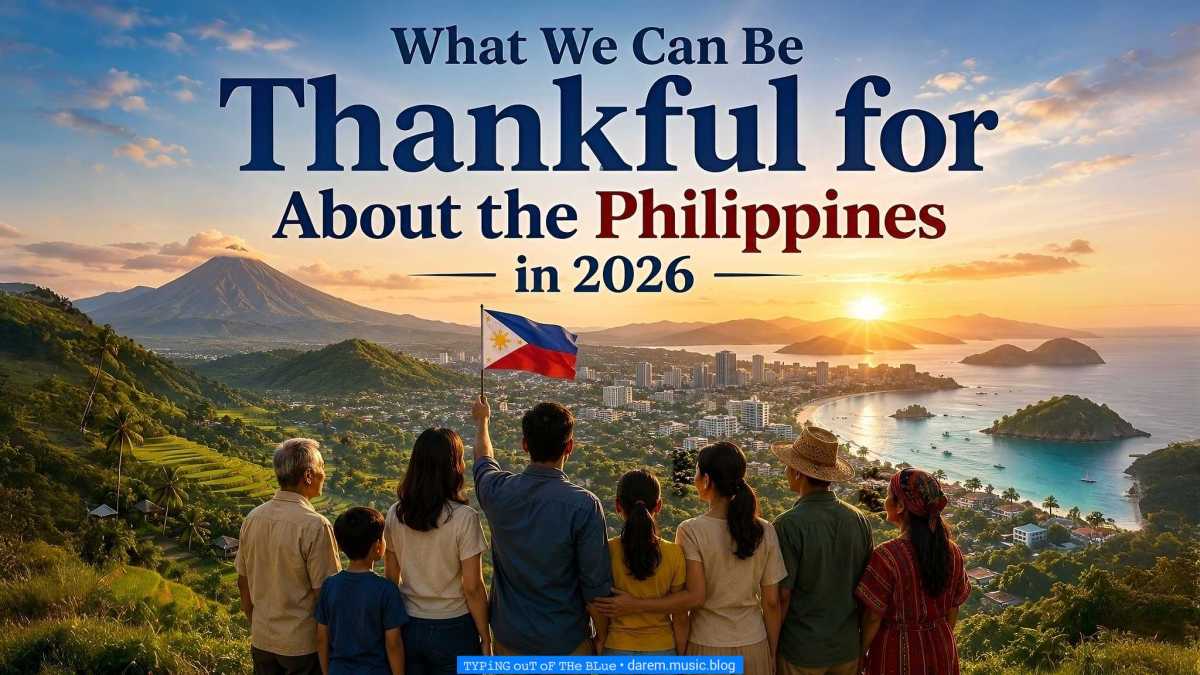
What We Can Be Thankful for About the Philippines in 2026

Looking beyond the headlines, there are still many reasons to appreciate life in the Philippines today.

It is easy to focus on problems. Every country has them. The Philippines has them too.

But there are also many things worth being thankful for.

• We live in a free country. We can speak, learn, create, vote, and practice our faith freely.

• We are surrounded by relatives, friends, and communities that support us through life’s challenges.

• When disasters happen, we often help one another by sharing food, donating supplies, volunteering, and helping neighbors rebuild.

• We have more opportunities today than ever before. Technology, education, and English have opened doors that many earlier generations never had.

• We have a rich culture. Our food, languages, stories, music, and traditions make the Philippines unique.

• We have beautiful places. Beaches, mountains, forests, rivers, and islands remind us that nature is one of our greatest treasures.

• We are creative and resourceful. We are known for music, art, storytelling, and finding ways to solve problems.

• We are growing up in a time of peace rather than war or foreign occupation.

Perhaps the greatest reason to be thankful is this:

The Philippines we know today was built by countless people who came before us. It is not perfect. It never has been. But every generation has the chance to make it a little better than they found it.

The Philippines of tomorrow will be shaped by what we do today.

Voices Across the Field • Darem Placer

⌨ ᴛʸᵖⁱⁿᵍ ᴏᵘᵗ ᵒᶠ ᵗʰᵉ ʙˡᵘᵉ ᵈᵃʳᵉᵐ ᵐᵘˢⁱᶜ ᵇˡᵒᵍ