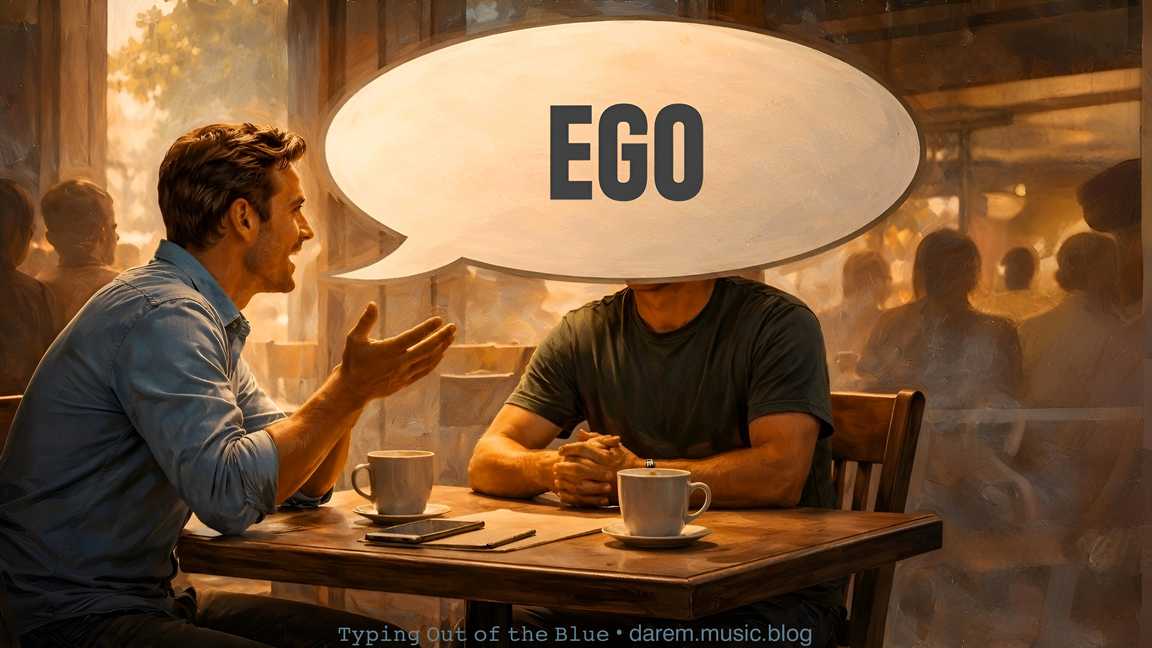
Ego

A simple look at what ego really is, why it stays, and how it quietly affects everyday life.

For those who’d rather listen.

Ego is the voice inside a person that keeps saying, “Me first.” It is the part that wants to be right, to be seen, to be praised, to win. It is not always loud. Sometimes it hides behind good actions. Sometimes it even wears the costume of kindness. But at its core, ego is the strong attachment to self image.

In psychology, ego just means your sense of self. It is the part that knows you are you. It is not always pride. The problem starts when that sense of self becomes too big and too sensitive.

Ego is hard to remove because it protects something fragile. Deep inside, people want to feel important and safe. Ego gives that feeling. It says, “If you admit you are wrong, you lose value.” It says, “If others shine, you fade.” So people hold on to it. It becomes part of their identity. Over time, ego feels normal. It feels like survival.

The bad effects are quiet but heavy. Ego damages relationships because it refuses to listen. Ego kills conversations. While the other person is still speaking, you are already rehearsing your reply. It turns small disagreements into battles. It makes people defensive instead of honest. In work, ego blocks growth because a person will not accept correction. In families, it builds walls. In society, it creates division. Ego also steals peace. A person with a strong ego is always comparing, competing, or proving something. That is tiring.

Removing ego does not mean removing confidence. It means learning to separate worth from pride. People can start with small habits. Admit when you are wrong. Listen without planning your reply. Celebrate someone else’s success without comparing it to yours. Ask yourself, “Am I doing this to serve or to be seen?” Spend quiet time alone without showing your life online. Practice gratitude. Gratitude weakens ego because it reminds a person that not everything is earned alone.

Ego does not disappear in one day. It shrinks through awareness. Each time a person chooses humility over pride, ego loses power. Each time someone chooses understanding over winning, something inside becomes lighter.

The goal is not to become invisible. The goal is to become free.

⌨ ᴛʸᵖⁱⁿᵍ ᴏᵘᵗ ᵒᶠ ᵗʰᵉ ʙˡᵘᵉ ᵈᵃʳᵉᵐ ᵐᵘˢⁱᶜ ᵇˡᵒᵍ
The Tuition That Never Paid Off

Some dreams lift us out of poverty. Others teach us why we fell in the first place.

They were poor, but the parents had a dream bigger than their hunger. Every coin they saved was a step toward a promise: their child would study in the best school. Maybe one day, they’d never have to count coins again.

The boy grew up seeing his mother skip meals and his father work double shifts. When he entered that expensive school, he thought he finally belonged to the world he always watched from the outside—polished shoes, shiny phones, soft accents. Soon, he learned how to pretend.

He started walking ahead of his mother so his classmates wouldn’t see her faded dress. He told his friends his father worked abroad. He laughed at the poor, forgetting that his own laughter smelled like rice from home that wasn’t enough.

One rainy night, both parents died in an accident on their way home from work. The next morning, he realized something worse than loss—there was no money for tomorrow. No savings, no food, no income. Only one thing remained untouched: the education fund his parents had protected all their lives.

He dropped out, saying school could wait. He told himself he’d go back once things were “stable.” But he never did.

He rented a small room, bought new clothes, ate in cafes, and scrolled through life pretending everything was fine. The money slowly disappeared, like the people who used to believe in him.

Then came the hunger. The same kind his parents knew—but without love beside it. He searched for jobs but found none that fit the image he built. He couldn’t even afford to print a resume.

One night, he saw a wallet left on a cafe table. He looked around. No one was watching. His hands shook—not because of fear, but because it felt familiar. Easy money, like a shortcut to the dream his parents once worked for.

He took it.
Then another.
Then another.

By the time the police caught him, the only thing left in his pocket was a small piece of paper—torn from the envelope his mother once used to keep their savings. On it, her handwriting still whispered: “For your college.”

He stared at it for a long time. The words blurred under his tears, and for the first time in years, he whispered back—almost like a prayer no one could hear.

“Nay… Tay… naubos ko na pati yung para bukas. At akoy unti-unti na ring nauubos.”

The officer pulled him away. The paper slipped from his hand, drifting down the station floor like a promise he could never pay back.

⌨ ᴛʸᵖⁱⁿᵍ ᴏᵘᵗ ᵒᶠ ᵗʰᵉ ʙˡᵘᵉ ᵈᵃʳᵉᵐ ᵐᵘˢⁱᶜ ᵇˡᵒᵍ