The History of Blood Donation

What began as dangerous experiments eventually became one of medicine’s most powerful ways to save lives.

A drop of blood can save a life.

Getting to that point took centuries of trial, error, and courage.

The history of blood donation is a story of all three.

• 1660s

Doctors in Europe began experimenting with blood transfusions. Some even transferred blood from animals to humans. The results were often disastrous because nobody understood blood types.

• 1818

James Blundell performed the first successful human-to-human blood transfusion. He used blood from donors to help a woman suffering severe bleeding after childbirth.

• 1901

A major breakthrough came when Karl Landsteiner discovered the ABO blood groups (A, B, AB, and O). This explained why some transfusions worked and others failed.

• 1914–1915

Researchers discovered ways to prevent blood from clotting outside the body. This made it possible to store blood for later use.

• World War I

The first practical blood banks began to appear near battlefields, helping save wounded soldiers.

• 1930s

The first modern blood banks were established. Blood could now be collected, stored, and distributed more efficiently.

• World War II

Large-scale blood donation campaigns became common. Millions of units of blood were collected and transported to military hospitals.

• 1950s–Present

Blood collection became safer through improved testing, sterile equipment, and screening for diseases. Today, donated blood can be separated into red cells, plasma, and platelets, allowing one donation to help multiple patients.

But blood donation has never been only about science. It also includes stories of ordinary people choosing to help strangers they will never meet. Century after century, that simple act has kept the music going for someone else. A patient returns home. A mother watches her child grow up. A life that was close to ending gets another verse.

⌨ ᴛʸᵖⁱⁿᵍ ᴏᵘᵗ ᵒᶠ ᵗʰᵉ ʙˡᵘᵉ ᵈᵃʳᵉᵐ ᵐᵘˢⁱᶜ ᵇˡᵒᵍ
Unbroken Pieces of a Tangled Mind • Darem Placer • Full album. Press play.

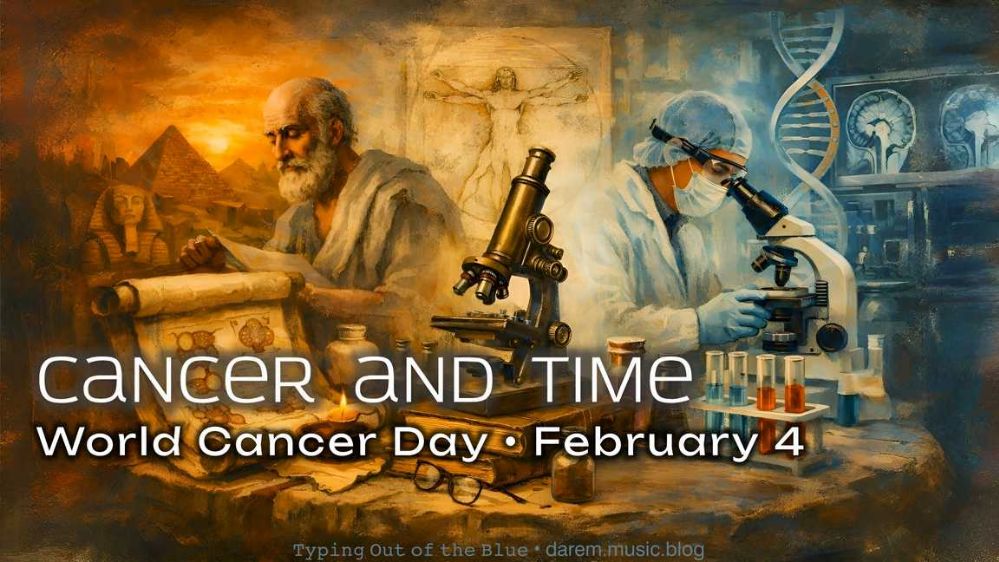
Cancer and Time

Cancer has followed humanity through time, changing not in nature, but in how we understand and face it.

World Cancer Day • February 4

For those who’d rather listen.

Cancer did not suddenly appear like a villain in a movie. It has been with humanity for a very long time. Quiet. Persistent. Historically, it has followed civilization like a shadow.

As early as around 1600 BC, there were already records of cancer in Ancient Egypt. The Edwin Smith Papyrus described tumors, especially breast tumors. There was no cure mentioned. It simply stated, “There is no treatment.” Direct. No emotion. Just fact.

In Ancient Greece, Hippocrates, often called the father of medicine, used the word karkinos, the Greek word for crab. He noticed that cancer spread and clung to the body the way a crab does. He believed cancer was caused by an imbalance of bodily fluids. This idea was incorrect by modern science, but it was a serious attempt to understand the disease at the time.

During the Roman period, Galen expanded on this theory, claiming that cancer came from an excess of “black bile.” This belief dominated medical thinking in Europe for more than a thousand years. Tradition carried the idea forward, even when it was wrong.

From the Middle Ages through the Renaissance, progress was slow. Surgery existed but was dangerous. There was no anesthesia and no antibiotics. For most people, cancer meant certain death.

Real change began in the 19th century with the invention of the microscope. Doctors could finally see cells. Cancer was understood as a disease caused by uncontrolled cell growth, not a curse or a mysterious imbalance.

In the early 20th century, radiation therapy emerged after the discovery of X-rays and radium. Chemotherapy followed after World War II. In a strange twist of history, research meant for war helped advance medicine.

Today, cancer is understood at the genetic level. We talk about mutations, targeted therapy, and immunotherapy. Cancer is not a single disease but many different ones. Some can be cured. Some can be controlled. Others remain aggressive and deadly. But the fight is now based on knowledge, not guesswork.

Cancer has always existed. What changed was us. Our tools. Our understanding. And our decision to keep asking why.

What slowly emerged from that long history is a shared struggle made up of many different stories, where progress came not from forcing a single answer, but from understanding differences and moving forward together.

⌨ ᴛʸᵖⁱⁿᵍ ᴏᵘᵗ ᵒᶠ ᵗʰᵉ ʙˡᵘᵉ ᵈᵃʳᵉᵐ ᵐᵘˢⁱᶜ ᵇˡᵒᵍ

Darem Placer on YouTube Music