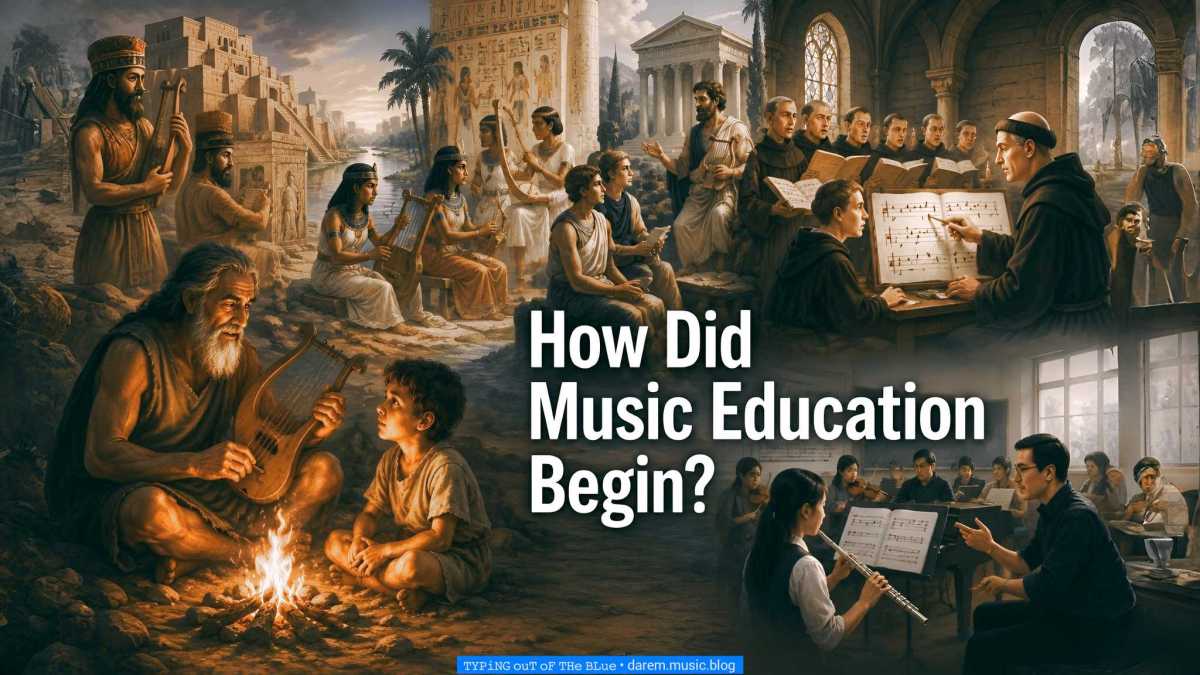
How Did Music Education Begin?

Music has a history that stretches far beyond the first classroom.

Every music teacher was once a student.

But if every teacher first learned from someone else, where did music education begin?

The first music lessons probably happened wherever people gathered. A parent taught a child. An elder shared a rhythm around a fire. A new melody was discovered, and others learned it by listening, watching, and repeating.

When people discover something new, the natural next step is to share it. Those who learn build on that knowledge, make discoveries of their own, and pass them on. Music followed the same path. Every rhythm, melody, technique, and teaching method survived because each generation chose to teach the next.

By around 3000 BC in Mesopotamia, one of the world’s earliest civilizations, musicians were already serving in temples and royal courts, where experienced musicians trained the next generation.

In Ancient Egypt, around 2500 BC, experienced musicians trained younger performers for religious ceremonies, festivals, and royal events.

Centuries later, Ancient Greece, between the 6th and 4th centuries BC, made music an essential part of education. Philosophers such as Pythagoras explored the mathematics of musical sound, while students learned singing, rhythm, poetry, and instruments.

Centuries later, between the 6th and 9th centuries AD, a new chapter began with the rise of Gregorian chant across Western Europe. Monks taught these sacred melodies almost entirely by singing and repetition. As the number of chants grew, remembering every melody became increasingly difficult. Early notation called neumes offered some guidance. These symbols indicated whether the melody went up or down, but they did not show exact pitches. Students still depended heavily on their teachers to learn the chants accurately.

The breakthrough came around 1025 AD in Arezzo, Italy. The Benedictine monk Guido of Arezzo introduced a clearer four-line staff notation and practical teaching methods. His system allowed students to read musical pitches with much greater accuracy instead of relying almost entirely on memory. Over the following centuries, musicians refined his system by expanding the staff from four lines to the now familiar five-line staff, which became the standard across much of Europe during the 15th and 16th centuries.

During the Middle Ages, monasteries and cathedral schools across Europe became organized centers of music education, where choir members and young musicians studied singing, notation, and musical discipline.

Modern music schools did not invent music education.

They organized a tradition that had already been growing for thousands of years.

Before there were classrooms, there was curiosity.

Before there were music schools, there were people willing to teach.

And before there were teachers, there were people willing to share what they had learned.

⌨ ᴛʸᵖⁱⁿᵍ ᴏᵘᵗ ᵒᶠ ᵗʰᵉ ʙˡᵘᵉ ᵈᵃʳᵉᵐ ᵐᵘˢⁱᶜ ᵇˡᵒᵍ

There Was a Time • Darem Placer
The music of Bach, Pachelbel, Debussy, Mozart, and Beethoven as interpreted by Darem Placer

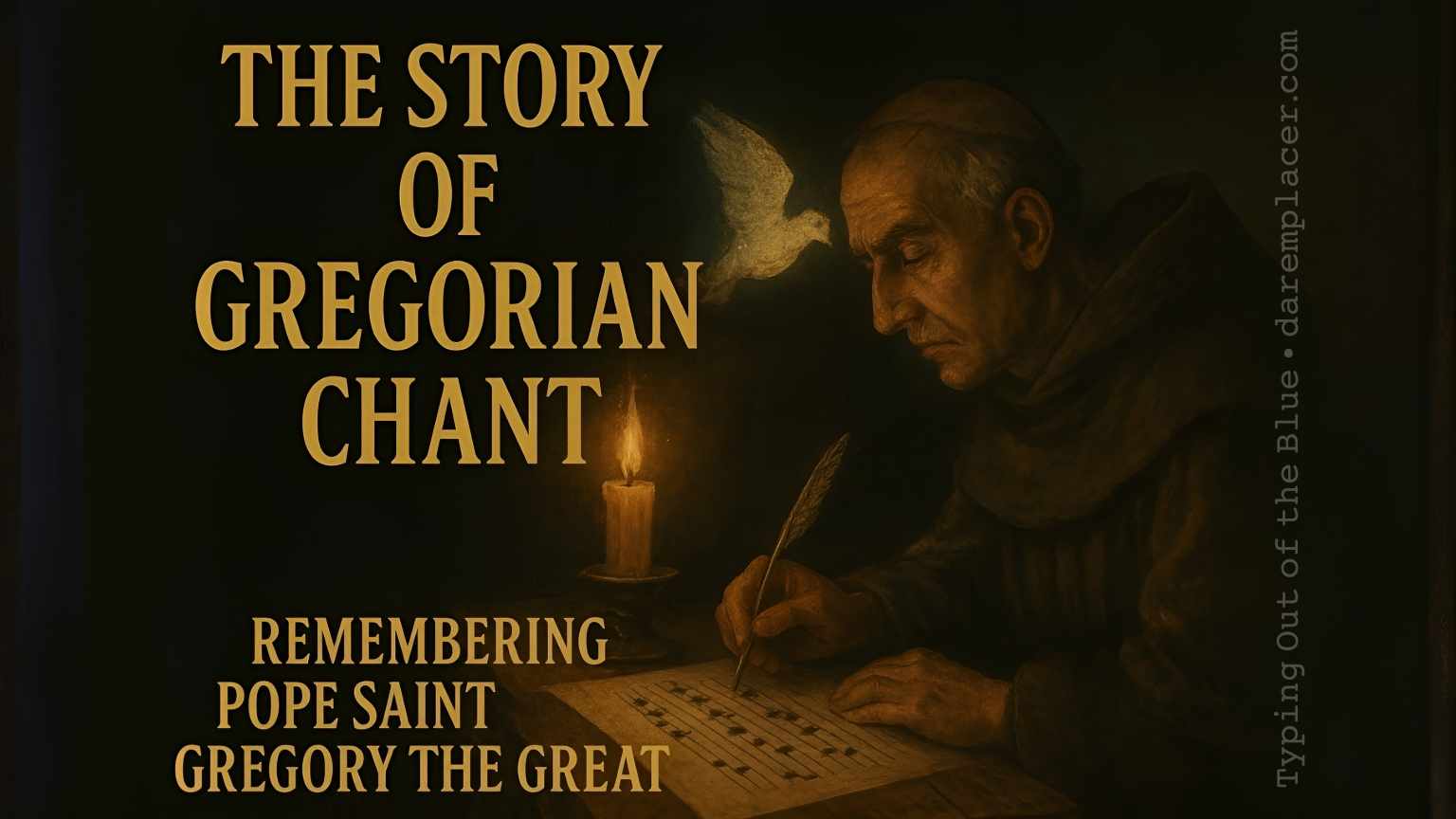
The Story of Gregorian Chant

Gregorian chant is often called the first written music of the West. It began as a simple line of prayer in melody—one that would shape centuries of worship and inspire music far beyond the church walls.

Remembering Pope Saint Gregory the Great

When we look back at the history of music, one name rises from the early centuries—Gregorian chant. Many call it the first written music in the Western world. The starting point. The ground where everything else would later grow.

But why is it called Gregorian? The answer takes us to Pope Saint Gregory the Great (590–604 AD), a leader remembered not only for guiding the Church but also for shaping how worship would sound for centuries.

One Voice

In Gregory’s time, the Church sang in many different ways. Each region had its own melodies, its own flow. Beautiful, but scattered. Gregory dreamed of unity. He began to collect and arrange the chants, giving them order, and teaching the Church to sing with one voice. He even founded a school of singers in Rome—the schola cantorum—to carry this vision forward.

The Dove

A legend tells us that Gregory wrote while a dove whispered in his ear—the Holy Spirit guiding him note by note. Maybe he didn’t actually compose the melodies himself, but the story captures something true: people felt this music was not just human, but divine.

More Than Sound

Gregorian chant was prayer in melody. One pure line of sound, sung together in unison. No instruments, no extra layers—just voices moving as one, carrying words of Scripture. In monasteries and cathedrals, this music shaped the rhythm of worship and the soul of a people.

Why It Matters

To remember Pope Gregory is to remember a beginning. Gregorian chant is not just old music—it is the seed from which Western music grew. Every symphony, every song, in some way traces back to these simple lines sung in stone halls long ago.

At the heart of it was a man who wanted unity, who listened for the Spirit, and who left us the gift of a music that still whispers of heaven. And every September 3, the Church remembers him—not only as a pope and a saint, but as the one whose name became forever linked with the first music of the West.

That spirit of pure melody still speaks today. One of my own pieces, Yearning Thoughts from Voices Across the Field, carries a trace of that same yearning. It’s not Gregorian chant, but it feels like a modern echo of it.

Yearning Thoughts • Darem Placer

For the rest of the album Voices Across the Field, you can listen on Apple Music and Apple Music Classical

Only on Apple Music and Apple Music Classical

𝚃𝚢𝚙𝚒𝚗𝚐 𝙾𝚞𝚝 𝚘𝚏 𝚝𝚑𝚎 𝙱𝚕𝚞𝚎 • 𝚍𝚊𝚛𝚎𝚖𝚙𝚕𝚊𝚌𝚎𝚛.𝚌𝚘𝚖