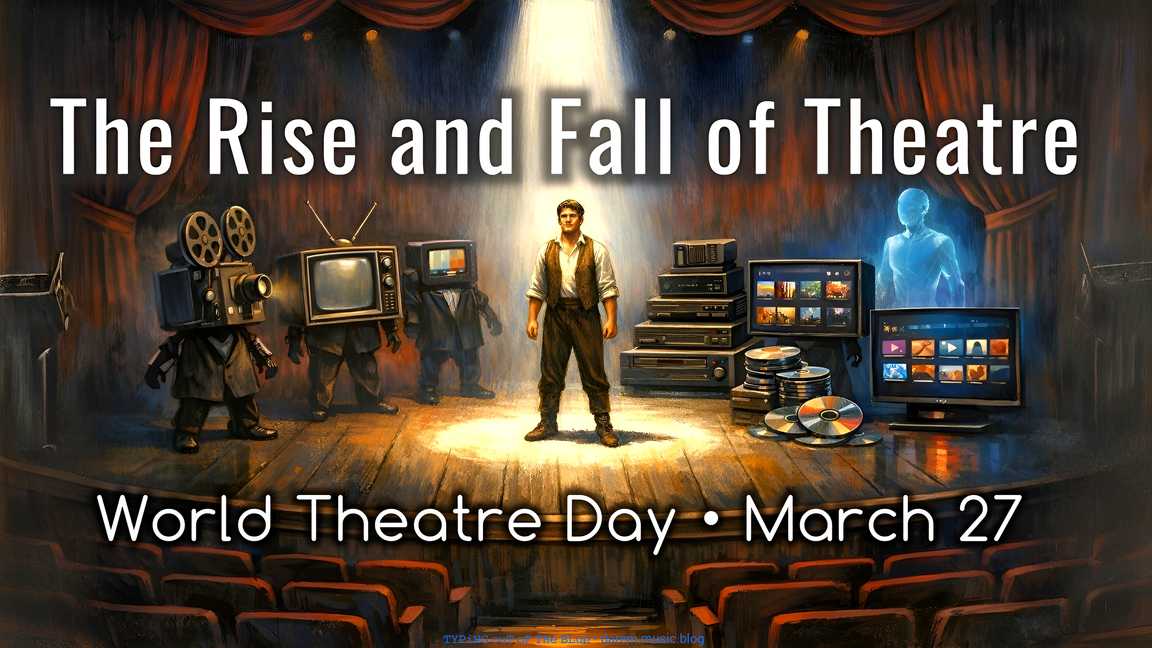
World Theatre Day • March 27
There was a time when theatre was not a choice.
It was where people went to feel something. Stories were performed live, right in front of you. No screens. No pause. Just people, light, and a story happening in real time.
Then came the first fall.
In the 1920s, silent films filled cinemas. They reached more people, more easily, and at a lower cost. Theatre was still there, but it was no longer the center.
Then the drop deepened.
By the late 1920s, sound entered film. Talkies gave audiences voices, music, and dialogue on screen. Cinema felt complete. Theatre now had a stronger rival.
Then it rose again.
From the 1940s to the early 1950s, musicals brought life back to the stage. Oklahoma! (1943), West Side Story (1957), and The Sound of Music (1959) made theatre feel alive again. It became something people chose to experience.
Then another fall began.
By the mid-1950s, television entered the home. Entertainment no longer required going out.
By the 1960s and 1970s, color television made staying home even more appealing. Theatre lost more of its everyday audience.
Then came the quiet squeeze.
From the late 1970s into the 1990s, home media took over. Betamax and VHS allowed people to watch anytime. LaserDisc improved quality. Then CDs and DVDs made access easier. Entertainment was no longer scheduled. It was owned.
Going out became optional.
Even as this shift was happening, theatre found another way to rise.
In the 1980s, it adapted. It went bigger. Cats (1981), Les Misérables (1980), and The Phantom of the Opera (1986) turned the stage into a full experience. Theatre became an event.
Then it leveled out.
In the 1990s and early 2000s, theatre expanded globally. Touring productions reached new audiences. It was no longer the default, but it stayed alive by moving.
Then another shift.
In 2007, Netflix introduced streaming. By the mid-2010s, binge-watching became normal. By the late 2010s, multiple platforms made content endless and always available.
Staying home was no longer just easy.
For many, it felt better.
Then another rise.
In 2015, Hamilton brought new energy. It reached a younger audience and made theatre feel current again.
Then the sharpest fall.
In 2020, the pandemic closed theatres. Stages went dark across the world. For a time, theatre did not just struggle—it stopped.
And now?
It is rising again. But differently.
The audience is smaller, but more intentional. People no longer watch everything. They choose what is worth leaving the house for.
In the age of artificial intelligence, content became faster and more refined. Yet theatre remains unchanged—live, imperfect, and unrepeatable.
It cannot be replayed. It cannot be edited. It happens once, and then it is gone.
That is why it fell behind.
And that is why it keeps rising back.
Because as long as people still look for something real—the stage will never stay empty.
⌨ ᴛʸᵖⁱⁿᵍ ᴏᵘᵗ ᵒᶠ ᵗʰᵉ ʙˡᵘᵉ ᵈᵃʳᵉᵐ ᵐᵘˢⁱᶜ ᵇˡᵒᵍ