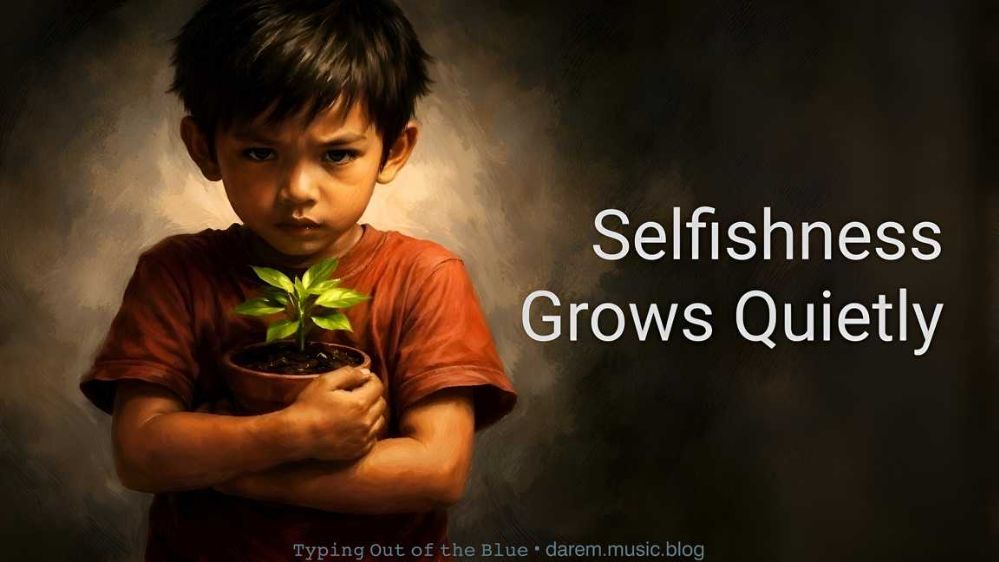
Selfishness Grows Quietly

Selfishness forms slowly, shaped by childhood, habits, and what we learn to ignore.

For those who’d rather listen.

Selfishness doesn’t just pop out of nowhere one morning. It grows quietly, like a plant you didn’t notice, until it’s already big.

It starts in childhood, and it’s actually very normal. A kid says “mine” because they’re still in survival mode. They don’t know empathy yet. Their world is small, mostly about needs and comfort. This is not selfishness. This is instinct. The danger starts when someone gets stuck here.

If a child grows up always getting what they want, or never being corrected, a message sinks in: “I come first. Always.” On the other hand, if a child grows up neglected, ignored, or emotionally starved, another message forms: “No one will take care of me, so I must take everything I can.” Different roots, same outcome.

Then comes adolescence. This is where selfishness gets trained. Peer pressure, comparison, validation. Likes, approval, status. Teens quickly learn what gets rewarded. Sometimes it’s kindness. Often it’s attention-seeking, dominance, or stepping on others to look strong. If empathy isn’t modeled at home, the shortcut becomes attractive: take, don’t share. Win, don’t care.

By adulthood, selfishness looks more “polite” but sharper. It wears suits, smiles, and excuses. “I’m just being practical.” “I need to protect my peace.” Sometimes those are true. Sometimes they’re just dressed-up self-interest. Adults who were never taught emotional responsibility tend to center every decision on comfort, gain, or image. People become tools, not companions.

Selfishness is often not about loving oneself too much. It’s about never learning how to love others properly, or never being shown how.

But it’s not permanent. Empathy can be learned later. Generosity can be practiced. Awareness alone already cracks the shell. Selfishness grows unconsciously, but it shrinks the moment someone starts asking,

“How does this affect others?”

That question is where growing up really begins.

⌨ ᴛʸᵖⁱⁿᵍ ᴏᵘᵗ ᵒᶠ ᵗʰᵉ ʙˡᵘᵉ ᵈᵃʳᵉᵐ ᵐᵘˢⁱᶜ ᵇˡᵒᵍ

Digital Albums by Darem Placer on Bandcamp
Listen. Support. Buy. Download.

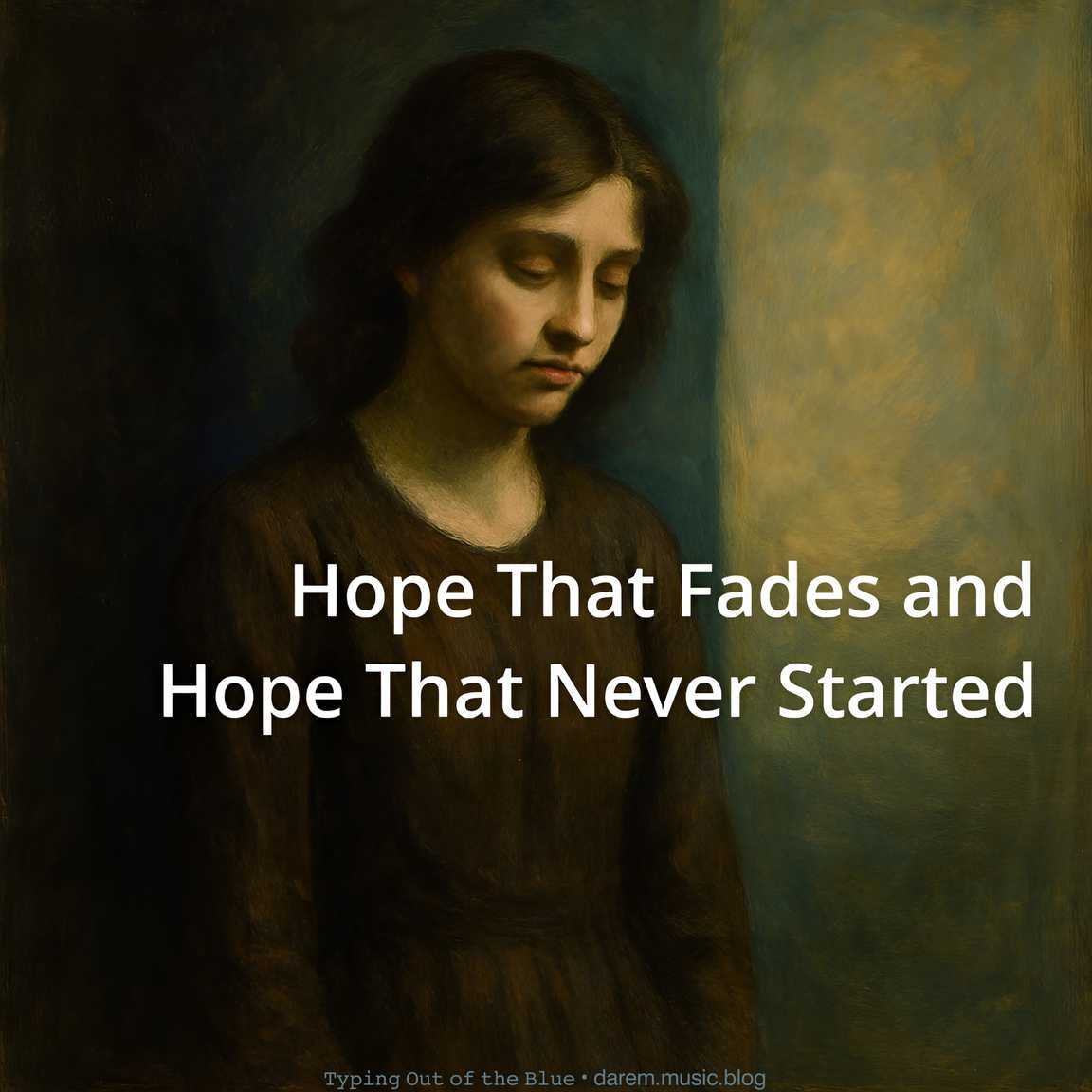
Hope That Fades and Hope That Never Started

Why losing hope is not the same as never learning how to hope at all.

People often think hope works the same for everyone.
But it doesn’t.
There’s a clear difference between a person who lost hope and a person who never hoped at all.

When someone loses hope

A person who loses hope is not empty.
They once looked forward to something.
They once believed in a better moment.
They know how hope feels because they lived it before.

That memory stays.
It becomes a small spark inside, even if life feels heavy.
It can come back with patience, rest, and the right time.

When someone never hoped

This is a different story.
Some people grow up with comfort, stability, or a life that never pushed them to reach for anything bigger.
They did not learn how to wait for something.
They did not learn how to want something deeply.

Their life is not meaningless, but it can feel flat.
So when life finally shakes them, they struggle more.
They don’t have a “hope reflex.”
They don’t know what to hold on to because they never had to hold on before.

Hope is not magic.
It is a skill built through real experience.

• If you lost hope, you can still find your way back because you know what hope feels like.

• If you never hoped, you can still learn—but you start from zero.

Both paths are human.
Both can move forward.
Hope does not disappear.
It waits for the moment when someone chooses to reach again—
and maybe even chooses to Hold.

Hold • Darem Placer

The story doesn’t end here. Hold is just one voice in a larger echo. The rest of the album, Indelible Imprint of Reverberation, carries the same journey—tracks that fade, linger, rise, and wait. Soon on Bandcamp.

⌨ ᴛʸᵖⁱⁿᵍ ᴏᵘᵗ ᵒᶠ ᵗʰᵉ ʙˡᵘᵉ ᵈᵃʳᵉᵐ ᵐᵘˢⁱᶜ ᵇˡᵒᵍ