Faith Needed Silence—The Life of Saint Paul the First Hermit

His desert life shows how small moments of quiet still shape faith today.

Paul lived in Egypt in the 3rd century, during a time when Christians were being hunted. He was still young, around his early 20s. He was already Christian, already praying, already trying to live honestly. When persecution began, staying around meant pressure to deny his faith or betray others. So he left. He went into the desert.

He did not go there to become famous, holy, or extreme. He went because it was the only place where he could live without compromise. The desert was not a goal. It was a condition. Away from fear, noise, and pressure, he lived a very simple life. He prayed. He worked. He stayed disciplined. Day after day, with no audience and no reward.

Paul did not prepare for a mission. He did not teach. He did not plan to return. He simply stayed faithful where he was. His life was quiet, steady, and hidden. That was enough.

Today, we do not need to copy his life. We do not need to disappear or live alone forever. What Paul did in the desert can be done in smaller ways now. A room can be a desert. A few quiet minutes can be enough. Putting the phone down. Sitting still. Praying honestly. Choosing silence once in a while. These are small forms of the same discipline Paul lived for many years.

What matters is not the place or the length of time. What matters is the choice to live without distraction and without pretending.

We do not really aspire to become saints. We aspire to become better people each day. More honest. More focused. More faithful in simple ways. That is where Saint Paul the First Hermit still speaks to us today.

Let’s keep learning the saints’ way—day by day.

⌨ ᴛʸᵖⁱⁿᵍ ᴏᵘᵗ ᵒᶠ ᵗʰᵉ ʙˡᵘᵉ ᵈᵃʳᵉᵐ ᵐᵘˢⁱᶜ ᵇˡᵒᵍ

Digital Albums by Darem Placer on Bandcamp
Listen. Support. Buy. Download.

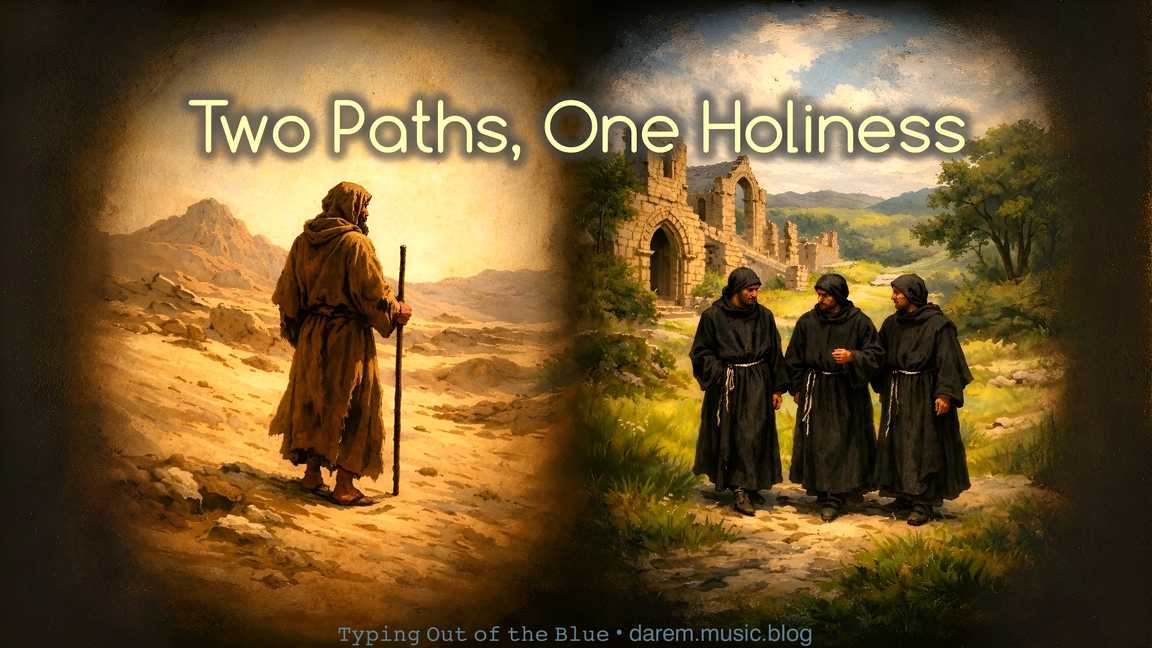
Two Paths, One Holiness

Holiness has taken different shapes across time. Some saints stepped away from people. Others learned how to love them well.

For those who’d rather listen.

Holiness did not always look the same.

In the 3rd century, in the deserts of Egypt, one man decided that the only way to be honest before God was to disappear from everything else.

Anthony the Great, later recognized as a saint, left his home, his inheritance, and ordinary life to go where almost no one wanted to stay. He is often regarded as the first monk, not because he founded an order, but because he lived the idea before it had a name. No monastery yet. No rulebook. Just heat, silence, prayer, and time.

He lived that way for decades. People eventually found him, learned from him, then left him again.

When he died, around 105 years old, he chose to die alone. No crowd. No grave marker. Even his burial place was kept secret. For Anthony, holiness meant stripping life down until nothing was left to perform.

That made sense then. The world he lived in was unstable and violent. Faith needed space to breathe. Solitude was not escape. It was survival.

Fast forward almost nine centuries.

Now we are in 12th-century England, in a green, cold place far from the desert. Monasteries already exist. Silence is scheduled. Prayer has structure. And yet, a different struggle appears. People live together in quiet places, but the heart can still harden.

This is where Saint Aelred of Rievaulx belongs.

Aelred was a monk and later abbot at Rievaulx Abbey in Yorkshire. Before that, he had known public life and power. He chose the monastery, not to escape people, but to learn how to live with them rightly. His concern was not noise from the outside world. It was distance growing inside quiet walls.

Aelred wrote about friendship, not as something soft or sentimental, but as something demanding. It required patience, truth, correction without cruelty, and presence without control. For him, holiness was tested daily in shared life, not proven by withdrawal.

At first glance, the paths look opposed. Anthony walked away from people. Aelred stayed among them.

They were answering different problems. They were not choosing opposite truths, but responding to different needs of their time.

Anthony lived in a time when faith could drown in chaos. Solitude purified intention. Aelred lived in a time when faith could turn cold. Relationship revealed character.

One cleared the ground. The other examined what grew on it.

Holiness does not have one shape. Some are called to step back so life becomes honest. Some are called to stay so love becomes real.

What matters is not copying a saint’s lifestyle, but understanding why it existed in the first place.

Holiness adapts to the wound of the time. And that is why both paths still speak.

Learning the saints’ way—day by day.

⌨ ᴛʸᵖⁱⁿᵍ ᴏᵘᵗ ᵒᶠ ᵗʰᵉ ʙˡᵘᵉ ᵈᵃʳᵉᵐ ᵐᵘˢⁱᶜ ᵇˡᵒᵍ
Traces of courage, silence, and sacrifice—this is Saints.

Listen on Apple Music, Apple Music Classical, and YouTube Music