No One Escapes Climate Change

Climate change is not tomorrow’s problem. It’s today’s emergency—and no one gets a free pass from its effects.

The sky is getting low

The Earth has already warmed by 1.2°C. It sounds small — but it’s already killing people, wrecking homes, and reshaping life as we know it. Push past 1.5°C, and everything gets worse.

The Heat That Kills

This isn’t just about sweating more.
• Heatwaves now kill thousands — Europe lost 1,500 in a single summer.
• Imagine your grandparents in 40°C heat with no relief.
• Cities turn into giant ovens — deadly for the poor, the old, the sick.

The Ocean Fights Back

• 84% of the world’s coral reefs are already bleached.
• Warmer seas create monster typhoons — the Philippines, Japan, Caribbean are all targets.
• Fish populations collapse, and suddenly the cheapest meal on the table becomes unaffordable.
• The ocean, once our carbon sponge, is starting to leak CO₂ back into the air.

Ice Is Melting, Seas Are Rising

• Arctic air is now 5°C hotter than a century ago.
• Greenland and Antarctica bleed ice into the sea.
• Coastal towns and islands are slowly drowning. “Permanent flood” is no longer science fiction.

Forests on Fire

• The Amazon and other rainforests are drying, burning, and collapsing.
• When forests fall, carbon pours back into the sky.
• Hillsides stripped of trees crumble in mudslides, burying homes.

Food, Water, and Survival

• Crops fail in heat and flood alike. Rice, wheat, maize — the basics — are all at risk.
• Glaciers that once fed rivers are gone. Some taps run dry while others drown in floods.
• Food prices rise, hunger deepens. For millions, even plain rice or bread may slip out of reach.

The Disappearing Wild

• At 1.5°C warming, 14% of species face extinction.
• Coral reefs, mangroves, tundra — once full of life, now silent.
• Ecosystems unravel when keystone species vanish.

The Human Cost

This is where it hits hardest.
• Stronger storms and floods wipe out homes, schools, jobs.
• Indigenous peoples lose sacred lands and ways of life.
• Warmer climates spread diseases — dengue, malaria, heat stroke everywhere.
• Millions become climate refugees, forced to leave everything behind.
• The poor suffer most — least prepared, least resources, most exposed.

The Hard Truth

This is not tomorrow’s problem. It’s today’s emergency. Forests, oceans, poles, farmland — collapsing in real time.

If you think you’re safe, think again.
• Your food will cost more.
• Your water will run short.
• Your home may flood or burn.
• Your children will inherit the wreckage.

Every delay means more lives lost, more homes destroyed, more nature erased.

But Hope Still Breathes

The future is not written yet. We know what fuels this crisis — and we know how to fight back.

• Cut emissions fast.
• Protect forests, oceans, and wildlife.
• Build communities that can withstand storms and droughts.
• Hold leaders accountable, and live choices that push change.

The window is small, but it’s still open.
If we act now, we can turn the tide. Not just for us, but for every generation after.


🌍 A Soundtrack for Awareness

I created an instrumental album called Sky-Low — heavy, shifting, sometimes unsettling, just like the world we live in. Let it remind you of what’s at stake, but don’t get lost in the music. Awareness only matters if it leads to action.

💿 Just type 0 if you want to download the album for free. If you’d like to support my efforts, feel free to name your price.

👉 Download Sky-Low on Bandcamp

Sky-Low
“Sky-Low” is not just an album—it’s an awareness campaign about climate change and a challenge to protect our planet.


𝚃𝚢𝚙𝚒𝚗𝚐 𝙾𝚞𝚝 𝚘𝚏 𝚝𝚑𝚎 𝙱𝚕𝚞𝚎 • 𝖽𝖺𝗋𝖾𝗆.𝗆𝗎𝗌𝗂𝖼.𝖻𝗅𝗈𝗀
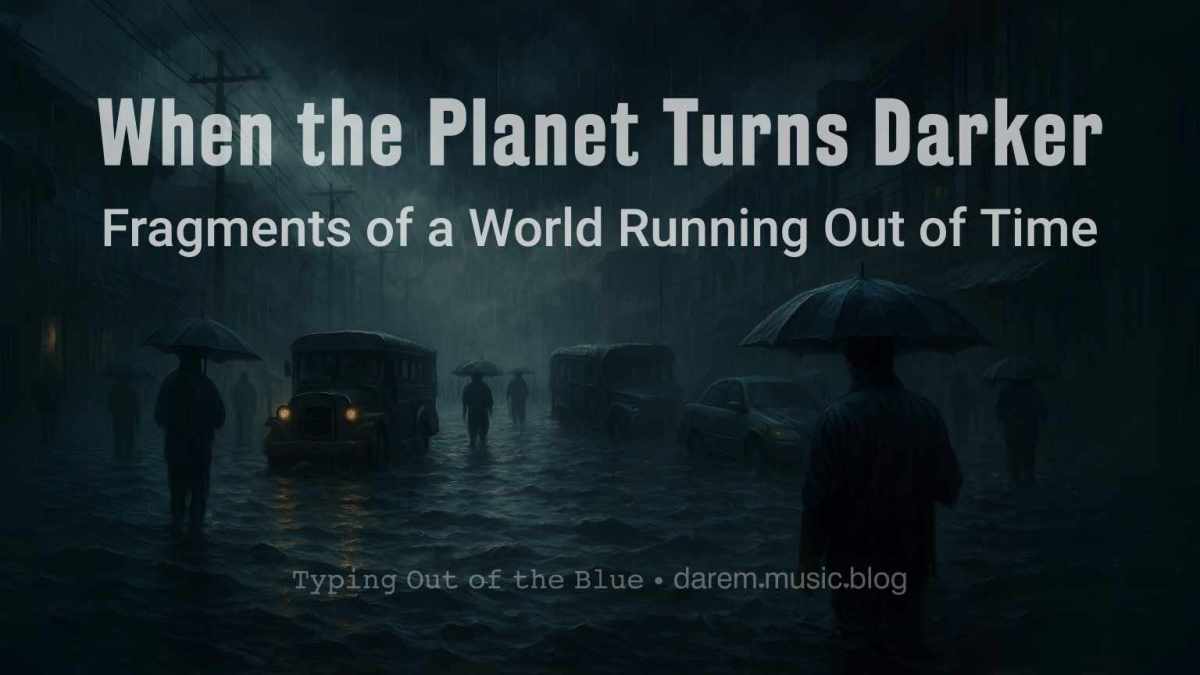
When the Planet Turns Darker

From glaciers vanishing in Venezuela to sudden floods drowning Metro Manila, the past weeks have felt less like news and more like a countdown. The planet isn’t whispering anymore—it’s screaming.

Fragments of a World Running Out of Time

This past month, climate change didn’t whisper—it screamed. From vanished glaciers to flooded city streets, the planet feels like it’s running out of time.

Aug 30, 2025 — Pakistan’s Summer Escape Turns Deadly

What used to be a cool mountain refuge turned into a death trap. A sudden cloudburst at Babusar Pass killed 13 people, while more than 800 have died in this year’s floods across Pakistan. Melting glaciers, stripped forests, and unstable monsoons turned postcard views into disaster zones.

Aug 30, 2025 — Philippines Flash Flood Nightmare

In Quezon City, five days’ worth of rain fell in just one hour. Streets became rivers, drainage collapsed in 36 barangays, and families scrambled to safety. The deluge even surpassed the intensity of Ondoy back in 2009.

Sept 2, 2025 — Scientists vs. Politics

More than 85 climate scientists openly criticized the U.S. Department of Energy’s latest climate report, calling it biased and error-filled. Their warning: when politics twists science, the fight against climate change turns into shadowboxing.

Sept 5, 2025 — Venezuela’s Last Glacier Is Gone

Venezuela has become the first country in modern times to officially lose all its glaciers. The once-majestic Humboldt Glacier finally shrank past the point of recognition. It’s not just ice disappearing—it’s a nation losing part of its memory, its water source, and its soul.

Sept 5, 2025 — Wildfires Spread Toxic Skies

From the Amazon to Canada to Siberia, wildfires are burning so intensely that their smoke is circling the globe. The UN says dangerous particles are poisoning air quality thousands of miles away. What starts in one forest ends in another person’s lungs.

Sept 5, 2025 — Oceans at the Edge

New studies show coastal ecosystems could collapse by 2050 if warming seas and overfishing continue. This isn’t just about coral and fish—this is about food chains, storm protection, and life along every shore.

Sept 6, 2025 — India’s Monsoon Fury

Over 725 lives have been lost in northern India as floods and landslides ripped through villages from June to September. Scientists warn that shorter but more violent monsoons are the new normal. Rain that once nourished now strikes like a hammer.

Sept 6, 2025 — Philippines Weather Whiplash

By early September, Tropical Depression Lannie had already moved out of PAR, but its shadow lingered. The storm supercharged the southwest monsoon, hitting Metro Manila with sudden downpours. One moment sunny, the next moment knee-deep floods in low-lying areas of Las Piñas, Parañaque, and beyond. Climate change doesn’t feel abstract here—it feels like a mood swing in the sky.

Sept 2025 — Corals Losing Their Color

The 2023–2025 global coral bleaching event has already affected about 84% of reefs worldwide. Reefs are nurseries of the ocean, and they’re fading faster than anyone imagined. Once they’re gone, they don’t come back.

Sept 2025 — The Next Five Years

The World Meteorological Organization projects there’s an 80% chance that one year between 2025–2029 will be hotter than 2024—the hottest year on record. And an 86% chance the planet will cross the 1.5°C threshold. That line in the sand is about to be erased.

Glaciers gone. Rivers raging. Forests burning. Seas rising. Science ignored.

Every headline feels less like news, more like a countdown.

And the countdown only stops if we act before the timer hits zero—all that because we chose to ignore climate change.

𝚃𝚢𝚙𝚒𝚗𝚐 𝙾𝚞𝚝 𝚘𝚏 𝚝𝚑𝚎 𝙱𝚕𝚞𝚎 • 𝖽𝖺𝗋𝖾𝗆.𝗆𝗎𝗌𝗂𝖼.𝖻𝗅𝗈𝗀