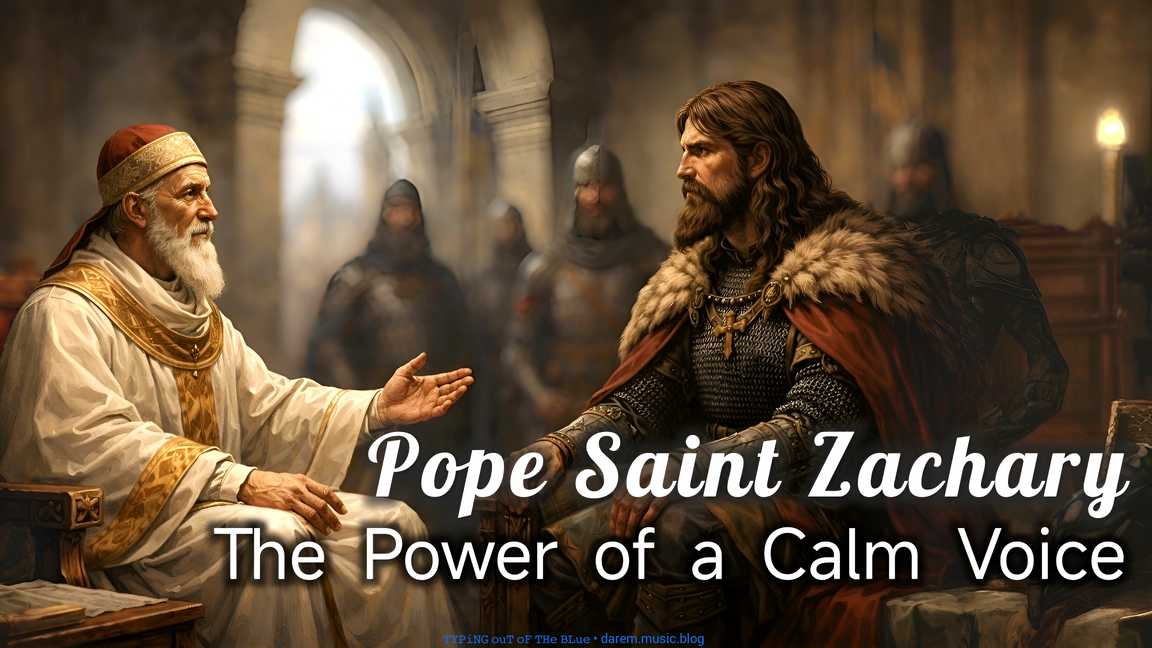
In the middle of the 8th century, the Church was led by a pope who preferred conversation over confrontation. His name was Pope Zachary.
Pope Zachary served as pope from 741 to 752. He was born to a Greek family in southern Italy and became known for a calm and thoughtful way of leading the Church. His time as pope was not easy. Europe then was full of rival kingdoms, shifting alliances, and threats of war. Rome itself often stood in the middle of those tensions.
Instead of relying on force, Zachary often chose diplomacy. One well-known moment involved the Lombards, a powerful kingdom that could have attacked Rome. Their ruler, King Liutprand, had the strength to do it. Yet through dialogue and negotiation, Zachary managed to prevent the attack. Rather than turning the conflict into a battle, the situation was settled through conversation.
His influence also reached beyond Italy. When the Frankish kingdom faced a question about who should truly be king, Zachary’s answer helped shape the future of Europe. His guidance supported the rise of Pepin the Short, whose family line would later produce Charlemagne, one of the most powerful rulers in European history.
What makes Zachary interesting is not military strength or dramatic victories. His strength was wisdom. In an age when leaders often turned quickly to war, he showed that careful words could sometimes achieve what armies could not.
That lesson still makes sense today. Most conflicts in daily life are not battles between armies. They happen in ordinary places.
A misunderstanding between friends can be fixed by sitting down and talking honestly. A disagreement in the workplace can be settled when someone calmly explains the situation instead of reacting with anger. Even small neighborhood problems, like noise, parking, or shared spaces, can often be resolved when someone simply knocks on the door and speaks respectfully.
We do not need to become a pope to practice good negotiation. We do not need a throne, authority, or a title. What we need are patience, respect, and the willingness to listen before reacting.
The story of Pope Saint Zachary reminds us that peace does not always begin in grand meetings between powerful leaders. Sometimes it begins in simple conversations where someone chooses understanding over conflict.
Let’s keep learning the saints’ way—day by day.
⌨ ᴛʸᵖⁱⁿᵍ ᴏᵘᵗ ᵒᶠ ᵗʰᵉ ʙˡᵘᵉ ᵈᵃʳᵉᵐ ᵐᵘˢⁱᶜ ᵇˡᵒᵍ