Saint John Bosco as a Teen

Don Bosco’s teen years, where his way of guiding young people quietly took shape.

Don Bosco was born in 1815 in Italy and grew up during a time of deep poverty and social change. Don is an Italian title used for priests, similar to “Father,” and it became the name people naturally called him by. Long before that title, though, his direction was already visible in his youth.

He has a solid teen-days story. This is often told because you can already feel the Don Bosco vibe even when he was still young.

As a teenager, he already loved performing. Magic tricks, juggling, acrobatics. Like a street performer. But not just for show. After every performance, he would suddenly go quiet, then give a short prayer or a moral talk. Not preachy. Just right. On a peer level.

The catch? He used talent to catch attention. He knew that if he started with sermons, kids would walk away. So first fun, then meaning. Smart move.

He also came from a very poor family. Even as a child, he already worked wherever he could just to study. Sometimes he walked long distances with no money for fare. Then at night, he still studied. He didnt talk about it. He just did the work.

And the most iconic teen moment: he had a dream around age nine. A dream about unruly boys fighting, and he was told that people are not changed by force but by gentleness. He was still a child then, but the idea stuck. Like a seed planted early.

So yeah. He did not suddenly become a “saint” when he grew up. Even as a teen, you can already feel the direction. Fun first. Care always. Discipline later.

Classic Saint John Bosco. His way still works.

Let’s keep learning the saints’ way—day by day.

⌨ ᴛʸᵖⁱⁿᵍ ᴏᵘᵗ ᵒᶠ ᵗʰᵉ ʙˡᵘᵉ ᵈᵃʳᵉᵐ ᵐᵘˢⁱᶜ ᵇˡᵒᵍ

Digital Albums by Darem Placer on Bandcamp
Listen. Support. Buy. Download.

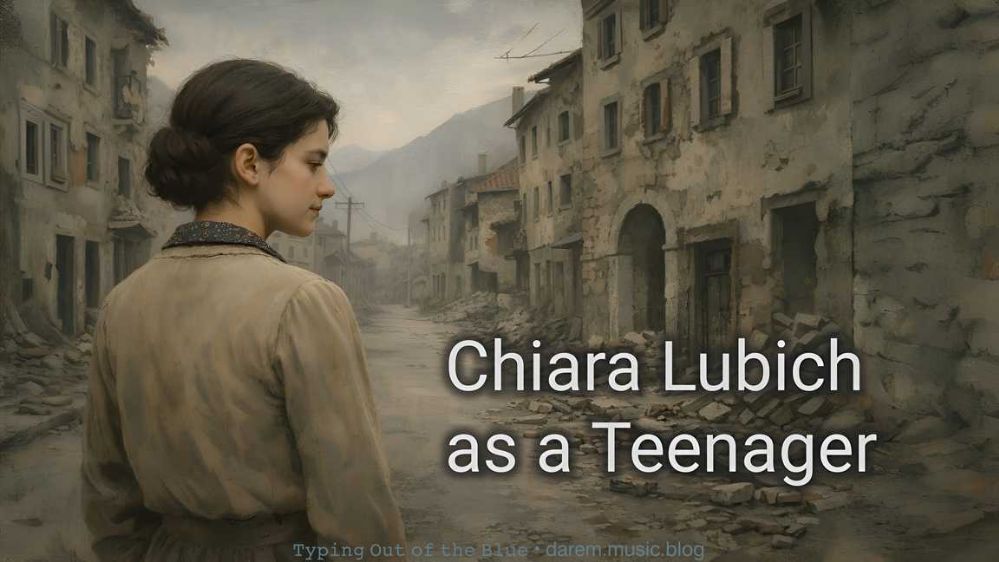
Chiara Lubich as a Teenager

A teenage girl grows up amid limits, uncertainty, and the questions war leaves behind.

For those who’d rather listen.

Chiara was born on January 22, 1920, in Trento, Italy, a small city in northern Italy. She grew up between the two world wars, during a time of tension and uncertainty. Long before she became known as the founder of the Focolare Movement, she was simply a teenage girl trying to understand life and truth.

As a teenager, Chiara lived with clear limits. Her family struggled financially, and her father lost his job because of his political views. Because of this, she learned early how to be practical. She wanted to study philosophy, but her family could not afford university, so she trained to become a primary school teacher instead. She adjusted her path and moved forward.

At home, she encountered two different ways of seeing the world. Her father questioned authority and power. Her mother lived a steady Catholic faith. Growing up with these differences taught Chiara how to think carefully and honestly. She did not accept ideas just because they were common. She wanted truth that could hold up in real life.

As a teen, Chiara was quiet and observant. She liked reading and studying. She paid attention to people, especially those who were struggling. She noticed when words and actions did not match, and this stayed with her.

Her faith developed slowly. There were no sudden changes or dramatic moments. Instead, she formed simple habits: prayer, self-discipline, and listening to her conscience. These became part of her daily life.

When World War II began during her late teenage years, daily life became unstable. Bombings, fear, and loss surrounded her. This did not change her direction, but it sharpened her questions.

What lasts when everything else can be taken away? What is worth holding on to?

⌨ ᴛʸᵖⁱⁿᵍ ᴏᵘᵗ ᵒᶠ ᵗʰᵉ ʙˡᵘᵉ ᵈᵃʳᵉᵐ ᵐᵘˢⁱᶜ ᵇˡᵒᵍ