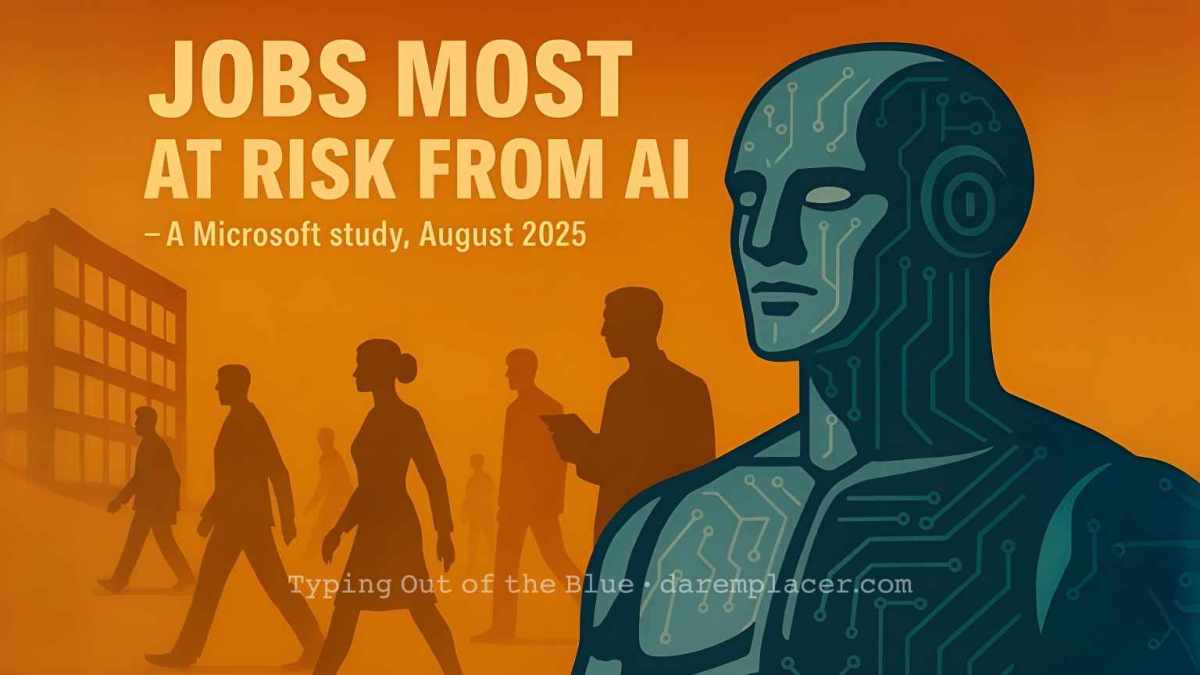
AI is changing the way people work. A Microsoft study shows which jobs are most at risk—and which ones may still be safe.
—A Microsoft study, August 2025
AI isn’t coming for every job—but for some, it’s already knocking. A new Microsoft study reveals which roles face the most risk, and which remain safer for now.
Jobs Most Affected by AI (alphabetical order)
These jobs depend on writing, communication, or analysis—areas where AI already performs strongly:
• Advertising sales agents
• Broadcast announcers and radio DJs
• Brokerage clerks
• CNC tool programmers
• Concierges
• Customer service representatives
• Data scientists
• Demonstrators and product promoters
• Editors
• Farm and home management educators
• Historians
• Hosts and hostesses
• Interpreters and translators
• Management analysts
• Market research analysts
• Mathematicians
• News analysts, reporters, and journalists
• Passenger attendants
• Political scientists
• Postsecondary business teachers
• Proofreaders and copy markers
• Public relations specialists
• Sales representatives (services)
• Technical writers
• Telemarketers
• Telephone operators
• Ticket agents and travel clerks
• Web developers
• Writers and authors
Jobs Least Affected by AI (alphabetical order)
These roles require hands-on skills, physical presence, or a human touch:
• Bridge and lock tenders
• Cement masons and concrete finishers
• Dishwashers
• Dredge operators
• Floor sanders and finishers
• Foundry mold and coremakers
• Gas compressor and pumping station operators
• Helpers-roofers
• Industrial truck and tractor operators
• Logging equipment operators
• Machine feeders and offbearers
• Massage therapists
• Medical equipment preparers
• Motorboat operators
• Ophthalmic medical technicians
• Orderlies
• Packaging and filling machine operators
• Pile driver operators
• Rail-track maintenance equipment operators
• Roofers
• Roustabouts, oil and gas
• Supervisors of firefighters
• Surgical assistants
• Tire builders
• Water treatment plant and system operators
Extra Findings
Historians push back – They argue AI can assist research but can’t replace human judgment in understanding history.
Data scientists under pressure – Once seen as future-proof, their role is now highly exposed.
Young workers hit hardest – A Stanford study shows people in their early 20s in customer service, software, and accounting are already losing jobs to AI.
AI won’t erase every job, but it will reshape many. Success depends on learning to work with it instead of resisting. And while machines can handle tasks, only people bring creativity, empathy, and judgment—the qualities that will always matter in the future of work.
𝚃𝚢𝚙𝚒𝚗𝚐 𝙾𝚞𝚝 𝚘𝚏 𝚝𝚑𝚎 𝙱𝚕𝚞𝚎 • 𝚍𝚊𝚛𝚎𝚖𝚙𝚕𝚊𝚌𝚎𝚛.𝚌𝚘𝚖