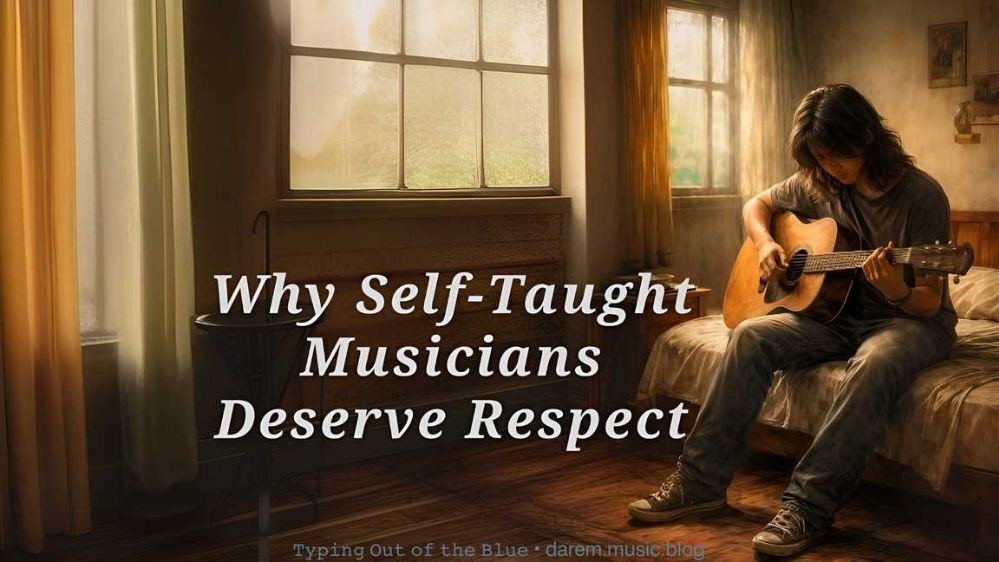
Some of the most honest music comes from people who never studied music theory.
They did not learn from books. They learned by listening. By repeating sounds. By trying, failing, and trying again. They followed their ears and their feelings. That takes patience and courage.
I’ve seen this play out in my own experience.
Before I studied music formally, I did not know music theory at all. No rules. No labels. I was already composing songs using a few chords I learned on my own. No teacher. Just listening and feeling my way through. Nothing to please. Nothing to avoid.
Later, when I entered the conservatory, everything changed.
There were rules now. Correct progressions. Proper movement. My mind became more conscious. My ears became choosier. Sometimes a chord would sound “off” to me, not because it felt wrong, but because I learned it was not supposed to be there.
The learning shaped me, but it also changed how I listened.
When I look back at my older compositions, they sound different. More open. Less filtered. Not better or worse—just coming from a different place.
This is why self-taught musicians matter.
They build music the old way. They play what feels right. Sometimes the notes are not perfect. Sometimes the timing is rough. But the music is alive. You can feel a person behind it.
This is very different from using AI music makers.
AI does not listen the way humans do. It skips the struggle. It skips the quiet moments where you sit with a chord and ask, “Does this feel right?” The sound may be clean, but the journey is missing.
Music has always been passed from human to human. From watching. From copying. From long hours alone with an instrument. That process shapes not just sound, but character.
You do not need music theory to be real. You need ears. Time. And honesty.
That is why a self-taught musician who creates from scratch still deserves deep respect.
——
October 19, 1987.
I wrote my very first song.
Nine years later, my band THE END submitted a cassette demo to Universal Records and Vicor Music.
Universal Records rejected it. At the time, the OPM production department was headed by Ito Rapadas, vocalist of Neocolours, who chose Weedd (Anong Pake Mo sa Long Hair Ko) instead.
Our submission to Vicor Music, however, led to a release in the compilation album Filipino Alternative Collection.
This is that first song.
Song: Utol ng Kabarkada Ko
Artist: The End
Oi! Oi! Oi! Oi!
Talagang maganda ang chick na ito,
Cool na cool pumorma kapag Sabado.
Wow naman! Bakit ganito ang puso ko?
Nagmahal sa utol ng kabarkada ko.
Mahirap maka-visit sa hay-bols nila,
Dahil nabwi-bwi-sit ang epa niya.
Paano pa kung nandoon yung kuya niya?
Mahirap umibig sa utol ng ka-tro-
pa no na ito?
Akala tuloy niya ako’y nam-bo-bo-
Labo talaga, dahil kuya niya’y ka-tro-
parap… parap… pa…
No way! Dehin ’ko gustong layuan siya,
But her kuya’y makulit naman talaga.
Eh kasi, yung kuya niya’y kabarkada ko pa,
Yan, sira tuloy ang diskarte ko sa kan-
yari na ako!
Akala tuloy niya ako’y nan-lo-lo-
Korny talaga, dahil kuya niya’y ka-tro-
parap… parap… pa…
Band Members:
Gene Pabalan: Drums, Back-up Vocals
Chay Sapida: Keyboards, Back-up Vocals
Darem Placer: Guitars, Lead Vocals
Words and Music by Darem Placer
⌨ ᴛʸᵖⁱⁿᵍ ᴏᵘᵗ ᵒᶠ ᵗʰᵉ ʙˡᵘᵉ ᵈᵃʳᵉᵐ ᵐᵘˢⁱᶜ ᵇˡᵒᵍ