Saint Lioba and Saint Boniface: A Different Kind of Love

Their closeness in mission was unmatched—yet in the end, it took a turn only true spiritual love can explain.

Most love stories talk about a woman trusting a man. But here, the story is reversed. Bishop Boniface—later known as the Apostle of Germany—placed his deepest trust in a woman of God, Sister Lioba.

In the 700s, Bishop Boniface carried the Gospel across Germany, but he knew he could not do it alone. He called Sister Lioba from her convent in England and asked her to guide the women’s communities with wisdom and prayer. She became a leader, teacher, and mother to many. And to Bishop Boniface, she was more than a helper—she was his most trusted friend. He once said she was “beloved above all others.”

Before his final mission to Friesland in 754, where he would be martyred, Bishop Boniface made a personal request to her: “When your time comes, may you rest at my side in Fulda.” Fulda was the monastery he had founded in 744, and where he himself would be laid to rest. It sounded almost like a romance, but it was not. It was something higher—a bond of spiritual love, rooted in God and mission.

Yet when Sister Lioba’s time came in 782, she refused that wish. Out of humility, she said she did not deserve to rest beside a martyr. So she was laid to rest close to him, but not at his side. Their tombs stood apart.

It feels like a sad ending—two who wished to remain together, yet separated in death. And still, it is also a happy ending. Because their closeness was never about the grave. It was about God, about trust, about a love that is not romantic, but eternal. Romantic love ends at the grave. Spiritual love does not. It goes beyond. It lasts forever.

ᴛʸᵖⁱⁿᵍ ᴏᵘᵗ ᵒᶠ ᵗʰᵉ ʙˡᵘᵉ ᵈᵃʳᵉᵐ ᵐᵘˢⁱᶜ ᵇˡᵒᵍ

Go Away but Be Near Me • Darem Placer
Alone with a Piano includes Go Away but Be Near Me

Listen on Apple Music and YouTube Music
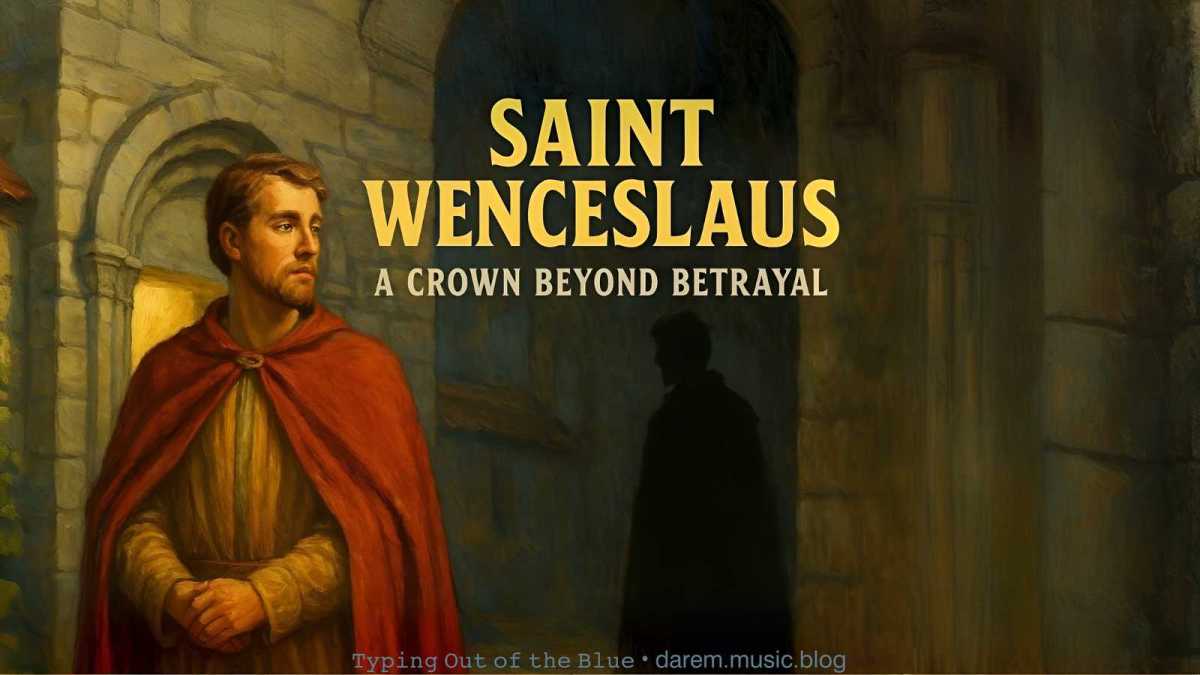
Saint Wenceslaus • A Crown Beyond Betrayal

A duke betrayed by his own brother shows the clash between worldly power and God’s eternal kingdom.

Prince Wenceslaus was born around 907 in Bohemia, a region in Central Europe that is now part of the Czech Republic. He was raised in the Christian faith by his grandmother, Saint Ludmila, who taught him to live differently from the power-hungry nobles around him. From a young age, he showed unusual devotion: feeding the poor, caring for orphans, and learning that true strength came from faith.

When he took the throne as Duke of Bohemia, Wenceslaus carried those lessons into leadership. He ruled with mercy instead of fear, promoted peace with Christian neighbors, and gave support to the Church. But this put him at odds with many pagan nobles who preferred the old ways of power and revenge. To them, his compassion looked like weakness.

The greatest threat came from within his own family. His younger brother, Boleslaus I—later remembered as Boleslaus the Cruel—wanted the throne. Backed by nobles who despised the Christian direction of Bohemia, Boleslaus plotted his death. On September 28, 935, as Duke Wenceslaus went to Mass in the town of Stará Boleslav, his brother’s men attacked him at the church door. Boleslaus himself stabbed him, delivering the fatal wound.

The world at the time called it politics. The Church called it martyrdom. And history now calls him Saint Wenceslaus, patron of the Czech people. His death exposed the clash of two worlds—one that glorifies power at any cost, and one that lives for God’s truth. The same choice confronts us today. Many people chase “goodness” that is really self-serving: loyalty for gain, generosity for image, kindness only when convenient. It is the same spirit that destroyed Wenceslaus—love for the wrong “world.”

Saint Wenceslaus lost his throne, but kept the only kingdom that lasts.

ᴛʸᵖⁱⁿᵍ ᴏᵘᵗ ᵒᶠ ᵗʰᵉ ʙˡᵘᵉ ᵈᵃʳᵉᵐ ᵐᵘˢⁱᶜ ᵇˡᵒᵍ

Traces of courage, silence, and sacrifice—this is Saints.

Listen on Apple Music, Apple Music Classical, and YouTube Music