
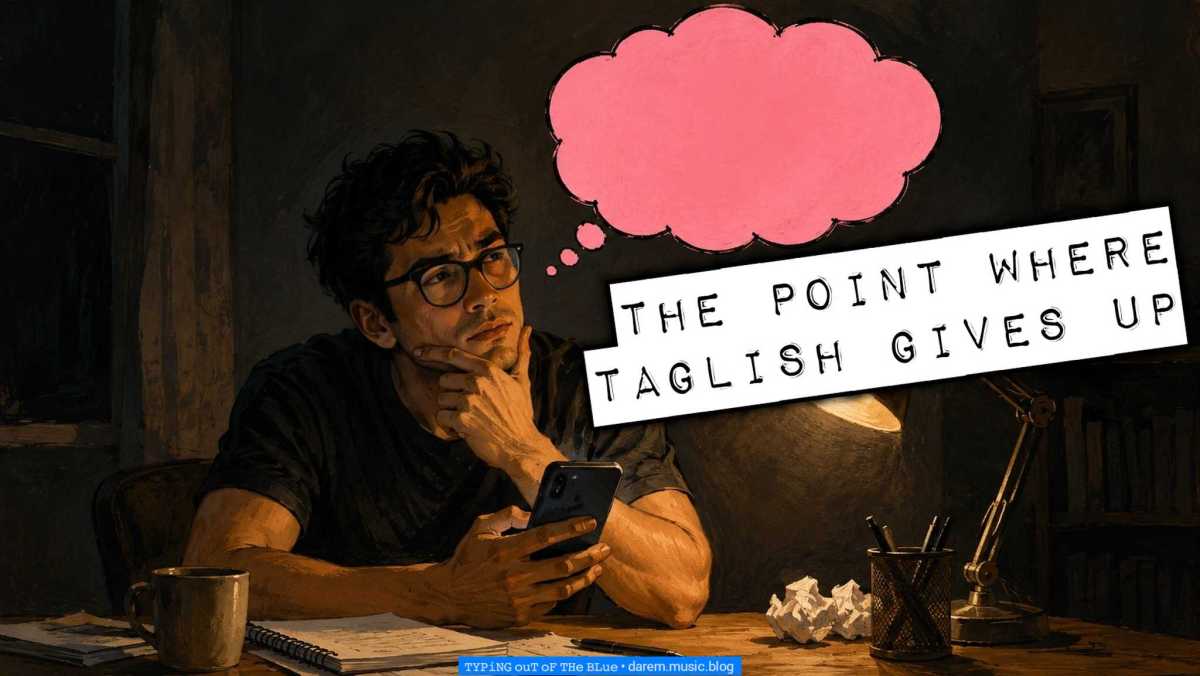
Taglish is one of the coolest things about the Philippines. We can take an English word, attach a Filipino affix, and somehow everyone understands it.
Na-download. Ni-like. Pinost. Magre-record. Kino-compose.
Nobody stops to ask if these words exist in a dictionary. They simply work.
Some hybrid words have become so normal that we barely notice how strange they actually are.
Kinodakan. Ginoogle. Finacebook. Pinost. Ni-like. Zino-Zonrox.
Imagine explaining those words to someone who has never heard Taglish before. Yet for Filipinos, they make perfect sense.
The funny part is that many of these words are easier to say than to write.
Sina-psych mo ba ako?
Isa-xylophone ba yung instrumental part?
Zinonrox mo ba ang damit mo?
All of them sound perfectly normal when spoken. The moment you write them down, however, you start wondering whether you’ve accidentally invented a new language.
Nobody seems completely sure, yet everybody understands. Language somehow keeps moving forward anyway.
The challenge becomes even bigger when the English word itself already looks complicated.
Imagine asking someone, “Ifu-fuchsia mo ba yung room?”
The sentence is understandable. The problem is not the meaning. The problem is surviving the spelling.
Fuchsia is already a difficult word in English. The letters look like they arrived from different countries and never met each other before. The longer you stare at it, the stranger it becomes.
Fuchsia.
Fuchsia.
Fuchsia.
Eventually it stops looking like a word and starts looking like a Wi-Fi password.
That is usually the moment when Taglish waves a white flag.
Instead of writing, “Ifu-fuchsia mo ba yung room?”, we suddenly switch to, “Will you paint the room fuchsia?”
Problem solved. No spelling debate. No affix engineering. No linguistic emergency services.
This happens more often than people realize. Some words are easy to absorb into Taglish. Others refuse to cooperate.
The result is a strange but practical rule: when Taglish becomes harder than English, we simply write in English.
Nobody planned this system. Nobody taught it in school. Yet millions of Filipinos follow it every day without thinking.
Language is funny that way. It doesn’t always choose the most correct path. It chooses the easiest one.
Maybe that’s why Taglish feels so natural. It behaves less like a rulebook and more like a jam session. People hear what works, add their own notes, and keep the rhythm going.
And somewhere out there, a writer is thinking about the word “fuchsia” and quietly deciding that plain pink is good enough.
⌨ ᴛʸᵖⁱⁿᵍ ᴏᵘᵗ ᵒᶠ ᵗʰᵉ ʙˡᵘᵉ ᵈᵃʳᵉᵐ ᵐᵘˢⁱᶜ ᵇˡᵒᵍ