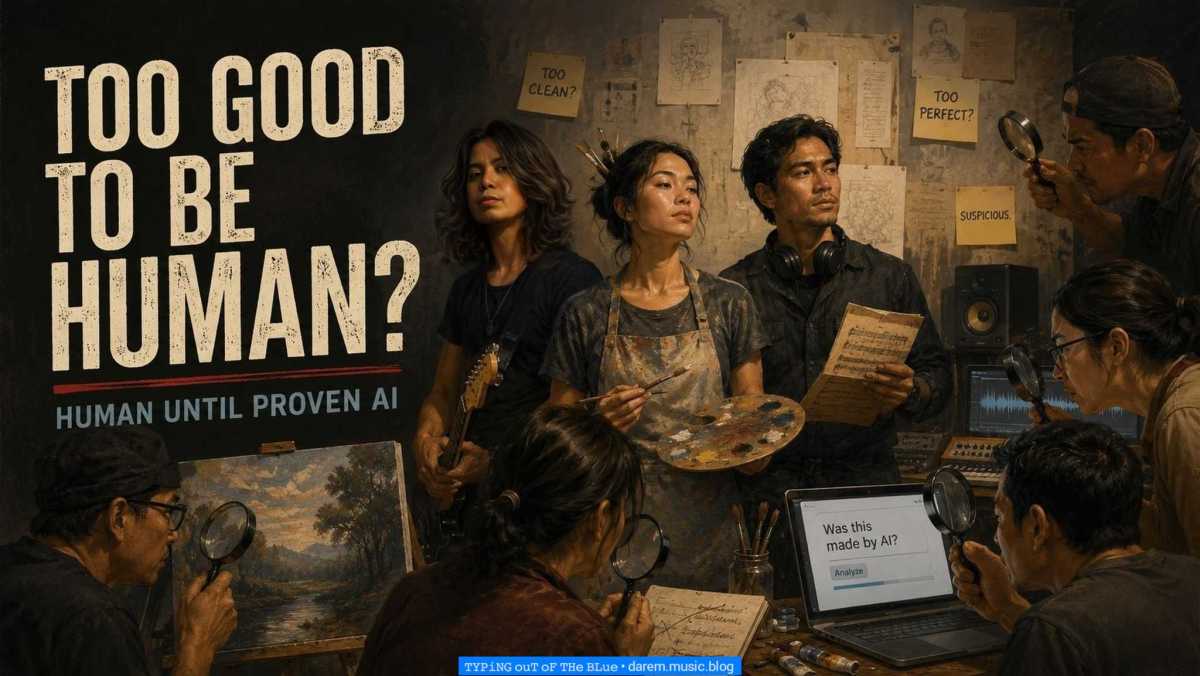
There was a time when incorrect grammar attracted corrections.
Wrong tense, bad spelling, awkward sentence. Someone would point it out. The message was clear: learn, practice, improve.
So people did.
Writers became better writers. Artists learned their craft. Musicians practiced, arranged, recorded, mixed, and spent years improving their sound.
Then AI came along, and good work could suddenly become suspicious.
Write poorly and people criticize your grammar. Write well and someone says, “You used AI.”
The same happens with visual art. Leave obvious flaws and they notice them. Make something impressive and they inspect the fingers, shadows, faces, and details for signs of AI.
Music isn’t spared either. Rough production sounds amateur. Polished production can invite questions about whether the music itself was generated.
Imperfection used to mean you needed more practice. Now it can serve as proof that you’re human.
Perfection needs an alibi.
Defending your work can make the suspicion worse. Explain your process, show your drafts, name the tools you used, and every answer can lead to another question.
For centuries, people learned their craft to make difficult things look effortless. Pianists practiced until difficult passages sounded natural. Painters studied until technique became instinct. Writers rewrote until the writing no longer showed the work behind it.
That was mastery.
Now mastery itself can make people doubt the person behind the work.
AI-generated work is real, and people do claim generated work as their own. Skepticism has a reason to exist. But suspicion shouldn’t become the automatic response to anything well made.
People shouldn’t have to write worse, draw worse, make worse music, or deliberately leave mistakes just to prove a human did it.
Imagine spending years getting better at something, only to find that your mistakes are more believable than your skill.
People are strange. AIs are learning.
⌨ ᴛʸᵖⁱⁿᵍ ᴏᵘᵗ ᵒᶠ ᵗʰᵉ ʙˡᵘᵉ ᵈᵃʳᵉᵐ ᵐᵘˢⁱᶜ ᵇˡᵒᵍ